Get Full Government Meeting Transcripts, Videos, & Alerts Forever!
Get email alerts on the Infrastructure Water topic
No spam. Unsubscribe anytime.
Oklahoma Water Resources Board requests infrastructure funding, staffing and monitoring support as demand grows
Summary
The Water Resources Board told legislators it has loaned more than $7.7 billion for water and wastewater projects since the program began, seeks continued funding for low-cost loans and asked for additional staff, monitoring and IT modernization to manage growing demand and new water-planning and flood initiatives.
Julie Cunningham, director of the Oklahoma Water Resources Board, told the House appropriations subcommittee the agency's financing programs, water-rights administration and statewide planning responsibilities are strained by rising demand, aging infrastructure and new policy mandates.
"We do about 60% of the state's water infrastructure financing," Cunningham said. She reported the board has financed more than $7.7 billion in water and wastewater projects since the revolving programs began.
Cunningham outlined the board's three broad responsibilities: water-rights permitting and administration, long-range planning (the state's comprehensive water supply plan) and dam/flood safety oversight. "We are required by statute to update the state's comprehensive water supply plan every 10 years," she told the committee. The board also regulates roughly 4,700 dams in Oklahoma.
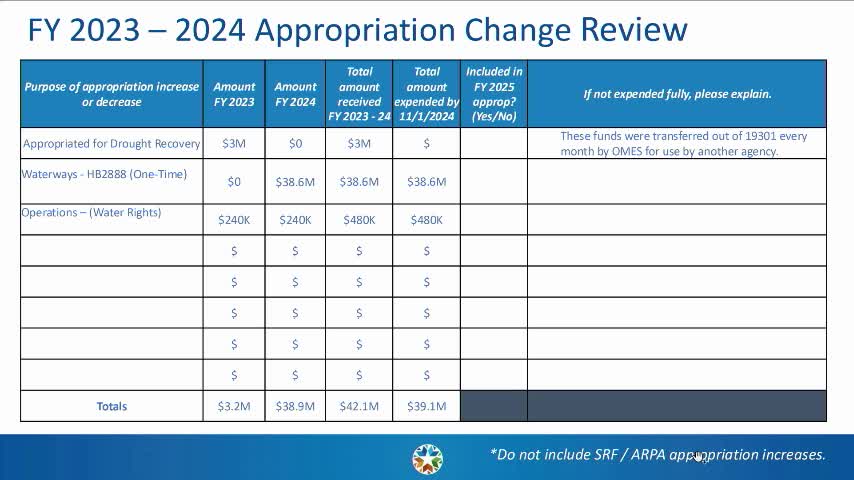
The agency asked lawmakers to consider a package that includes funding to modernize water-rights administration, additional staff for enforcement and permitting backlogs, an inflation adjustment to sustaining the statewide monitoring network, and continued capital for the Rural Economic Action Plan (REAP) infrastructure grants. In particular, Cunningham reported a need for resources to quantify reservoir storage that has been reduced by sedimentation and to expand stream and groundwater monitoring.
Cunningham also outlined drought and flood planning: the board will continue phase two of the state flood plan, a legislatively required project meant to guide hazard mitigation and local planning. She told the committee the board is coordinating with sister agencies and the federal government on models and technical tools.
Lawmakers asked about staffing, water-rights processes and the scale of needs in growing areas. Cunningham and staff said the board is pursuing IT modernization, renewed permitting staffing, and community-focused technical assistance for small water and wastewater systems.