Get Full Government Meeting Transcripts, Videos, & Alerts Forever!
Get email alerts on the Constitutional Law topic
No spam. Unsubscribe anytime.
House adopts memorial rejecting Obergefell, urges states' authority over marriage decisions
Summary
The Idaho House passed House Joint Memorial 1, a nonbinding statement urging the U.S. Supreme Court to revisit Obergefell v. Hodges and asserting that marriage decisions should be returned to the states; the memorial passed by roll call, 46-24.
BOISE — The Idaho House of Representatives on Jan. 27 approved House Joint Memorial 1, a nonbinding memorial that criticizes the U.S. Supreme Court's 2015 decision in Obergefell v. Hodges and urges restoration of marriage decision-making to the states. The measure passed on a roll-call vote, 46 ayes to 24 nays, and will be transmitted to the Senate and the chief clerk for delivery to the U.S. Supreme Court.
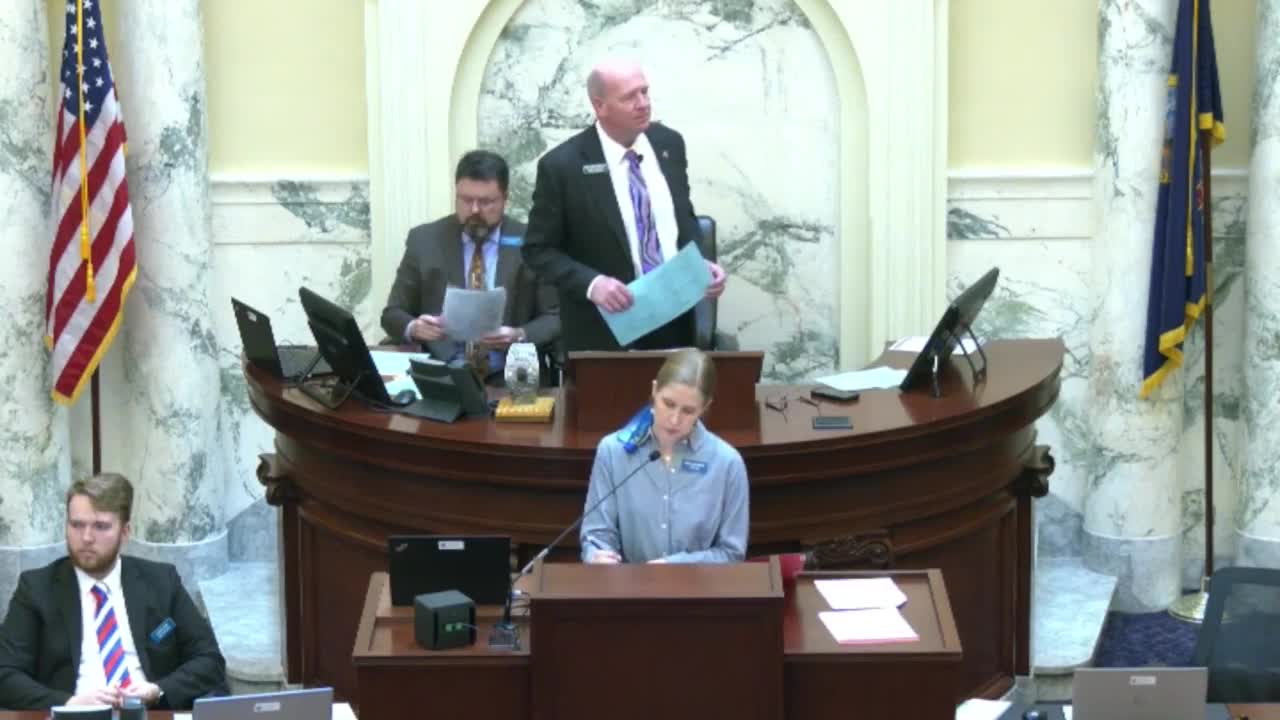
The memorial is explicitly nonbinding: several members noted on the floor that it is a statement rather than a law and carries no force to change federal precedent. "This memorial is about federalism and a state's rights or their sovereignty to make decisions for ourselves. This is not a memorial about defining marriage," the representative from District 2 said in floor remarks introducing the measure. She described the memorial as asking the Supreme Court to revisit Obergefell and "restore state authority."
Floor debate split along ideological lines. Opponents called the memorial a poor use of legislative time and said it was unlikely to change court outcomes. "This memorial does not do that... The courts are gonna toss it in the trash. It really accomplishes nothing. It's a waste of time and money," the gentleman from 25 said during floor debate, urging members to reject the measure. Another member described personal stakes: "My son, one of my sons is gay... he was very upset," the representative from District 18 said, urging rejection and noting community impacts.
Backers framed the memorial as a defense of state authority and criticized what they called judicial overreach by the Supreme Court. The presenter invoked dissenting opinions from the Obergefell decision and named other cases and incidents she said illustrated threats to religious liberty. The memorial's text cites Obergefell v. Hodges and references other cases and events raised during debate, including Roe v. Wade and Latta v. Otter (2014), and examples discussed on the floor such as the Kentucky clerk Kim Davis and bakers and photographers who had legal disputes over services for same-sex couples.
The House clerk announced a roll-call vote after objections were raised; the clerk recorded 46 ayes and 24 nays. The clerk confirmed the memorial "has passed the house." The presenter and others stressed that the memorial will be sent to the U.S. Supreme Court, but members acknowledged the court may ignore it. The floor record noted there is no fiscal cost attached to the memorial.