Get Full Government Meeting Transcripts, Videos, & Alerts Forever!
Get email alerts on the Animal Testing topic
No spam. Unsubscribe anytime.
Council sends live‑animal testing ordinance back to sponsor after weeks of public opposition
Summary
After hours of public comment — mostly opposed — the Everett City Council referred an ordinance that would amend the city's ban on live-animal testing back to the sponsor for further work and public engagement.
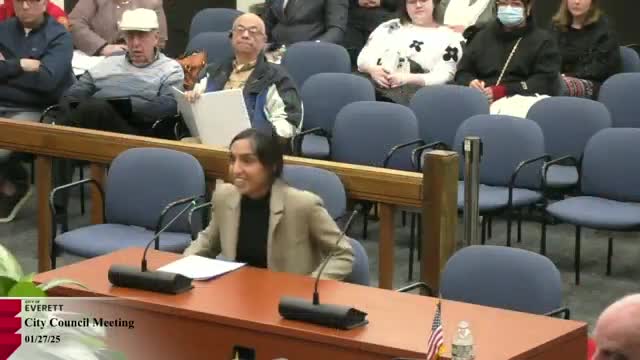
A proposed revision to Everett’s ban on live-animal testing drew more than a dozen speakers during public participation and a split council discussion before members voted to refer the ordinance back to its sponsor for further review.
Councilor Stephanie Smith introduced the ordinance (item 20) that would amend the city’s existing restrictions on live-animal testing. Smith said she supports alternative, non‑animal testing methods but argued the city was losing out on potential commercial tax revenue while federal and industry transitions to non-animal methods continue. “Until there is a federal ban, Everett's losing out on the revenues that our neighboring cities are getting,” Smith said.
Public comment at the meeting was heavily weighted against loosening the city’s ban. Prayal Patel, Massachusetts state director for the Humane Society of the United States, urged the council to “oppose the amendment that seeks to weaken Everett's current ban on animal testing,” saying modern non‑animal methods (3‑D human tissue models, organs‑on‑chips, computational models) are “faster, more cost effective, and avoid the ethical concerns surrounding animal testing.” Other residents and advocacy groups, including representatives from Salem Save the Animals, Boston Dog Lawyers and local animal-welfare activists, also urged the council to retain the city’s ban.
Speakers raised technical and logistical concerns: who would regulate private labs, whether Everett has staff or facilities to oversee biohazard risks, and the potential cost to taxpayers to fund oversight such as an institutional animal care committee or veterinarian. Councilor Stephanie Marchese and Councilor Patty Rogers emphasized local administrative and training gaps, noting Everett lacks an animal shelter and comprehensive animal-control programs.
Council debate reflected those tensions. Councilor Marchese argued for broader public engagement and said the issue would have been better considered as part of the Innovation Zoning District process. Councilor Smith said she had discussed the matter with Planning and understood Davis Company (a developer referenced in public comment) had been told site plan review would not allow animal testing, and that no tenant had been identified. After discussion, the council voted to refer the ordinance back to the sponsor (Councilor Smith) for additional work and outreach rather than moving it forward for ordainment.
The referral means the ordinance will not be advanced at this meeting and sponsors and staff said they plan to pursue additional public engagement and, if necessary, a formal committee referral for further study. The council did not adopt the ordinance or change the ban at this meeting.