Get Full Government Meeting Transcripts, Videos, & Alerts Forever!
Get email alerts on the State Archives Records And Libraries topic
No spam. Unsubscribe anytime.
State libraries ask for staff and operating funds as archive renovation begins
Summary
The Oklahoma Department of Libraries reported progress on a planned renovation of the Allen Wright Library (State Archives), said the state will implement a first‑ever digital preservation workflow, and requested recurring appropriations to add eight records positions, implement pay‑for‑performance, and cover recurring system costs and inflation.
Director Curie, director of the Oklahoma Department of Libraries, told the Appropriations Committee the agency is implementing a multi‑year plan to renovate the Allen Wright Library that houses the State Archives and State Records Center, and that work requires both one‑time capital (previously appropriated) and new recurring operating resources to protect collections and manage digital records.
Curie said the legislature provided approximately $17.6 million in legacy capital project funds for the renovation. The agency completed pre‑design and assessment phases, moved into schematic design, and plans to begin construction this summer. Curie said construction is expected to take 18–24 months; the agency will either shelter collections in place or move them to a temporary access location while the building is closed to walk‑in customers. The agency’s assessment showed the building’s second and third floors are at weight capacity and that the renovation will reassign floor space but will not solve the broader statewide capacity question for permanent records.
Curie described two major information‑management investments funded in the last session and now entering implementation: a replacement inventory management system for the State Records Center and a new digital record preservation system. The agency reported it is already implementing the inventory system and began the digital preservation system rollout. Curie estimated roughly $700,000 in state savings in the first year once records management practices and the new workflows are in use; the agency also cited smaller recurring savings from revised digital storage workflows and returning shared HR services in‑house.
The agency requested four continuing appropriations totaling just over $1.6 million: a stepped increase in State Aid to Public Libraries (to move toward a regional per‑capita average of $0.88), $886,084 to add eight positions for Archives and Records Management plus $170,571 to implement pay‑for‑performance (total request for those personnel items $1,056,655), recurring maintenance and operating costs for the records systems (estimated $92,043 for inventory management and $150,000 recurring for digital preservation), and $100,000 to absorb inflation and operational increases.
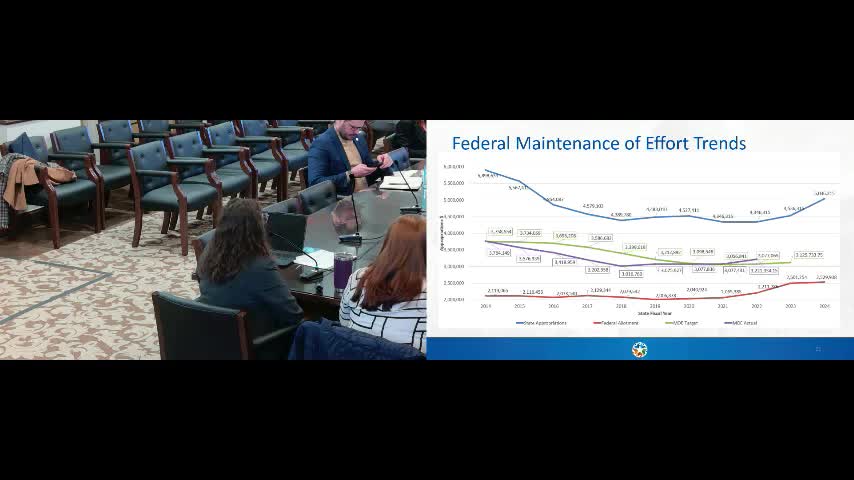
Curie emphasized the federal Institute of Museum and Library Services (IMLS) maintenance‑of‑effort/match requirements that tie state appropriations to federal awards used for statewide online resources; she noted the department is on track to meet MOE targets after recent appropriations restored funding. The director said the department reclassified 24 positions and realigned 15 as part of a classification, compensation and organizational study and that turnover has caused some carryover; the agency said it will redeploy unspent funds to renovation‑related needs (for example, furniture) and to pay‑for‑performance one‑time bonuses when available.
Representative McCain and others asked about pay‑for‑performance details and the value of librarians; Curie described OMES’s performance system as the vehicle the agency would use and said bonuses would be proportionate to documented performance ratings and that pay‑for‑performance plus better classification would help recruiting and retention, particularly for records managers who command high private‑sector salaries.
Clarifying details: renovation funding $17,600,000 legacy capital appropriation; construction timeline 18–24 months; requested continuing appropriations total just over $1,600,000 with $886,084 to add eight positions, $170,571 for pay‑for‑performance, inventory management recurring $92,043, digital preservation recurring ~$150,000, inflation/ops $100,000. Agency reported 8,400,000 library visits and 25,000,000 items checked out last year (statewide statistics provided).