Get Full Government Meeting Transcripts, Videos, & Alerts Forever!
Get email alerts on the Ossm Budget topic
No spam. Unsubscribe anytime.
Oklahoma School of Science and Math requests roughly $1.8 million for building repairs and teacher pay after 52% enrollment increase
Summary
OSSM President Tony Cornforth told the panel enrollment at the residential campus rose 52% year‑over‑year and requested about $1.8 million, mostly one‑time, to replace gym and dorm HVAC, repair dorm floors and raise teacher salaries to the state minimum.
Tony Cornforth, president of the Oklahoma School of Science and Mathematics, told the Appropriations and Budget committee his agency has increased residential enrollment by 52 percent since the COVID enrollment dip and is asking lawmakers for about $1.8 million to address deferred maintenance and teacher pay equity.
OSSM is a statewide public residential magnet for academically advanced high school students with a focus on math and science. Cornforth said the residential program and OSSM’s mentoring and summer STEM work contributed to national rankings and that the school’s recent recruitment and application changes expanded geographic representation — the most recent admitted class represented 26 Oklahoma counties.
Why it matters: OSSM’s residential program is a state‑funded educational program for high‑ability students; the school argued that improved facilities and competitive teacher pay are necessary to preserve program quality and maintain statewide access.
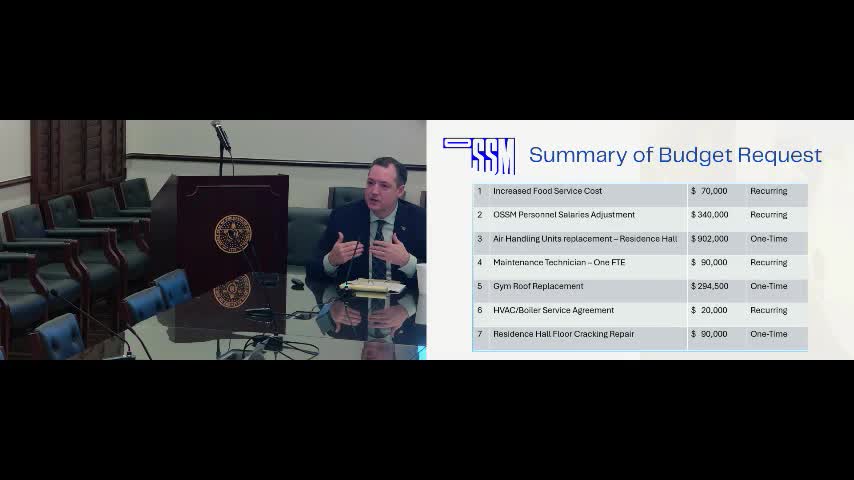
Budget request and facilities needs: Cornforth presented seven requests totaling roughly $1.8 million, most of them one‑time items to repair and extend the life of campus systems. The main items identified were:
- Increased food‑service funding to cover higher enrollment (requested about $70,000). - A teacher‑salary adjustment package (about $340,000) to bring 8 of 25 faculty up to the state minimum salary schedule and improve market competitiveness. - Replacement of two aging air‑handling units serving the residence hall (one‑time request included in the list; Cornforth described them as original equipment past normal service life). - Gym roof replacement (request cited at roughly $294,500) identified by an external roofing inspection as highest priority. - A preventative HVAC/boiler service agreement (about $20,000) to extend equipment life. - Repair of cracking in four dormitory floor slabs (about $90,000) after engineering review indicated the cracks are nonstructural but cosmetically and operationally important to fix.
Programs and outreach: Cornforth reviewed OSSM’s three instructional programs — residential campus, half‑day regional centers and virtual coursework — and said the school runs summer institutes for middle‑school math and science teachers, STEM day camps (about 900 participants last year), and a mentorship program that pairs students with local researchers. He described efforts to broaden access, including a pilot transitional math class for students from smaller high schools who show promise but need a bridge course to succeed on OSSM campus coursework.
Teacher recruitment and retention: Cornforth said OSSM has a highly credentialed faculty (17 of 25 faculty with Ph.D.s) but that pay lags other districts; the salary request would align most faculty with state minimums and reduce turnover risk. He said maintenance investments protect the long‑term value of facilities and support recruitment.
Ending: Cornforth closed by noting that most of the requested funding is one‑time work to repair and modernize campus systems and that the school will continue recruiting to expand statewide access for advanced STEM students.