Get Full Government Meeting Transcripts, Videos, & Alerts Forever!
Get email alerts on the Health Care Workforce topic
No spam. Unsubscribe anytime.
Health Care Workforce Training Commission seeks staff and program funding to expand rural provider pipeline
Summary
Cammie, executive director of the Health Care Workforce Training Commission, told the committee the commission manages nearly $98 million in ARPA awards and needs additional staff and program dollars — including an administrative position to run a new preceptor tax credit — to place more clinicians in rural Oklahoma.
Cammie, executive director of the Health Care Workforce Training Commission, and Deputy Director Cher Golding told the Appropriations and Budget committee the commission manages nearly $98 million in ARPA‑funded workforce grants while also administering longstanding loan repayment and residency support programs that place clinicians in rural Oklahoma.
The commission has disbursed about $41 million of approximately $98 million in ARPA funds to 27 projects and continues multi‑year monitoring, Cammie said. The commission’s statutory mission requires that half of its non‑ARPA budget support family‑medicine residency programs; with that constraint the agency said it has little discretionary money and must prioritize funding where statute directs it.
Why it matters: Oklahoma’s shortage of rural clinicians — primary care physicians, nurse practitioners, physician assistants and, stakeholders say, behavioral‑health providers — is a persistent policy concern. The commission manages a portfolio of scholarships, loan‑repayment and residency support intended to put clinicians in underserved communities.
Key program numbers and constraints: Cammie told the committee the commission supported 43 family‑medicine residency slots across six programs that the commission funds directly. CMS funding rules limit residency funding to an 18‑slot cap per sponsoring teaching hospital, a constraint that can leave new residency programs partially underfunded for the first three years; the commission uses state and leftover agency funds to cover the shortfall until CMS funding phases in. Cammie said the loan‑repayment program had 67 physicians in obligated practice in FY24 and approved an additional eight participants for FY26.
New program authority and administrative needs: The panel was told that House Bill 3351, enacted last session, created a preceptor tax credit for clinicians who supervise trainees in rural areas; the commission will administer the tax‑credit qualification process for the Tax Commission. The commission said it was allowed to retain only 5% of license‑board fee collections to run that program — an amount the agency estimates around $5,000 per year — and that sum is insufficient to hire a dedicated staff member to process and certify applicants. Cammie said the commission will try to cover the burden with existing staff but requested one additional administrative FTE to reliably operate the program.
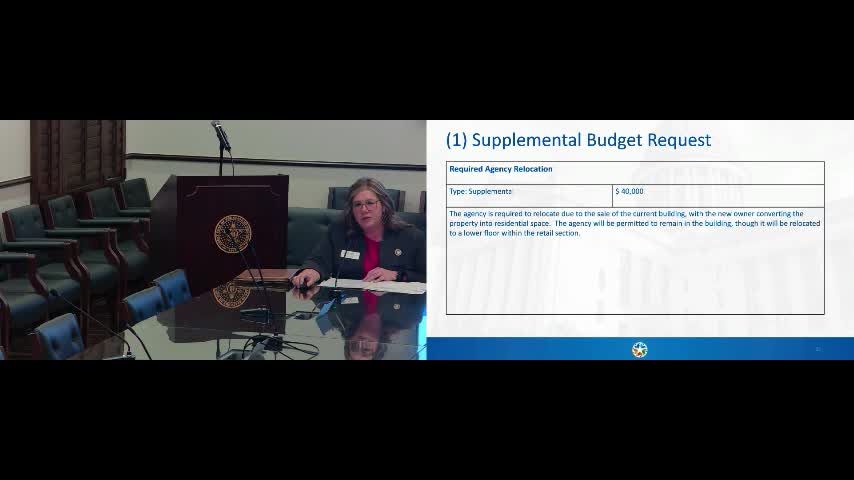
Other requests and constraints: The commission made a supplemental request of about $40,000 for an office relocation and build‑out (furniture and modest construction), asked for roughly $82,000 in FY26 for salary and rent increases (including a new position to administer the preceptor credit), and sought program increases to expand scholarship and loan‑repayment slots (the commission described the requested program funds as adding several physician slots and dozens of nursing scholarships). Cammie also noted a McAlester residency program requested an annual adjustment of $46,225 to stay within its regional salary parity requirement.
Workforce observations: The commission described practical barriers to rural recruitment beyond direct pay: housing availability, school quality for spouses’ children, and lack of nearby amenities can deter clinicians from relocating. The commission also receives repeated inquiries from behavioral‑health professionals seeking loan repayment; Cammie said statute currently excludes most mental‑health practitioners from the commission’s loan‑repayment programs and that expanding eligibility would require legislative change.
Monitoring and accountability: The commission’s grants director conducts frequent site visits to ARPA projects to ensure funds are spent according to awards and the commission expects multi‑year monitoring of projects through calendar year 2026. Cammie said the commission is evaluating partnerships with other funders, including TSET and professional associations, to expand slots and leverage federal sources such as HRSA where appropriate.
Ending: The commission asked the committee to consider the administrative cost of new statutory duties — especially the preceptor tax credit — and to weigh additional program funding as a lever to increase clinician presence in rural Oklahoma.