Get Full Government Meeting Transcripts, Videos, & Alerts Forever!
Get email alerts on the Appropriations And Budget topic
No spam. Unsubscribe anytime.
Commissioners of the Land Office cites record distributions, seeks restored operating budget to bolster staffing, invasive‑species control and well plugging
Summary
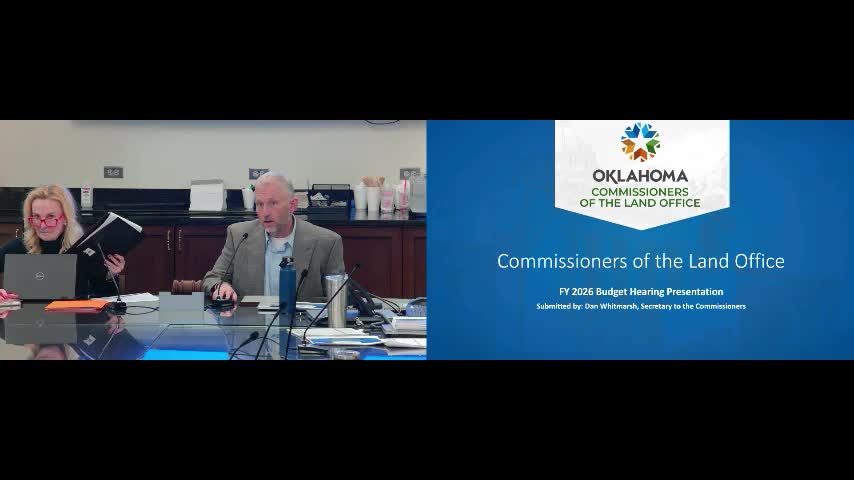
Dan Whitmarsh, secretary of the Commissioners of the Land Office, told the Appropriations and Budget committee the agency posted record distributions to schools last year but needs restored operating appropriations to expand royalty compliance, field staff, invasive woody‑species work and a program to plug abandoned wells.
Dan Whitmarsh, secretary of the Commissioners of the Land Office, told the Appropriations and Budget committee that the agency distributed roughly $145.2 million to Oklahoma public schools in the most recent fiscal year and is seeking a restoration of its pre‑cut operating appropriation to shore up staffing, auditing and land‑stewardship work.
The CLO manages state trust lands and minerals to generate revenue for public beneficiaries, primarily K–12 schools and land‑grant universities. Whitmarsh said the permanent trust is “closer to $3 billion” in value, and the agency’s operating appropriation is statutorily limited to 6 percent of revenues. “We are an ATM machine,” Whitmarsh said, describing the CLO’s role in distributing earnings to school districts by average daily attendance.
Why it matters: The CLO is both a revenue manager and a landowner. Its choices about hiring, auditing and environmental work affect distributions to schools and the condition of hundreds of thousands of acres of surface and mineral estate the state owns.
Whitmarsh summarized operations and recent changes. The CLO holds roughly 736,700 acres of surface estate and about 1,100,000 acres of mineral estate, he said, with an estimated 4,400–4,500 wells on CLO lands. The agency runs several mineral and surface auctions each year; Whitmarsh said moving auction listings to a third‑party platform, EnergyNet, increased bidder participation and bonus receipts without subscription costs to the CLO. At a December auction the CLO generated “a little over $12 million” in bonus money, he said.
The agency’s permanent trust provides monthly distributions; Whitmarsh said the trust’s corpus grew strongly in the most recent year and that part of the return is retained in the corpus while distributions are paid out. He described efforts to diversify revenue sources beyond minerals — including commercial real estate leases — and said the invested real estate portfolio presently represents roughly the size expected under the office’s 5 percent allocation cap, at about $140 million in holdings.
Budget and staffing requests: Whitmarsh said the CLO is asking to restore its FY2022 appropriation level (roughly the $8.3–8.7 million range the agency previously operated with) and to bolster field and compliance staffing. He noted the agency has struggled to recruit and retain attorneys, CPAs, IT specialists, landmen and auditors against higher private‑sector and other state salaries. He said the royalty‑compliance team currently has three auditors and the agency hopes to increase that to five; field staff that perform lease oversight have fallen from nine to seven and Whitmarsh recommended returning toward nine or more boots on the ground.
Legislative and program changes: Whitmarsh flagged a recently enacted statutory change he identified as “Senate Bill 15 14” that shortens the period the agency can look back for underpayments to five years; he said the measure should reduce protracted lawsuits over old underpayments. He also discussed bills addressing invasive woody species — principally eastern red cedar — and described the CLO’s new forester hire and a proposed expansion of forestry staff to map and treat infestations.
Environmental liabilities: The CLO has identified about 500 abandoned or orphan wells on its properties that agency staff would like to plug over time; Whitmarsh estimated plug costs vary widely depending on depth and condition and cited a typical range of about $15,000 to $200,000 per well. He said the agency is exploring partnerships and federal funding opportunities tied to methane mitigation and noted that technologies such as satellite mapping and private‑sector salvage arrangements — where a contractor can keep recovered scrap steel in exchange for completing remediation work — have been considered.
Commercial real estate and investments: Whitmarsh described a modest commercial real estate program (recently generating a distribution return the agency estimates near 5.5%–6%) and said the CLO has been proactive about marketing underperforming urban parcels. He said the CLO uses an investment consultant (identified as RBK) to oversee multiple fund managers in the permanent trust and plans to re‑RFP that consultant.
Transparency, records and efficiencies: The agency has digitized many records and upgraded its surface auction application. Whitmarsh said the CLO moved payroll to a biweekly system and transitioned its custodial bank and permanent‑trust custodian, producing some cost savings.
Open items and next steps: Whitmarsh said the agency wants to keep a five‑year stabilization or rolling average fund to smooth distributions in boom and bust cycles. He told the committee that if members want more detail on audit procedures or specific staffing plans the CLO staff would follow up and provide additional materials.
Ending: Whitmarsh closed by offering the agency’s assistance to the committee and said CLO staff would provide requested follow‑up documents and answers to detailed questions about audit capacity, the invasive species plan and well‑plugging priorities.