Get Full Government Meeting Transcripts, Videos, & Alerts Forever!
Get email alerts on the Prosecution Workforce topic
No spam. Unsubscribe anytime.
District attorneys urge more pay and retention incentives as caseloads rise
Summary
District Attorneys Council asked legislators for $8.8 million to recruit and retain prosecutors and to add staff as caseloads and vacancies grow across Oklahoma.
The District Attorneys Council told the House Appropriations and Budget Committee that the statewide prosecution workforce is under strain and asked the Legislature for $8.8 million to improve prosecutor recruitment and retention and to hire additional attorneys.
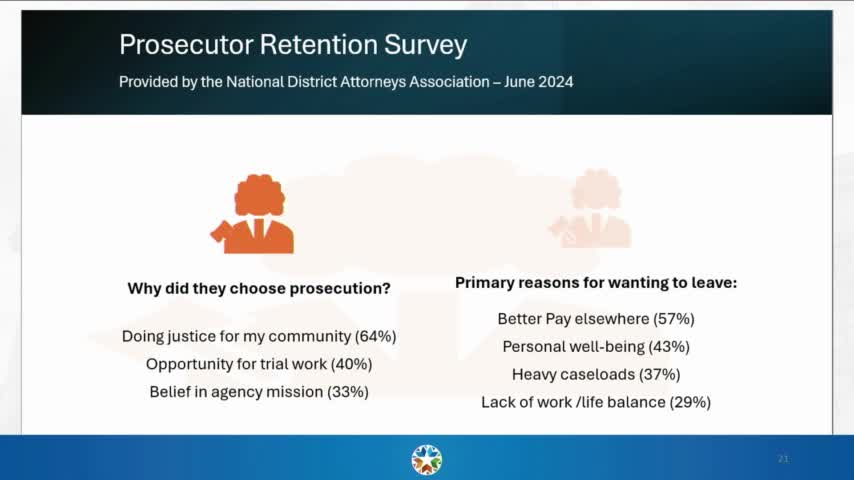
Catherine Brewer, executive coordinator for the council, said starting salaries for assistant district attorneys have increased over the last five years from roughly $50,000 to about $66,000 but still lag other public agencies and private employers — including the Office of the Attorney General, tribal governments and some municipal employers that can offer higher pay and lighter workloads. National and regional surveys cited by the council showed the top reason prosecutors leave is higher pay elsewhere (57%), followed by personal well-being (43%) and heavy caseloads (37%).
Several elected district attorneys from across Oklahoma described local effects: several rural and semi-urban offices have fallen from 10–12 lawyers a decade ago to far fewer attorneys today; one DA said Comanche County handled far more homicides and child-abuse cases in recent years with smaller staffs and reported trial volume rising from 29 jury trials in 2014 to 57 in one recent year. DAs described losing staff to other state employers, federal positions, tribes and higher-paying municipal counsel roles.
The council’s budget request included $3 million to add 36 prosecutors (various experience levels) to reduce caseload pressure and $5.8 million in retention/recruiting increases (total $8.8 million). DAs described other measures they use, including local county support for positions and training programs, internship pipelines, and limited retention incentives such as one-time payments approved in recent years. Members asked whether statutory pay scales or multi-year incentive packages could help; the council noted federal public-service student-loan programs exist but have been too small to meet needs.