Get AI Briefings, Transcripts & Alerts on Local & National Government Meetings — Forever.
Oklahoma Emergency Management seeks flat base budget, highlights $30 million revolving fund and disaster recovery payouts
Summary
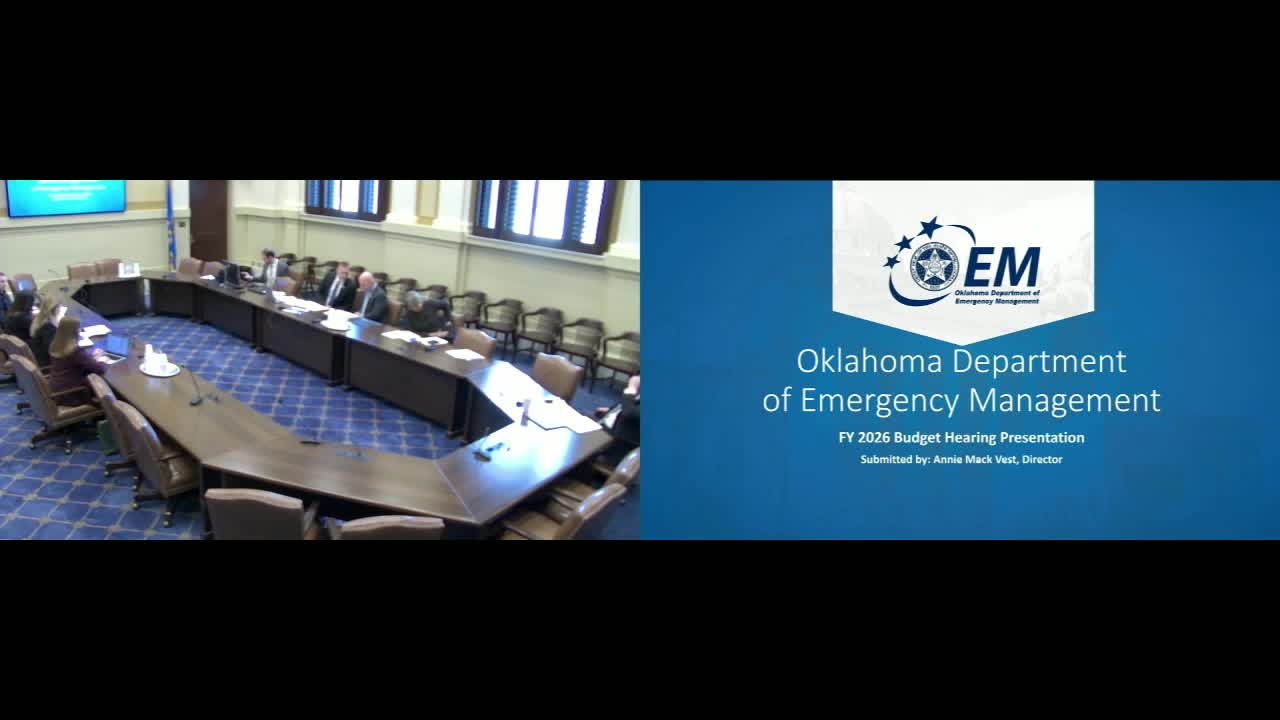
Director Annie MacVess told lawmakers the agency will request a flat operating appropriation for FY26 while managing a $30 million disaster revolving fund, ARPA allocations and recent large FEMA public assistance payouts; she outlined staffing changes, consulting costs and projects including a $5 million mobile command trailer.
Annie Mac MacVess, director of Oklahoma Emergency Management, told a legislative subcommittee that the agency will request a flat base appropriation for fiscal year 2026 while managing recent disaster-related funds and ongoing recovery work.
MacVess said OEM is overseeing a newly created $30,000,000 disaster revolving fund that lets the state advance money to impacted communities while awaiting federal reimbursement. She told the committee the agency has paid out about $113,000,000 in FEMA public assistance to applicants across the state and has secured four Fire Management Assistance Grants for northwest Oklahoma fires.
The agency director said 2024 was a record year for tornadoes in Oklahoma, producing two presidential disaster declarations early in the year and a pending request related to November storms. “Our vision: prepared and resilient communities within Oklahoma,” MacVess said, adding the agency’s focus is on getting funds quickly to communities and improving mitigation and preparedness.
MacVess described staffing and organizational changes aimed at limiting recurring costs. OEM currently lists 52 filled positions and about 16 unfilled positions, she said, and has chosen to use consulting firms and temporary hires for surge capacity rather than keeping all disaster-time positions as permanent FTEs. She told lawmakers the agency is contracting an organizational management firm and has budgeted a first-phase consultant study at about $200,000.
She outlined recent efficiencies and one-time savings: plans to close a warehouse (projected first-year savings of roughly $8,000 and about $15,000 in FY26), a restructured finance division to meet federal subrecipient-monitoring requirements, and use of ARPA funding ($25,000,000 was implemented for related projects). MacVess also said the legislature appropriated $5,000,000 to buy and build out a mobile command trailer.
On regional planning and mitigation, MacVess said roughly 50 percent of Oklahoma counties lack a current hazard mitigation plan, which affects eligibility for certain federal assistance. She described work to regionalize mitigation planning and to align OEM divisions more closely with FEMA processes.
Senators pressed MacVess on turnover and staffing levels. She said some long-term contract staff were converted to FTEs in earlier years and that the agency is now calibrating which positions are needed full time versus surge-only. On agency special accounts, she described a program to advance pay to Oklahoma task forces deployed to other states under the Emergency Management Assistance Compact (EMAC) and explained that reimbursements from the deploying state can take months to years to arrive.
MacVess said OEM does not plan an incremental or supplemental appropriation this year beyond the flat base request and the already enacted $30,000,000 revolving fund. She also listed ongoing objectives: completing hazard mitigation grant closeouts, implementing public-facing GIS for project and payment status, and developing a new strategic plan focused on operational efficiency.
Less-critical details: MacVess identified Lance Terry as the state 9‑1‑1 coordinator (that program has a separate appropriation), said OEM has paid 25 percent cost-share obligations in recent projects, and noted the agency will continue to rely on interagency coordination and out-of-state assistance in large events.
MacVess closed by thanking legislators for questions and said the agency will continue follow-up on specific budget items.