Get Full Government Meeting Transcripts, Videos, & Alerts Forever!
Get email alerts on the Public Defense topic
No spam. Unsubscribe anytime.
Indigent Defense system asks for funding to stabilize county contracts and expand client navigators
Summary
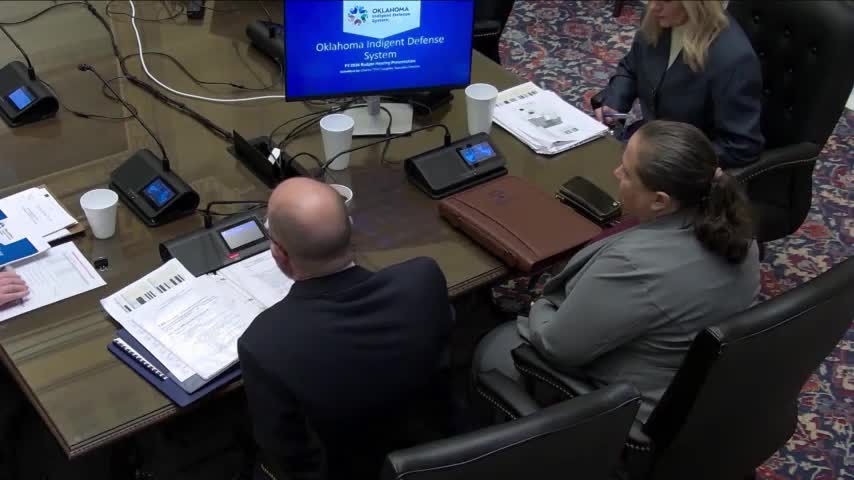
Oklahoma Indigent Defense System director told the committee the agency handled roughly 47,640 trial cases in FY 2024 across 75 counties, is straining under contractor shortages, and asked for $2.3 million to annualize recent carryover spending plus $500,000 to expand a client resource navigator program.
The Oklahoma Indigent Defense System (OIDS) told the House Appropriations and Budget Committee it served approximately 47,640 noncapital trial cases in fiscal 2024 across 75 counties and is operating under persistent staffing pressures and failures in the county contract model.
Executive Director said the agency relies on three main delivery methods: county contracts (fixed annual contracts with private attorneys), satellite offices (state-staffed offices in regions with low contractor availability) and hourly-paid contract counsel for conflicts. County contracts are the least expensive model but the agency reported failures in some counties where no contractors bid. The office described multiple recent satellite-office openings (Clinton, Okmulgee, Sapulpa, Mangum, Cleveland, Lawton, Enid, Woodward, El Reno) intended to maintain representation in rural areas when contracts fail.
OIDS said the agency’s average compensation per case has climbed from about $190 per case four years earlier to about $311 per case now (agency average: fiscal-year totals divided by appointments). The agency holds retained funds (10% retention from county-contract payments) to ensure contractors finish cases and reported approximately $1.3 million in retained funds that are restricted for that purpose. The agency said it has used carryover to maintain operations and projects that carryover funds will be exhausted by February 2027.
Director warned that county contracts are failing in pockets of the state (Rogers, Craig, Niwata/Ottawa cited) as private lawyers take better-paid work with tribes, the federal government or the private sector. The agency described its strategy of opening satellite offices in those counties to maintain services and said the quality of representation improves when offices are in place.
OIDS requested $2.3 million to annualize costs that have been covered with carryover (mainly to support satellite offices and stabilize contractor shortfalls) and $500,000 to expand its client service navigator program, which connects low-risk defendants and juveniles with wraparound services; agency said four navigators handled about 500 client referrals in the first six months of operation. The agency also asked lawmakers to consider longer-term policies, such as student-loan and hiring incentives, to improve rural recruitment and retention of defense counsel.