Get Full Government Meeting Transcripts, Videos, & Alerts Forever!
Get email alerts on the Maternal And Child Health topic
No spam. Unsubscribe anytime.
Committee extends deadline to spend maternal and child health fund, approves measure unanimously
Summary
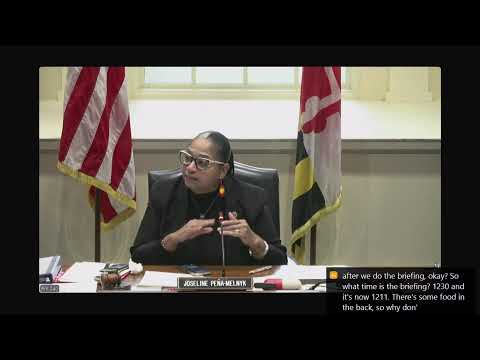
Jocelyn Pena Milnick, chair of the Health and Government Operations Committee, opened the committee’s first 2025 voting session and introduced action on House Bill 170, a departmental bill to extend the period during which the Maternal and Child Health Population Health Improvement Fund may be spent.
Jocelyn Pena Milnick, chair of the Health and Government Operations Committee, opened the committee’s first 2025 voting session and introduced action on House Bill 170, a departmental bill to extend the period during which the Maternal and Child Health Population Health Improvement Fund may be spent.
The committee voted unanimously to move the fund date from December 31, 2025, to December 31, 2027, allowing the Maryland Department of Health (MDH) to expend any fund balances remaining at the end of calendar year 2025. The bill contains no new appropriation; it permits the department to continue drawing down existing dollars and associated federal matches while the programs operate.
The subcommittee chair, Delegate Bagnell, told the committee the change merely “moves a date to allow us to draw down on existing funds,” and summarized program activity supported by the special fund. According to materials and summary figures presented to the committee, the fund initially held $40,000,000; MDH expects approximately $24,100,000 to remain near the end of 2025, though that amount may change as programs continue to spend.
Delegates and witnesses described several programs paid from the fund and the usage figures provided by MDH: perinatal home visiting (16 providers serving 14 of Maryland’s 24 jurisdictions; in 2023, 5,412 services were provided to 627 participants, 63% in rural communities); doula services (68% of participants were Black, per the department summary); the Centering Pregnancy prenatal cohort model (expanding from four sites in 2021 to 17 sites in eight counties by 2023; 82% of participants were Black or Hispanic); the MOM program (enhanced case management for pregnant and postpartum people with opioid use disorder); and HealthySteps (child development specialists embedded in pediatric primary care; 1,370 infants and toddlers served in 2023, 85% Black). Speakers also said the fund supports an asthma program. These figures were presented to the committee by the subcommittee chair and described as program snapshots under final review by MDH.
Committee members repeatedly emphasized that HB 170 would not create new funding. Delegate Bagnell said the extension “is no new money. It is not a mandate.” Several members asked what would happen after the fund balance is exhausted. The committee heard three distinct points: (1) if the fund expires and the programs are to continue, the General Assembly would need to decide how to finance them going forward; (2) the state could lose federal matching dollars if it cannot draw them down within the statutorily allowed period; and (3) mandated services placed on Medicaid managed‑care organizations (MCOs) could carry fiscal consequences and would likely require further analysis of capitation and mandate costs.
Some delegates urged that, beyond extending the spending deadline, the committee track program results closely. Delegate Shaliga (who had voted no in subcommittee and requested additional information) said she was “disappointed that they couldn’t get their act together and use the money in the amount of time we gave them,” while others, including Delegate Bagnell, said ramp‑up during COVID‑era operations had slowed initial spending and that unspent funds reflected careful, equitable program rollout rather than failure.
Committee members and the subcommittee chair discussed whether MCOs should provide the services directly. Speakers noted the programs require specialized providers—nurses, doulas, child development specialists and community health workers—and that the state used waivers and federal matching funds to pilot these services. Delegates observed that if the state later asks MCOs to deliver the services as a Medicaid benefit, that change would involve separate policy and fiscal decisions.
After extended discussion and requests for the final MDH 2024 report (committee members were told the department was still completing a final review), the committee moved and seconded the bill and approved it unanimously.
Votes at a glance: - House Bill 536 (withdrawal): committee accepted withdrawal; motion carried (withdrawn). Sponsor: Delegate Ghazoni (withdrawal introduced on the floor). No opposition recorded on the transcript. - House Bill 170: “Departmental bill — Maternal and Child Health Population Health Improvement Fund; extend use date to Dec. 31, 2027; allow MDH to expend remaining fund balances” — motion moved by Delegate Bagnell; second not specified on the record; outcome: passed unanimously.
The committee asked MDH to share the final 2024 evaluation and outcome data with members when it is available; members said they expect follow‑up reporting on participant counts and program outcomes as the extended period proceeds.