Get Full Government Meeting Transcripts, Videos, & Alerts Forever!
Get email alerts on the Land Use Stadium District topic
No spam. Unsubscribe anytime.
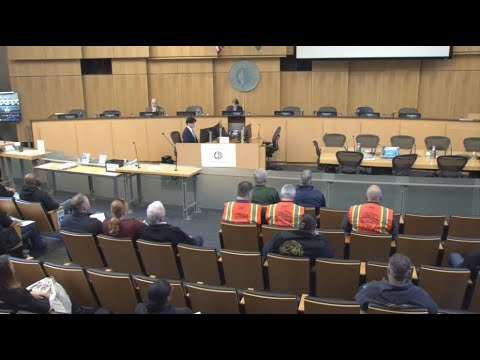
Seattle committee hears debate over bill to allow housing in SoDo’s stadium district
Summary
Council President Carrie Nelson on Friday introduced a briefing on Council Bill 12933, a proposal to allow residential development in the Stadium Transition Area Overlay District in SoDo; a public hearing is scheduled for Feb. 24 and a possible council vote could follow on Feb. 27.
Council President Carrie Nelson on Friday introduced a briefing on Council Bill 12933, a proposal to allow residential development in the Stadium Transition Area Overlay District in SoDo. The committee met for a public briefing and comment before further hearings; a public hearing is scheduled for Feb. 24 and a possible council vote could follow on Feb. 27.
Nelson said the measure would amend the overlay district to permit residential uses and remove the current 200‑foot limitation that bars housing within 200 feet of major truck streets. "This morning we'll be having our first briefing and discussion of council bill 12933 which would allow for housing in the stadium district," Nelson said as she opened the meeting.
The briefing drew dozens of in‑chamber and online commenters and a panel of presenters that included labor representatives, neighborhood and maker‑space advocates, central staff and the director of the Office of Planning and Community Development.
Why it matters: The stadium district sits between downtown neighborhoods and heavy industrial and maritime uses. Supporters argue modest residential development will bring workforce affordability and neighborhood activation; opponents say new housing will conflict with freight operations and risk the long‑term viability of maritime jobs and Port of Seattle facilities.
Supporters’ case: Presenters and several union and development groups said housing would expand workforce options and support small makers. Andrea Porter, program director for Seattle Made, said Seattle is losing local manufacturing for lack of affordable production space. "We see 2 to 3 Seattle Made member businesses leave Seattle monthly to relocate somewhere else more affordable," Porter said.
Representatives of the public stadium authorities said the stadiums and public facilities support mixed uses. John Marchioni, executive director of the Washington State Public Stadium Authority, said the authority "is fully supportive of council bill 12933" and argued that housing and small businesses could help create a more active 24‑7 neighborhood near Lumen Field and T‑Mobile Park.
Proponents also noted details in the 2022 programmatic environmental impact statement (EIS) that identified the stadium district as capable of accommodating housing under certain conditions. The proposed change would include a 50‑units‑per‑acre limit in line with existing urban industrial rules and require recorded covenants that notify residents of the neighborhood’s industrial character, speakers said. Lizanne Lyons, consultant for the stadium public facilities districts, said the area immediately south of T‑Mobile Park has seen little industrial activity for decades and called it a suitable transition zone for makers and housing.
Opposition from the port and maritime unions: Multiple port representatives, maritime employers and longshore unions urged the committee to oppose the bill. Port of Seattle Commissioner Fred Tulliman said the Port "strongly opposes this amendment, and we urge you to oppose it as well," arguing the change would reopen a negotiated industrial‑lands package adopted in 2023 and risk a “spot rezone” favoring a single landowner.
Maritime labor leaders emphasized job counts and freight reliability. Gordon Baxter, secretary‑treasurer of the Puget Sound Maritime Trades Council, cited thousands of port‑dependent jobs and warned that allowing housing in freight corridors could prompt operational limits that push shippers to other ports. Multiple longshore and maritime speakers described safety, noise, air‑quality and truck traffic concerns; one testified that Pier 46 is a natural deep‑water berth critical to statewide commerce.
Central staff and OPCD explanation: Keel Freeman of Council Central Staff summarized the zoning changes the bill would make. Under current city code, residential uses can be permitted in other urban industrial zones only as a conditional use subject to several mitigation measures, including the 200‑foot buffer from major truck streets and recorded covenants. Council Bill 12933 would remove the stadium district’s prohibition on residential uses and would lift the 200‑foot buffer requirement; however, other conditional‑use criteria and mitigation measures (sound insulation, air filtration, recorded covenants) would still apply.
Rico Kirindango, director of the Office of Planning and Community Development, said the 2023 industrial and maritime legislation and its EIS had included a preferred alternative that allowed up to 990 housing units in the stadium district, but the transmitted legislation ultimately excluded housing there. He described continued interagency coordination for South Downtown projects and the Wauska site and noted the EIS conclusion that housing configured under the urban industrial rules would not cause significant adverse environmental impacts.
Key factual details and constraints: The bill as discussed would: - Allow residential uses within the Stadium Transition Area Overlay District where they are now prohibited; - Remove the 200‑foot prohibition that currently applies to housing near major truck streets in that overlay district; - Leave in place other urban industrial conditional‑use requirements such as a maximum of 50 dwelling units per acre for limited workforce housing, recorded covenants acknowledging industrial character, and building mitigation measures; and - Rely on existing SEPA/EIS analysis for citywide industrial changes while the committee pursues a separate public hearing and council consideration.
Public process and next steps: Nelson said the committee would hold a public hearing Feb. 24. Central staff noted a possible council vote as soon as Feb. 27. Several council members asked for additional analysis of freight throughput between the Port of Seattle and I‑90 and other infrastructure and emergency‑management considerations raised by commenters.
What was not decided: The committee did not vote on the legislation at the briefing. No formal motion or amendment was made during the meeting. Testimony reflected sharply divided stakeholder positions and repeated requests for additional technical analysis of freight, safety, air‑quality and emergency preparedness risks.
Closing remarks: Nelson said she brought the briefing after more than a year of conversations with a broad coalition that includes labor, neighborhood and small‑business groups; she urged further public engagement ahead of the scheduled hearing. "This puts wind beneath my sails," she said of the coalition support, calling for continued deliberation as the process moves toward the Feb. 24 hearing.