Get Full Government Meeting Transcripts, Videos, & Alerts Forever!
Get email alerts on the Land Use Redevelopment topic
No spam. Unsubscribe anytime.
Cary board signals consensus to negotiate with developer A for Maplewood site
Summary
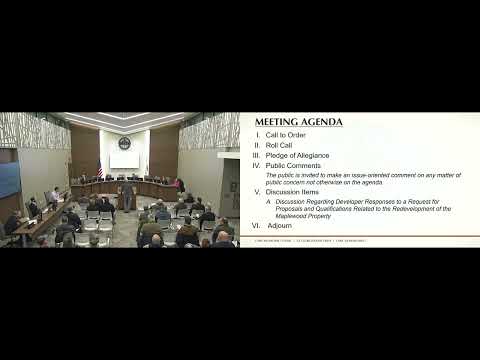
The Village of Cary Board on Jan. 21, 2025 moved to begin negotiating with one developer to redevelop the former Maplewood school property after hearing three proposals and more than an hour of public comment.
The Village of Cary Board on Jan. 21, 2025 moved to begin negotiating with one developer to redevelop the former Maplewood school property after hearing three proposals and more than an hour of public comment.
The board indicated a collective preference for the development team labeled “developer A” in staff materials and directed staff to start negotiations. The board and staff emphasized that no final site plan, zoning decision or purchase price for a developer has been approved.
Why it matters: Maplewood is a long‑discussed site adjacent to established single‑family neighborhoods. Residents who testified at the meeting said they fear increased traffic, higher density, loss of neighborhood character and inadequate notification; board members and staff said the process will include public hearings, open houses and required zoning reviews.
Director Simmons, the village staff member leading the project presentation, reminded the board and public that the village’s intergovernmental agreement with Community Unit School District 26 transfers the school property to the village and that the district provided funds to help relocate its transportation center. Simmons summarized the three proposals the village received: developer A proposed owner‑occupied townhomes (about 50 units) around the site perimeter and apartments in the interior with structured parking; developer B offered a mixed plan with higher‑rise sections and options for sale or rental; developer C proposed 100% rental housing. Simmons said the proposal labeled developer A was the least‑dense of the three and included a park in the southwest corner of the site, internal parking and two access points to a planned Maplewood access road.
Residents pressed the board for more notice and details. Rachel Byerly, a resident at 538 Norman Drive, said she learned of the meeting only hours before and described the neighborhood as quiet and family oriented. Elaine Bailey, who said she grew up in the area, and other speakers asked the village to prioritize owner‑occupied housing and affordability for young families. Several speakers questioned whether public notice and outreach to nearby subdivisions had been adequate and urged mailings or door hangers in addition to online posts.
Board members and staff described planned outreach steps. Mayor Connick said the village will maintain a dedicated Maplewood page on the village website, expand direct mail and consider a neighborhood text broadcast; staff confirmed property‑owner notification required by the Planned Unit Development (PUD) and zoning processes will be used later in the review. Trustee Dudek suggested the Frankie subdivision nominate a small liaison team (three to five residents) to meet with staff and developers.
The funding and purchase history drew questions. A resident asked about a $5.5 million number mentioned in public comment. Director Simmons responded that the intergovernmental agreement with District 26 included funds applied to purchase the Maplewood site and to help acquire and prepare a separate parcel for the district's transportation center, and that the district’s portion included use of funds for facility construction. Simmons said the school district’s asking price for the site had been roughly $2.75 million, and the additional funds supported relocation and construction for district facilities.
Board members indicated reasons for favoring developer A. Trustee McAlpine said she favored developer A because it provides an owner‑occupied transition along the neighborhood edge and indoor parking; Trustee Weinheimer and Trustee Collier also cited lower density, indoor parking and mixed ownership as advantages. Trustee Stefani (recorded in the meeting as a speaking trustee) and others said communication and traffic mitigation must be priorities if the village proceeds.
The board characterized the planned next steps as negotiation, not final approval. Mayor Connick said, “It seems like we have a consensus to go with developer A, to start the negotiating process.” The village reiterated that any redevelopment will require the developer to submit zoning entitlements and that those steps will include public hearings and direct notifications under the PUD/zoning rules.
Ending: Staff will return to the board with negotiated terms and any requested public‑process milestones for review. Residents wanting updates were told to check the village’s Maplewood web page, sign up for the village’s communications and may contact village staff or Mayor Connick’s office (village hall 847‑639‑0003) to request meetings. No binding agreement with a developer was executed at the Jan. 21 meeting; the board’s direction was to enter negotiations with developer A.