Get Full Government Meeting Transcripts, Videos, & Alerts Forever!
Get email alerts on the Shopping Carts topic
No spam. Unsubscribe anytime.
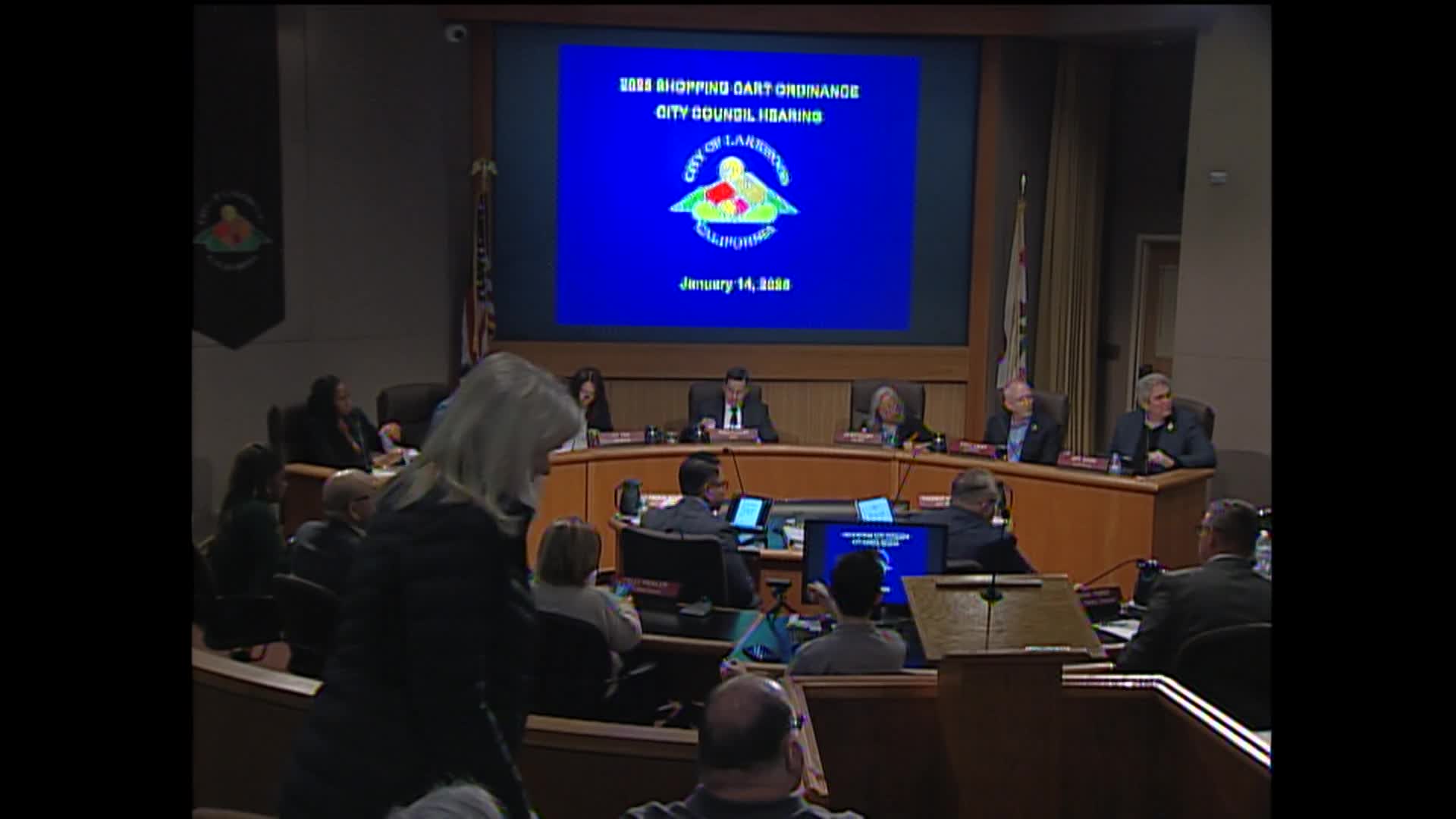
Lakewood council introduces ordinance requiring retail shopping cart identification, retention and retrieval
Summary
The Lakewood City Council voted unanimously to introduce Ordinance No. 2025-1, which would require commercial businesses with five or more shopping carts to adopt cart identification, retention and retrieval programs and treat abandoned carts as a public nuisance.
The Lakewood City Council on the council’s meeting introduced Ordinance No. 2025-1, a proposal that would require commercial businesses with five or more shopping carts to implement cart identification, retention and retrieval programs and declare abandoned carts a public nuisance, council members voted unanimously to introduce the measure.
The ordinance is intended to reduce cart theft and abandonment, address traffic and pedestrian safety concerns, and remove visual blight from neighborhoods. Acting Director Patrick McGuckian told the council that staff surveyed Lakewood’s commercial community and found roughly 37 retail stores with about 3,550 carts and six commercial laundries with about 50 carts—about 3,600 carts in total that would be subject to the new rules.
Under the ordinance as presented by Acting Director Patrick McGuckian, retail cart owners with five or more carts would be required to place on each cart a business name, phone number and email indicating where carts may be returned; post warning signage on the property; and establish a cart retention and retrieval program as a condition of business license renewal. Retention methods could include physical barriers, wheel-lock technology, security personnel or other practical measures determined by each business. The ordinance would allow the city to follow a typical enforcement progression—notice of violation followed by administrative steps—and permit city impoundment of unidentified or vandalized carts.
Council Member Wood said the measure “puts the ownership back on the people that own the carts,” describing abandoned carts as a safety and nuisance problem. Council Member Wood added that many carts never get reported when they are moved into yards or alleys. Acting Director McGuckian said the city would use a six-month education period before implementation and that the city’s intent is to work with businesses on compliance; the city would not provide direct financial assistance for retention systems.
City staff also told the council that Business and Professions Code section 22435 authorizes signage requirements; McGuckian said the most common initial expense for businesses would be applying identification stickers and posting customer-return signage. The report noted some businesses already use retention systems (for example, perimeter bars or security patrols) and that the city’s approach seeks flexibility so each retailer can choose a cost-effective solution.
The council’s introduction vote followed discussion about potential business costs, enforcement approaches used by other cities and the effect on city crews that currently collect abandoned carts. The ordinance as introduced would go into effect July 1, allowing an education period before enforcement begins, and staff said the Public Safety Committee would be available to consider suggested tweaks to the retention requirements before final adoption.
The council waived further reading and introduced Ordinance No. 2025-1 by unanimous roll call vote (Council Member Wood; Council Member Croft; Council Member Arellano; Vice Mayor Cassandra Chase; Mayor Rogers). The ordinance will return for a hearing and later consideration for final adoption.