Get Full Government Meeting Transcripts, Videos, & Alerts Forever!
Get email alerts on the Elections Districting topic
No spam. Unsubscribe anytime.
Committee opens lengthy review of council districts and a directly elected mayor; no decisions made
Summary
The Glendale Charter Review Committee heard staff briefings and public comment on district‑based elections, council size and the role of a directly elected mayor. Committee members asked staff for more legal background on the California Voting Rights Act, prior demographer maps and cost estimates; no vote or recommendation was made.
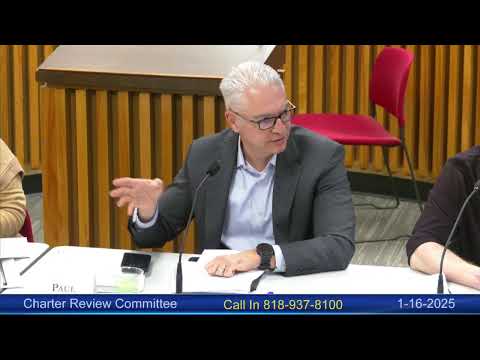
The Glendale Charter Review Committee devoted the latter part of its Jan. 16 meeting to an extended briefing and preliminary deliberation on whether the city should move from at‑large elections to district‑based elections, whether the council should be expanded, and whether the city should add a directly elected mayor.
Staff framed the discussion by defining election methods and summarizing common pros and cons of districting. "At‑large" methods allow all voters to elect each council member; "district" methods require candidates to live in a district and be elected only by voters within that district, staff said. The packet and presentation also summarized legal and practical steps in a districting process, including public hearings, map drafting and compliance with state law.
Legal context and outreach: Staff told the committee that the California Voting Rights Act (CVRA) has driven litigation in other jurisdictions and clarified the legal stakes. The committee heard that the city previously explored districting in 2015 and again beginning in 2023; mapping work and outreach have been partially completed. Staff cautioned that although demographers may draw many maps, the council must choose the number of districts before maps are finalized and that maps must be redrawn every ten years to reflect census data.
Costs, turnout and representation: Committee members raised repeated questions about cost (one‑time mapping and possible ongoing costs), voter turnout disparities across neighborhoods and the ability to draw a legally compliant district that creates a majority‑minority district. Staff said city demographers advised there is no way with current population data to draw a majority‑minority district in Glendale, which complicates CVRA exposure but does not eliminate risk.
Directly elected mayor models: Staff described four common models for a directly elected mayor in a council‑manager city: (1) mayor elected citywide with equal vote and no veto (common model, used in Pasadena); (2) mayor with veto power and no regular vote (Long Beach model); (3) mayor who votes only to break ties and has no veto (Bakersfield model); and (4) mayor who votes to break ties and also has veto power (Riverside model). Staff emphasized that the committee’s charge is to consider a directly elected mayor within a council‑manager framework, not to propose a wholesale switch to a mayor‑council (strong‑mayor) government.
Public comment and concerns: Multiple public speakers urged caution. Public commenter Herbert Molano warned that switching to districts could lower turnout or create situations where a small absolute number of votes decides a council seat in a low‑participation district. Staff and committee members discussed possible mitigations, such as residency requirements, and asked staff to research potential legal constraints under state election law.
Next steps: Committee members asked staff to provide (1) concise legal background on the CVRA and recent relevant court rulings, (2) links to prior council meeting presentations and the demographer’s slide decks and videos, (3) an estimate of one‑time and ongoing costs associated with a districting transition and (4) prior draft maps prepared for Glendale (staff said those materials are available and will be circulated). Committee members also suggested inviting the city demographer to present at a future session and to identify scenarios and timelines if the committee ultimately recommends a ballot measure for 2026.
Ending: No action was taken on districting or a directly elected mayor at the Jan. 16 meeting. Committee members agreed to continue the discussion at future meetings after staff circulates the requested legal, mapping and cost information.