Get Full Government Meeting Transcripts, Videos, & Alerts Forever!
Get email alerts on the Charter Governance topic
No spam. Unsubscribe anytime.
Charter Review Committee elects Steven Flower as chair; adopts location rule and several charter cleanups
Summary
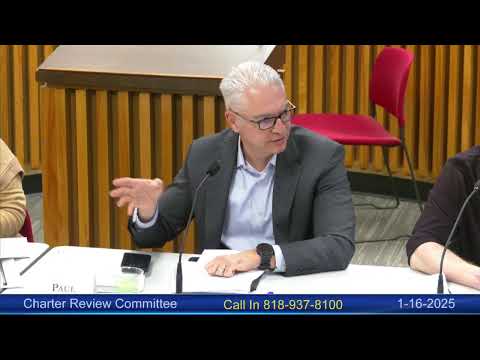
Steven Flower was elected chair of the Glendale Charter Review Committee on Jan. 16, 2025, and the committee voted to keep regular City Council meetings in the council chamber except in emergencies while approving several charter cleanup edits and a post‑term employment exception for elected offices.
Steven Flower was elected chair of the Glendale Charter Review Committee on Jan. 16, 2025, after a roll‑call vote of committee members. The committee also approved a charter amendment that keeps regular Glendale City Council meetings in the council chambers except in emergencies, and adopted a set of noncontroversial cleanup edits to obsolete employee titles in the charter. Members also approved a clarification to the charter’s post‑term employment restriction to exempt elected positions.
Why it matters: The committee is preparing proposed charter changes that could go to the City Council and, if the council approves, to the ballot. The items approved on Jan. 16 are procedural and housekeeping measures but affect how the public expects to find council meetings, how charter text reads about city officers, and whether former council members may later hold certain elected or appointed offices.
The meeting opened with a public comment urging care and study of charter changes. “The decisions that you're going to make with regard to this charter will impact roughly the people who live in 75,000 dwellings in the city of Glendale,” public speaker Herbert Molano said, urging thorough review and outreach.
Staff presented two alternative drafts of Article 6, Section 2 (location of meetings). Senior Assistant City Attorney Aaron Israel summarized the options and the legal context: the first alternative would allow meetings to be held at any place the council chooses; the second would state that regular meetings are held in the council chamber except in an emergency, and leave special‑meeting location rules to the Brown Act. "Because it's silent as to location on special meetings, location of special meetings would fall back to the requirements of the Brown Act," Israel said.
After discussion the committee voted to adopt alternative 2, keeping regular meetings in council chambers but allowing flexibility for special or emergency meetings under state law.
The committee unanimously approved a separate set of charter edits removing obsolete position titles (for example, replacing "director of administrative services" with "director of finance" and striking listed, outdated positions). Committee members also asked staff to return with an option to consider gender‑neutral language across the charter.
On a related charter item addressing post‑term employment restrictions, committee members approved language broadening an exception so the two‑year restriction would not apply to currently elected city offices. The final approved wording reads, in effect, that the limitation will not apply to elected positions or to appointment of a council member to fill a vacancy.
The committee scheduled follow‑up work: staff will return with additional background materials for the larger districting and mayor discussion (including prior demographer presentations and related council meeting videos), a draft resolution setting the committee’s 2025 meeting calendar, and a possible agenda item to address civil‑service designations in the charter.
Votes at a glance
- Approval of minutes (Jan. 16 draft): Motion carried; roll call showed 11 yes, 0 no, 1 abstention (Denise Miller). (Recorded during the meeting roll call.)
- Chair election: Steven Flower elected chair — 7 votes for Flower, 5 votes for Carl Provolaitis. Outcome: elected.
- Location of council meetings (Article 6, Sec. 2) — Adopted Alternative 2 (regular meetings in council chambers; special‑meeting location governed by Brown Act): 7 yes, 4 no, 1 abstain. Outcome: approved by committee vote.
- Charter cleanup (obsolete employee titles) — Unanimous yes. Outcome: approved.
- Post‑term employment language (section change clarifying exception for elected positions and appointment to fill vacancy) — Motion carried: 9 yes, 3 no. Outcome: approved.
What’s next: The committee spent the second half of the meeting on a lengthy information session and preliminary deliberation about switching to district‑based elections, expanding council size and whether to add a directly elected mayor. That topic generated extensive questions about legal risk under the California Voting Rights Act, costs, map‑drawing mechanics and turnout disparities; staff and committee members agreed to return with further documentation, video excerpts of prior council discussions and specific legal background for future meetings.
Ending: The committee adjourned after agreeing to place a vice‑chair item on the next meeting agenda and to circulate additional background materials on the districting and mayor topics.