Get Full Government Meeting Transcripts, Videos, & Alerts Forever!
Get email alerts on the Traffic Safety Truck Routes topic
No spam. Unsubscribe anytime.
Redondo Beach reviews truck-route gap at Torrance border, considers traffic-calming for Palos Verdes Boulevard and Prospect Avenue
Summary
City public works and police outlined legal limits and engineering options for addressing heavy truck traffic and speeding on Palos Verdes Boulevard and Prospect Avenue; commissioners heard resident data and voted to continue formal action with Torrance to April.
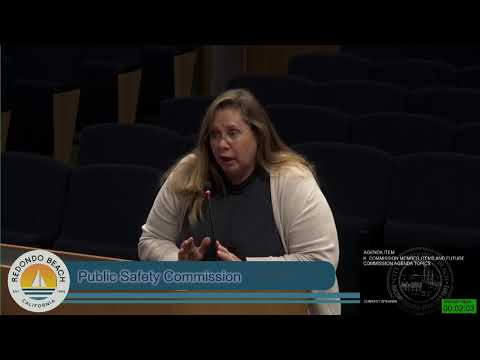
Public Works Director Andy Wingie and transportation engineer Ryan Lehi briefed the Redondo Beach Public Safety Commission on January 23 on truck-route conflicts at the Torrance city border and a menu of traffic‑calming options for Palos Verdes Boulevard (PV Boulevard) and Prospect Avenue.
The presentation said California Vehicle Code sections cited by staff allow local truck-route regulation (Cal. Veh. Code §35701) but permit trucks to use non‑route streets to make deliveries (Cal. Veh. Code §35703). "The base of it is that we have incompatible truck routes at the city border," Lehi told commissioners, explaining that PV Boulevard is a truck route in Torrance but not in Redondo Beach, which creates an enforcement gap where a truck legally on Torrance routes crosses into Redondo and is suddenly on a street where the city lacks an enforceable truck‑route designation.
Why it matters: commissioners, staff and dozens of residents said the corridor carries heavy local traffic, school crossings and bicycle and pedestrian trips. Resident speakers described high truck volumes and near misses. "There were over 30,000 trucks that came by since that date," said resident John Pershlan, summarizing neighborhood counts and video recordings he and neighbors compiled. Police staff told the commission they have worked with the California Highway Patrol on targeted enforcement "3 different times" and said CHP brings specialized truck‑inspection equipment.
Public works described steps already taken: additional legally compliant truck‑restriction signs where enforcement is feasible, and permission from Torrance to place directional signage near Pacific Coast Highway (PCH). Lehi said the department also plans soon to stripe Class II bike lanes on PV Boulevard between South Bridal and the Torrance city line per an earlier City Council direction.
On traffic‑calming options, staff reviewed engineering trade‑offs. Potential measures include curb extensions, lane reductions ("road diets"), single‑lane roundabouts where geometry allows, and an arterial speed‑table pilot. Lehi cautioned many measures require technical feasibility studies, Fire Department review for emergency access, City Council approval and dedicated funding. "All traffic‑calming measures are subject to technical feasibility," he said. Several commissioners stressed the need for a corridor‑level study that combines police speed data, collision history and engineering analysis before pursuing large conversions.
Commissioners also discussed interagency coordination with Torrance. Wingie said Redondo staff have met with Torrance counterparts in 2023–24 but that Torrance staff previously declined to change their truck‑route maps; the conversation is ongoing. Chair and commissioners encouraged continued outreach and recommended developing a coordinated plan that blends enforcement, signage and engineering.
Action: The commission considered an advisory memo to City Council regarding the Torrance truck‑route matter and decided not to send a letter immediately; instead the commission voted to continue the item to April for further work and staff followup. The continuation was approved by voice vote; no roll‑call mover/second was recorded in the minutes.
Next steps: staff will continue coordination with Torrance, pursue feasible signage and enforcement partnerships (including CHP operations), and report back with corridor study options and cost estimates. Residents and several commissioners urged City Council to prioritize funding for a formal corridor study and for pilot engineering measures that could reduce speeds near schools and residential crossings.