Get Full Government Meeting Transcripts, Videos, & Alerts Forever!
Get email alerts on the Block Grants topic
No spam. Unsubscribe anytime.
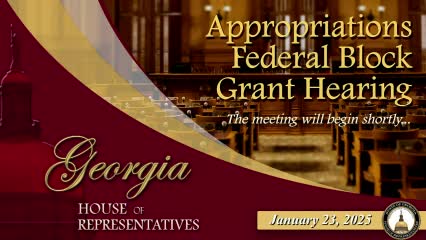
Georgia legislative hearing reviews five federal human-services block grants; no public speakers registered
Summary
Agency officials summarized five federal human-services block grants for state fiscal year 2026 at a legislative hearing convened by state lawmakers; no members of the public signed up to speak.
Senators and House members convened a public hearing on federal human-services block grants during which state agency officials summarized five grant programs for state fiscal year 2026 and no members of the public registered to provide oral comments.
Senator Kay Kirkpatrick opened the hearing and introduced Representative Katie Dempsey and agency staff who presented summaries and logistics for public comment. The hearing is one of the public-input steps the Georgia Legislature uses as it considers allocations for the block grants that will apply to the fiscal year beginning July 1, 2025.
Rashad Jackson, budget director for the Georgia Department of Human Services, told the committee that, by federal law, the state is required to hold public hearings on these grants. Jackson summarized three grants administered through the Department of Human Services: the Community Services Block Grant (funding services that address causes of poverty and distributing funds to local agencies for employment programs, education, meals and nutrition services, and housing), the Low Income Home Energy Assistance Program (LIHEAP, providing cash assistance for energy costs, weatherization measures such as insulation and caulking, and crisis-intervention aid), and the Social Services Block Grant (supporting daycare for children and adults, services for people with intellectual and developmental disabilities, home-delivered meals, homemaker services, transportation and protective services).
Chris Hamilton, chief financial officer for the Department of Behavioral Health and Developmental Disabilities, summarized two block grants his agency oversees: the Community Mental Health Services Block Grant (funding services for adults with serious mental illness and children with serious emotional disturbance) and the Substance Use Prevention, Treatment and Recovery Services Block Grant (funding community-based prevention, treatment and early-intervention programs for alcohol and drug use).
Officials directed attendees to color-coded pamphlets available outside the hearing room containing more details on eligible programs and proposed funding levels and explained the public-comment process: speakers sign up on a sheet, are called in order, are allotted five minutes each and will be notified when one minute remains, and organizers initially call two speakers to the podium so one can approach while the other speaks. The panel asked that organizations with multiple representatives designate a single speaker to conserve time and that written comments or copies of remarks be left on the table at the end of the meeting.
After calling for speakers in the order listed on the sign-up sheet, the panel announced that no one had signed up to comment. Senator Kirkpatrick and Representative Dempsey then closed the hearing and adjourned the meeting.
The summaries and any written submissions from the hearing are part of the record the Legislature will consider while preparing budget decisions for the five federal block grants for state fiscal year 2026.