Get Full Government Meeting Transcripts, Videos, & Alerts Forever!
Get email alerts on the Vapor Intrusion Funding topic
No spam. Unsubscribe anytime.
Subgroup advances vapor-intrusion funding proposal; seeks mid-February draft and legislative support
Summary
A vapor-intrusion subgroup presented a funding allocation framework Jan. 23 and said it will produce a draft for an ad hoc review committee by mid-February to support legislative or budgetary consideration.
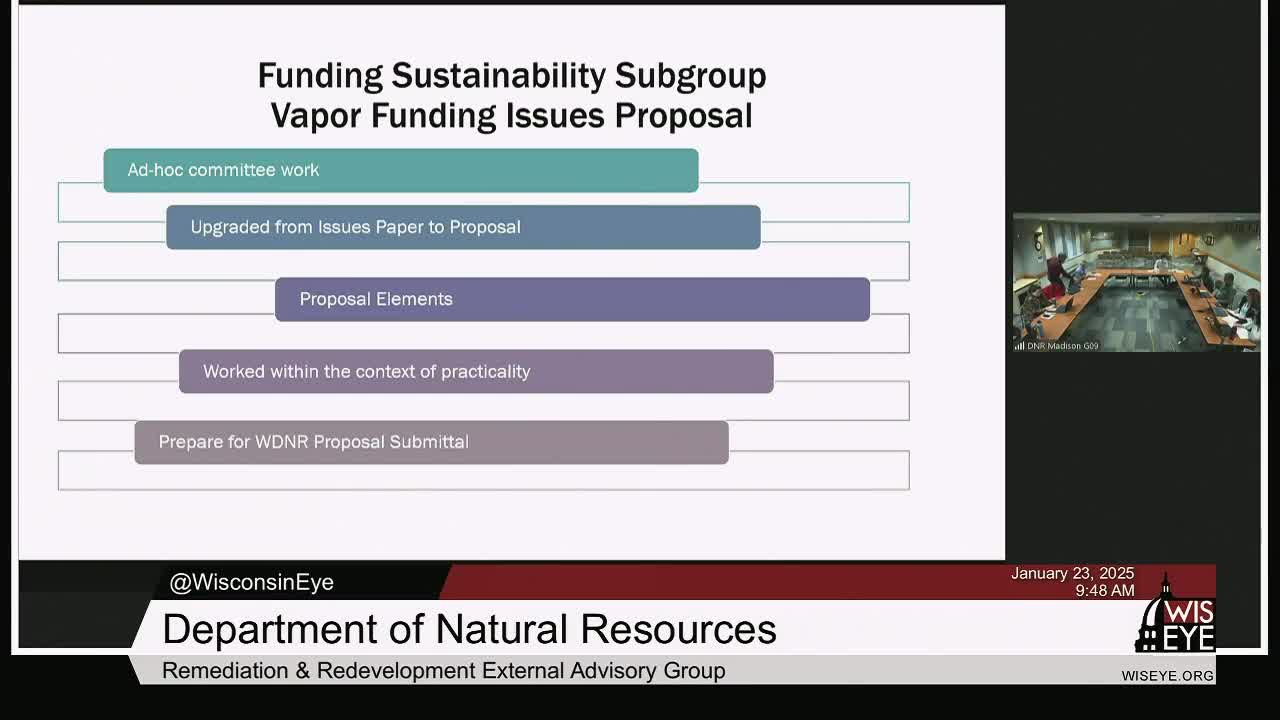
Subgroup members presented a draft proposal on Jan. 23 to establish criteria and a scoring matrix for allocating funding to address vapor-intrusion risks where resources are limited, and they said they will develop a draft for an ad hoc review committee by mid-February.
The subgroup said the proposal responds to a “punch list” developed by the EAG, including ranking high-risk sites (including sites without responsible parties), defining eligibility criteria, identifying factors DNR should consider in fund allocation, considering outreach costs to secure access agreements, and clarifying cost-recovery options for responsible parties. Presenters said the funding challenge for vapor intrusion differs from many brownfield funding contexts because health risks from indoor vapor exposures can be chronic and diffuse and are less visible than surface redevelopment projects.
Key elements described in the proposal include a scoring matrix with three primary factor groups (site-specific risk factors, regulatory-compliance considerations, and public-interest/sensitive-population criteria); an expanded definition of residential property that includes single-family and multifamily housing and certain institutional or public-gathering sites (day-care centers, schools, health-care facilities); a sensitive-population receptor definition covering groups more likely to experience adverse health effects; and recommended use of agency discretion (similar to EPA enforcement discretion) when determining eligibility, rather than a strict first-in-first-out allocation which the subgroup warned could disadvantage resource-poor applicants.
Presenters said the subgroup recommends requesting legislative assistance to address funding shortfalls and noted the subgroup will convene an ad hoc committee to produce a final draft in mid-February for internal review, with a goal of preparing language suitable for legislative or budget consideration. Volunteers were invited to assist with redrafting and legal framing.