Get Full Government Meeting Transcripts, Videos, & Alerts Forever!
Get email alerts on the Site Investigation Csm topic
No spam. Unsubscribe anytime.
Subgroup seeks further review of conceptual site model and site-investigation recommendations; decision deferred
Summary
An NR 700 subgroup presented seven technical recommendations to improve conceptual site models, work-plan scoping and reporting quality; attendees asked for more discussion on substantive reviewer comments and the item was deferred for further subgroup work.
The NR 700 subgroup presented a technical issue paper that recommends rule and practice changes to improve conceptual site models (CSMs), site-investigation scoping and report quality; attendees agreed the document needs further discussion and asked the subgroup to resolve substantive reviewer comments before final approval.
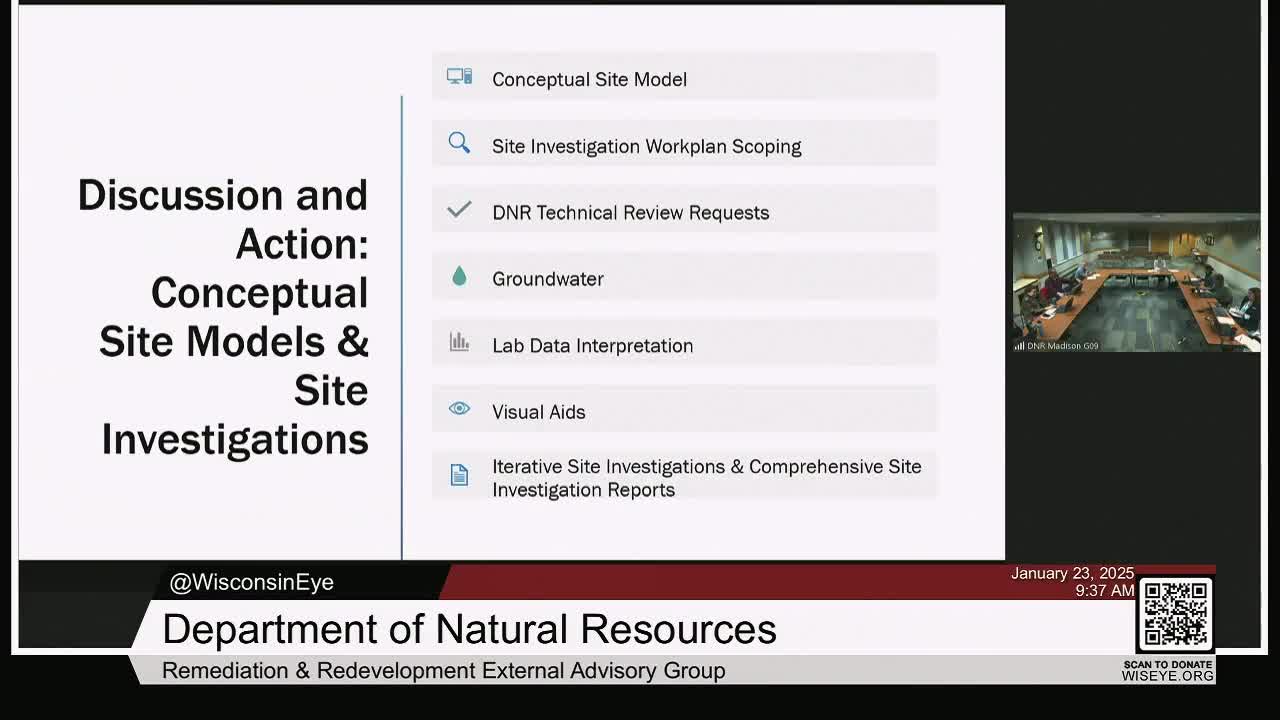
Presenters described seven interlocking recommendations intended to improve report quality and DNR review efficiency: define CSMs (using ITRC definitions) and require their development and maintenance; require submission of site-investigation work-plan scoping information; revise technical-assistance review procedures and timelines to reduce disincentives for fee reviews; require monitoring or inclusion of natural attenuation parameters when appropriate; require full interpretation of lab data including flagged results and method detection limit issues; require clearer visual aids (flow maps, concentration and migration cross-sections, photos); and require interim reports to be submitted in a way that allows efficient DNR review and requires a comprehensive site-investigation report.
Discussion participants said many of the recommendations reflect best practices already used by experienced consultants but are not written explicitly in code, and that clarifying rule language could help raise the quality of average submissions. Several reviewers provided red-line comments that the subgroup plans to address through further targeted conversations; participants recommended the subgroup resolve substantive comments before returning to the full EAG. The subgroup will incorporate feedback and bring a revised draft to a future EAG meeting (tentatively April).