Get AI Briefings, Transcripts & Alerts on Local & National Government Meetings — Forever.
Senate committee votes to continue Arizona Board of Executive Clemency after audit flags disclosure, notification and scheduling gaps
Loading...
Summary
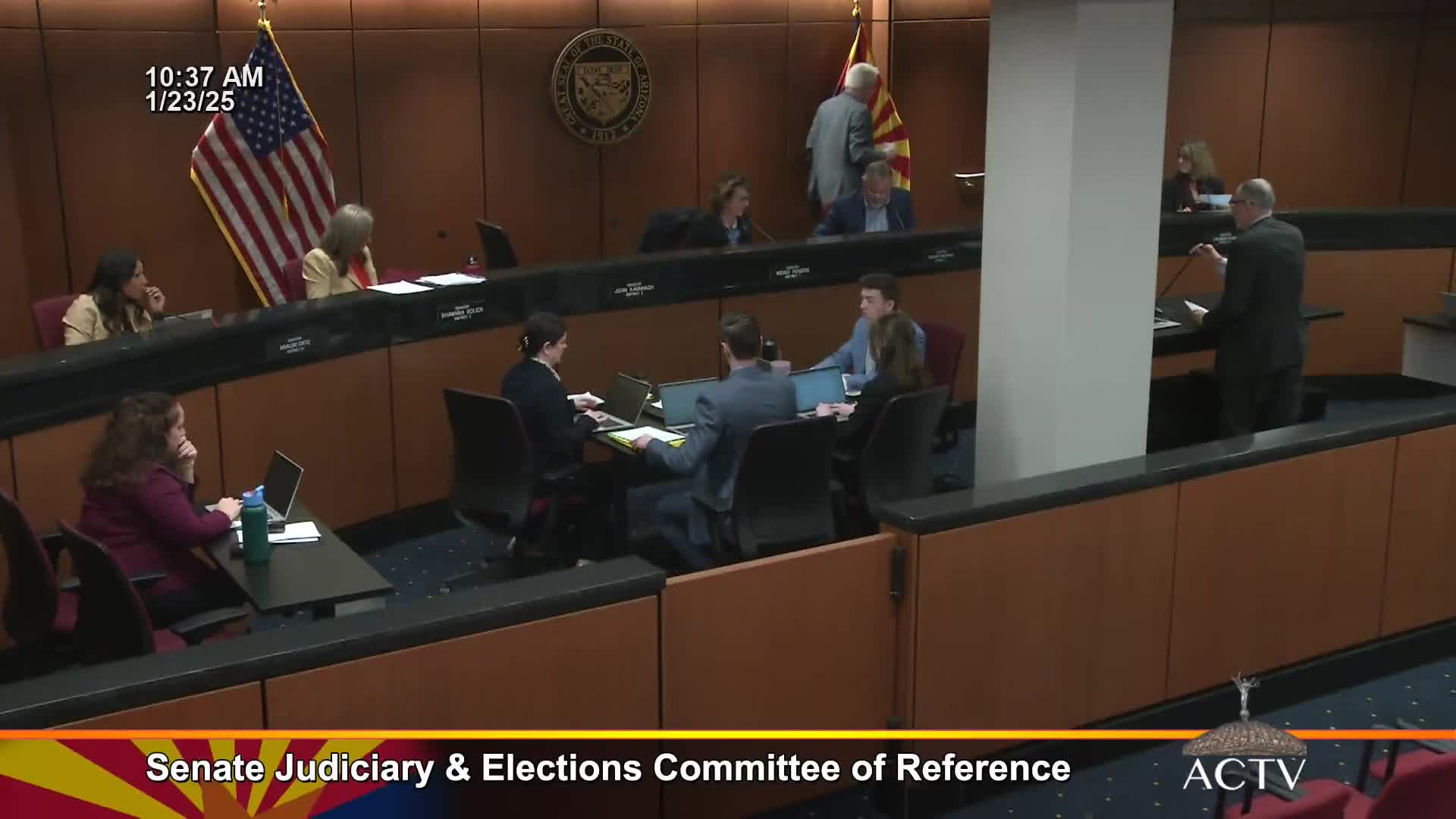
The Arizona Senate Judiciary and Elections Committee voted to recommend that the Arizona Board of Executive Clemency be continued following a sunset review that identified weaknesses in conflict-of-interest disclosures, victim-notification tracking and the timeliness of revocation hearings.
The Arizona Senate Judiciary and Elections Committee voted to recommend that the Arizona Board of Executive Clemency be continued following a sunset review that identified weaknesses in conflict-of-interest disclosures, victim-notification tracking and the timeliness of revocation hearings.
The committee hearing included a presentation of the Office of the Auditor General’s contracted performance audit and sunset review and testimony from the board’s executive director, victims’ advocates and a man whose sentence the board recommended commuting.
The Auditor General’s contractor reported that between fiscal years 2021 and 2023 the board conducted 621 clemency hearings and made 17 commutation recommendations to the governor. The audit identified four principal problems: the board’s conflict-of-interest policy and disclosure form were outdated and not consistently completed; the board did not consistently track whether it sent statutorily required victim notifications; about one-third of revocation hearings were not scheduled within a 60-day timeframe identified in case law; and the board had not adopted a structured decision-making model for parole and revocation decisions.
"We found that the board did not comply with some of the state's conflict of interest requirements," Auditor General presenter George Skiles said during the hearing. The audit said the board had not stored disclosures in a single, publicly accessible file as required by Arizona law and that the board relied on the Arizona Department of Administration for disclosures without ensuring its own policies were current.
Gretchen McClellan Singh, executive director of the board, told the committee the board agreed with the findings and has implemented or begun implementing the audit’s recommendations. Singh corrected one timeline in the audit report, saying a board vacancy began in June 2023 (the audit had said June 2024), and described operational pressures that contribute to scheduling delays.
"We strive to complete [revocation hearings] within 60 days when possible," Singh said, adding that the board cannot begin its scheduling responsibility until it receives a warrant from the Arizona Department of Corrections. She told senators the board had begun tracking return-to-custody dates in addition to the warrant-receipt date, had started receiving warrants electronically in late 2023, and holds monthly meetings with ADCRR warrant staff.
The audit found that from July 2022 through June 2023, 310 of 933 revocation hearings (roughly one-third) were not held within the 60-day period referenced in the cited case law; the 60 days is not a statutory deadline but has been used in court decisions as a reasonableness benchmark. The auditors noted this was a recurring problem: a 2014 audit similarly found that the board missed the 60-day benchmark in more than one-third of cases.
On victim notifications, the audit reported that from January 2023 to March 2024 the board tracked whether victims should be notified for 644 hearings but did not track that information for 50 hearings; for hearing-result notifications the board tracked 592 and did not track 102. The auditors sampled untracked hearings and found notifications had been sent in those sampled cases, but the report said incomplete tracking increases the risk that notifications might be missed and victims could lose statutory participation rights.
Singh told the committee the board now conducts a monthly audit of the victim-notification tracking log and sends a victim satisfaction survey that asks whether victims received 15-day advance notice and notification of results. On conflicts of interest, Singh said the board has implemented annual disclosures, an electronic and physical public file for disclosures, and an annual conflict-of-interest training plan.
Public testimony at the hearing included Adam Petzales, who described having had a 292-year sentence reduced after the board recommended commutation; he said the board "made me feel like a human being and made me feel like a citizen of Arizona." Hope Dealap of the Arizona Justice Project and Donna Hamm of Middle Ground Prison Reform urged the committee to continue the board, citing it as a needed avenue for review when judicial remedies are exhausted and noting the board’s role in victim notification and public hearings.
Senators pressed the board on the causes of delays. Senator Finchem asked whether timeliness was a personnel-driven process or handled with software; Singh said the process remains person-driven but that electronic warrant receipt and improved communications have reduced some delays. Singh said the board has requested additional staff and a second hearing room in a fiscal year 2026 budget request to allow simultaneous panels and free calendar space for revocation hearings.
Vice Chair Kavanaugh moved that the committee recommend continuation. The motion carried; the record shows the committee voice vote resulted in approval (the committee chair announced "the motion carries").
The auditor's office made nine recommendations; Singh told the committee the board agreed to all nine and that the auditor general’s office will conduct an initial follow-up in the coming months. The committee’s recommendation to continue the board leaves open legislative follow-up and any statutory changes the committee of reference might later propose.
The hearing record shows the board’s operational constraints — limited staff, dependence on ADCRR warrants, and substantial record review for commutation and parole packets — as factors the board cited in explaining timing issues. The board reported conducting an average of about eight parole hearings and eight commutation hearings per week, and up to 40 community supervision revocation hearings per week, with commutation packets sometimes exceeding 200 pages and parole packets about 100 pages.
Next steps recorded at the hearing: the board agreed to implement the audit recommendations and the Auditor General’s office will follow up; the committee’s continuation recommendation will be transmitted as part of the sunset process.