Get Full Government Meeting Transcripts, Videos, & Alerts Forever!
Get email alerts on the Pfas Testing topic
No spam. Unsubscribe anytime.
DNR lab-cert program to adopt EPA Method 1633a for most PFAS testing outside drinking water
Summary
At the Jan. 23 Remediation and Redevelopment External Advisory Group meeting, DNR lab-cert staff said the department is moving to EPA Method 1633a for PFAS analysis in non-drinking-water media, expanding reported compounds and tightening quality controls; labs and data systems will need updates.
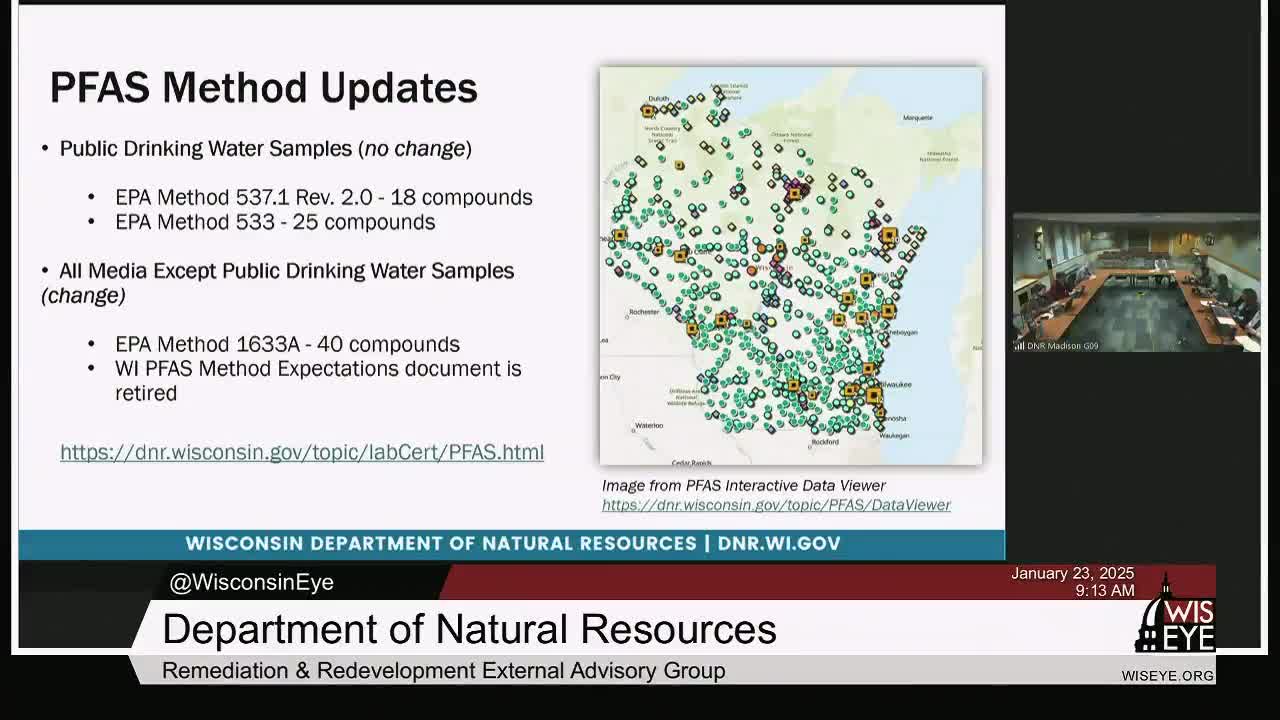
Tom Trainer, laboratory certification program, Department of Natural Resources, told the Remediation and Redevelopment External Advisory Group on Jan. 23 that the DNR is moving to EPA Method 1633a for PFAS testing in media other than public drinking water.
Trainer said EPA 537.1 and EPA 533 remain the approved methods for public drinking water; the 1633a method covers about 40 PFAS compounds and will expand the set laboratories report from the roughly 33 compounds previously used under Wisconsin guidance. He said seven compounds are newly reported under 1633a and that many laboratories have already started reporting to the new method or will do so “starting in February” if they have not already.
The change matters because it increases the number of analytes and standardizes laboratory procedures and quality-control (QC) limits across labs, Trainer said. He told attendees DNR and partner data systems must be updated to accept and display all 40 compound codes and that reviewers should use the EPA 1633a compound acronyms to avoid confusion.
Trainer reviewed sample-handling and reporting details in the new method: composite sampling is discouraged; laboratories should receive water samples within 48 hours of collection per the method; projects should plan for three bottles per water sample (analysis bottle, QC/backup, and an additional bottle if needed); if total suspended solids (TSS) exceeds 10% the method allows treating and reporting the sample as a solid (reported in ng/kg); and the method includes tighter QC limits that may produce more qualified (flagged) data. He also said equipment blanks, field blanks and field duplicates are not required by 1633a but may be used if project plans require them. He emphasized that subsampling from a bottle requires client notification and client agreement and that any subsampling must be qualified in the data.
During Q&A, Kurt McLaughlin of End Point Solutions asked why the method treats samples with more than 10% TSS as solids. Trainer replied that PFAS commonly sorb to solid particles and that the method’s 10% threshold is the EPA’s decision based on multi-lab validation data; further rationale would require contacting the EPA method authors. Heidi Wolfell of GZA GeoEnvironmental asked that the lab-cert link be posted in the chat; Trainer said he would add the link and invited follow-up questions by email at tom.trainer@wisconsin.gov.
The DNR presenter also noted that the lab-cert PFAS application page includes a July 2024 update with technical details and that the department is available to help labs and data managers with implementation.