Get Full Government Meeting Transcripts, Videos, & Alerts Forever!
Get email alerts on the K12 Education Reform topic
No spam. Unsubscribe anytime.
Arizona superintendent emphasizes school safety, teacher retention and AI tutoring in broad K-12 agenda
Summary
Superintendent of Public Instruction Tom Horn outlined 15 initiatives focused on school safety, teacher recruitment and retention, reading proficiency, career technical education and expanded use of AI tutoring during a Senate Education Committee presentation.
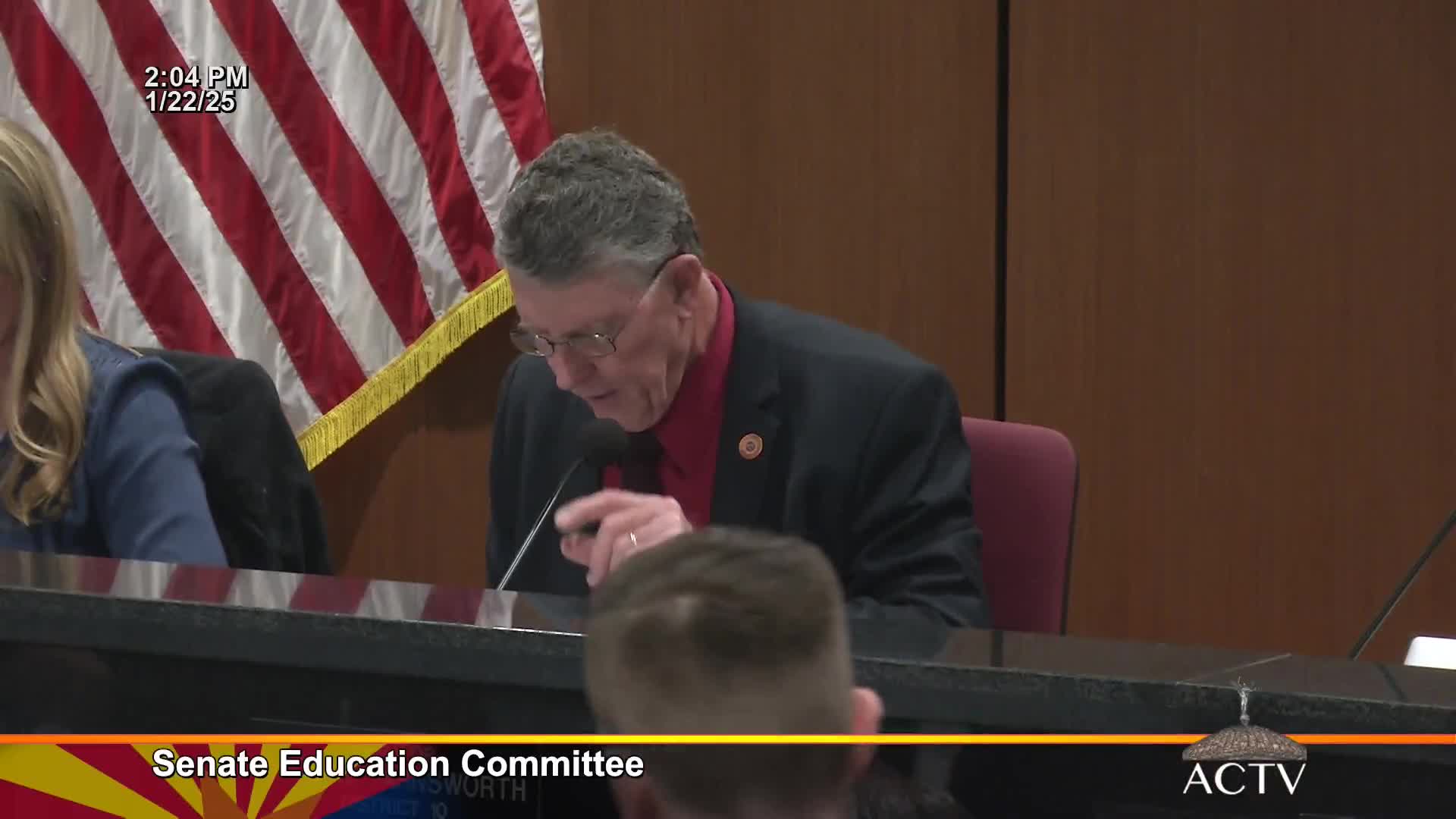
Tom Horn, Arizona Superintendent of Public Instruction, told the Senate Education Committee that his office is pursuing 15 initiatives aimed at raising academic outcomes, expanding school safety and supporting teachers.
Horn opened his presentation by recounting a recent incident in Tucson in which a newly placed school resource officer (SRO) intervened after a person entered a classroom with a knife and a firearm; Horn said the SRO arrested the individual and likely prevented ‘‘the nightmare I have often talked about.’’ He urged the committee to support expansion of SROs funded through the Department of Education’s program and to give consideration to a bill in the Senate sponsored by Sen. Kavanaugh that would set a minimum performance requirement tied to statewide assessment results for graduation.
Horn described his department’s mission as ‘‘a service organization dedicated to raising academic results and empowering parents’’ and summarized a set of initiatives that he said drive that mission. He listed teacher recruitment and retention programs, leadership training for principals, targeted coaching in low-performing schools, expanded career and technical education (CTE), county consortia for rural professional development, a $40 million federally funded tutoring program, reductions in administrative reporting and a digital education library. Horn said the department has trained about 2,900 principals and leaders and that its improvement teams helped move 70% of bottom‑5% schools out of that category after two years of work.
Horn also highlighted safety and mental‑health supports: he said the number of schools with a police presence rose from about 190 to 565 since he took office and that state funds intended for SROs are allocated to counselors and social workers in some cases. When senators pressed for cost and contracting details for school safety officers and third‑party companies that manage off‑duty officers, Horn said he did not have an exact dollar figure in hand but offered to provide it to the committee on request.
On instruction and standards, Horn pressed for renewed graduation standards tied to academic competency. He urged reinstating a requirement that students demonstrate competency (for example, by meeting an ACT cutoff or earning an industry credential) before graduating, and he said Sen. Kavanaugh will sponsor related legislation. Horn recalled the AIMS-era exit requirement and argued that the absence of a comparable statewide competency test has allowed students to graduate ‘‘who have not learned anything,’’ a concern he said employers have reported to him.
Horn spoke at length about English‑learner instruction, saying the department enforces the voter‑approved 2000 initiative that requires structured English immersion and reported historical gains after teacher training was implemented. He told the committee the department had raised English proficiency rates from single digits to higher rates at one point by combining immersion policy with teacher training.
On technology, Horn described a contract the department has with an adaptive tutoring product (identified in testimony as Conmigo, provided through a partnership with Khan Academy) to offer individualized, AI‑driven tutoring. He said the department paid $1.5 million to cover the first 100,000 students and that after the initial cohort the product would cost roughly $25 per student per year; Horn characterized the tool as a supplement that ‘‘gives every student a tutor’’ and said it is intended to direct students back to areas they did not master.
Horn closed by describing parent‑facing measures, including a hotline and continued support for Empowerment Scholarship Accounts (ESAs), and said he would return to testify on Sen. Kavanaugh’s bill. Committee members asked multiple substantive questions about the SRO program, the ACT as a graduation measure, and teacher shortages and closures in districts; Horn answered or offered to supply follow‑up details.
The presentation was followed by a separate overview from the Arizona State Board of Education executive director Sean Ross (noted separately in committee minutes).