Get Full Government Meeting Transcripts, Videos, & Alerts Forever!
Get email alerts on the Elections Vote Centers topic
No spam. Unsubscribe anytime.
Arizona committee advances bill to limit vote centers, return to precinct caps after hours of debate
Summary
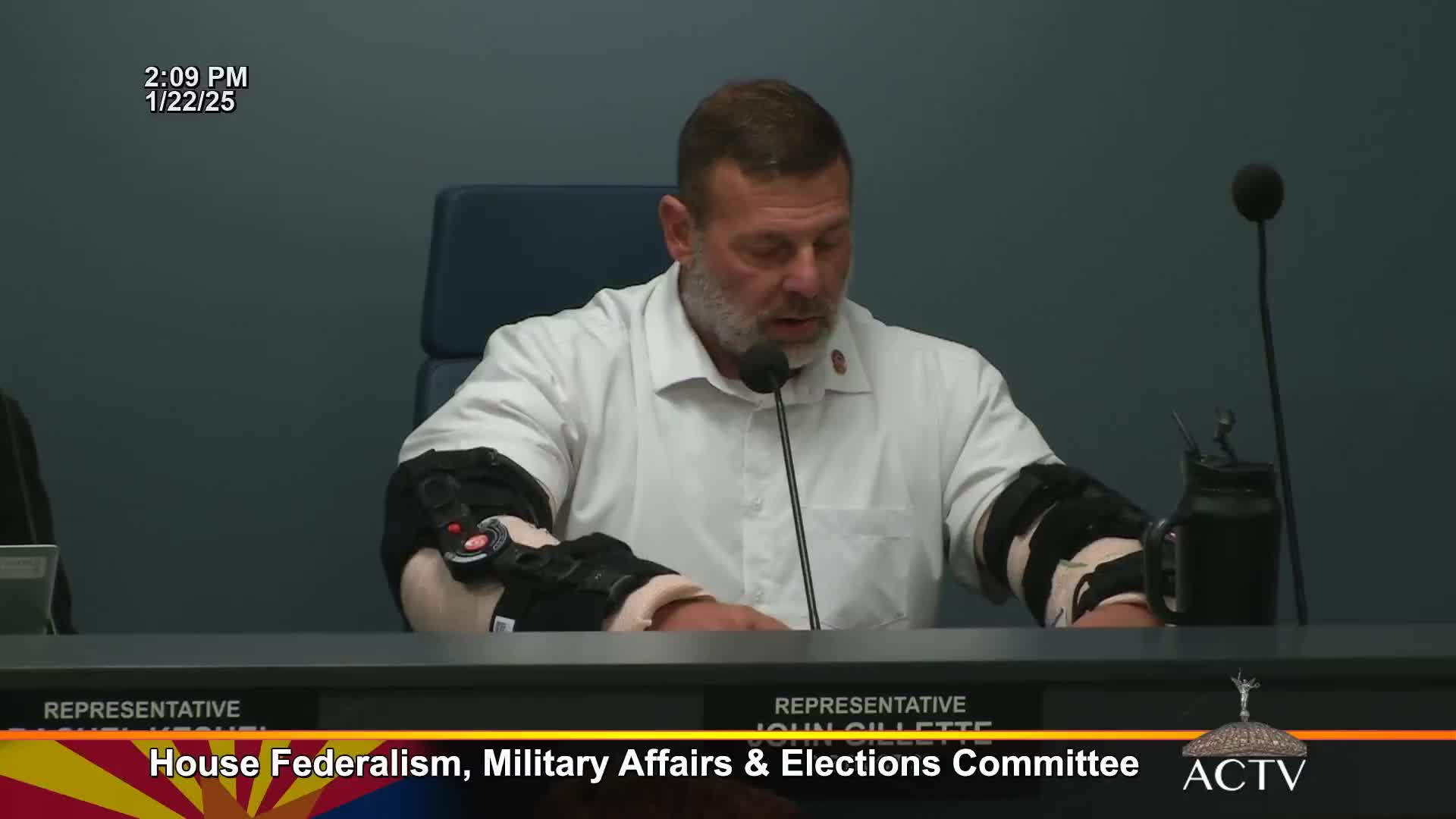
The House Federalism, Military Affairs and Elections Committee voted 4-3 to give House Bill 2017 (and identical HCR 2002) a due-pass recommendation after extended testimony from county officials, civil-rights and voting-access advocates and the Maricopa County recorder.
The House Committee on Federalism, Military Affairs and Elections on Jan. 19 voted 4-3 to give House Bill 2017 a due-pass recommendation. The bill, which is identical to House Concurrent Resolution 2002, would prohibit county boards from authorizing vote centers, cap election precincts at a maximum of 1,000 registered voters and remove a provision that allowed county recorders to establish on-site early-voting locations.
Supporters said the measure restores a neighborhood-based precinct system that they contend increases voter confidence and reduces problems created by vote centers. "I do not believe that this disenfranchises voters. I believe the voting centers do that more, actually," sponsor Representative Rachel Kessel said, urging committee approval and noting she ran similar measures in prior sessions.
Opponents — including county election officials, voting-rights groups, and environmental and student organizations — said the bill would make in-person voting harder for many Arizonans, increase lines and provisional ballots, create staffing and facility shortfalls and disproportionately affect students, rural and working voters. Jen Morrison of the Arizona Association of Counties said counties adopted vote centers because they "didn't have enough places to be polling places in a traditional sense," and warned the bill does not provide a practical contingency if precinct locations cannot be found. Caitlin Contreras of the ACLU of Arizona said early-voting methods are widely used: "2,854,548 early ballots were returned during the early voting period in the 2024 Arizona general election. That's 85% of all 2024 votes cast in Arizona," she said.
Maricopa County Recorder Justin Heap, speaking for himself, said Maricopa used a precinct system until 2018 and argued precinct-based voting could speed on-site processing and restore voter confidence. "This is how Maricopa County voted until 2018," Heap said, describing operational problems county officials believe were introduced or amplified under the vote-center model, including printer failures during the 2022 cycle that contributed to long lines.
Committee members pressed county witnesses on logistics: how many buildings would be available, staffing levels required for precinct sites, how hybrid systems operate and whether the bill would unintentionally eliminate in-person early voting. Jen Morrison and others told the committee that many counties use hybrid models and that converting entirely back to precinct-based systems would require more polling places and poll workers than some counties can reliably secure.
After extended questions and public testimony, the committee voted. Roll-call votes recorded during the meeting showed Representatives Alexander Collin, Kyle Powell, Rachel Kessel and Chairman John Gillette voting aye; Representatives Brian Garcia, Aaron Marquez and Hernandez voting nay. The committee clerk announced the result as 4 ayes, 3 nays, 0 absent, giving HB 2017 and identical HCR 2002 a due-pass recommendation.
The measures now move to the House floor. If enacted, the concurrent resolution would appear on the ballot for voters as described by the sponsor.