Get Full Government Meeting Transcripts, Videos, & Alerts Forever!
Get email alerts on the Technology Economy topic
No spam. Unsubscribe anytime.
Arizona lawmakers hear industry leaders on semiconductor boom, workforce gaps and infrastructure needs
Summary
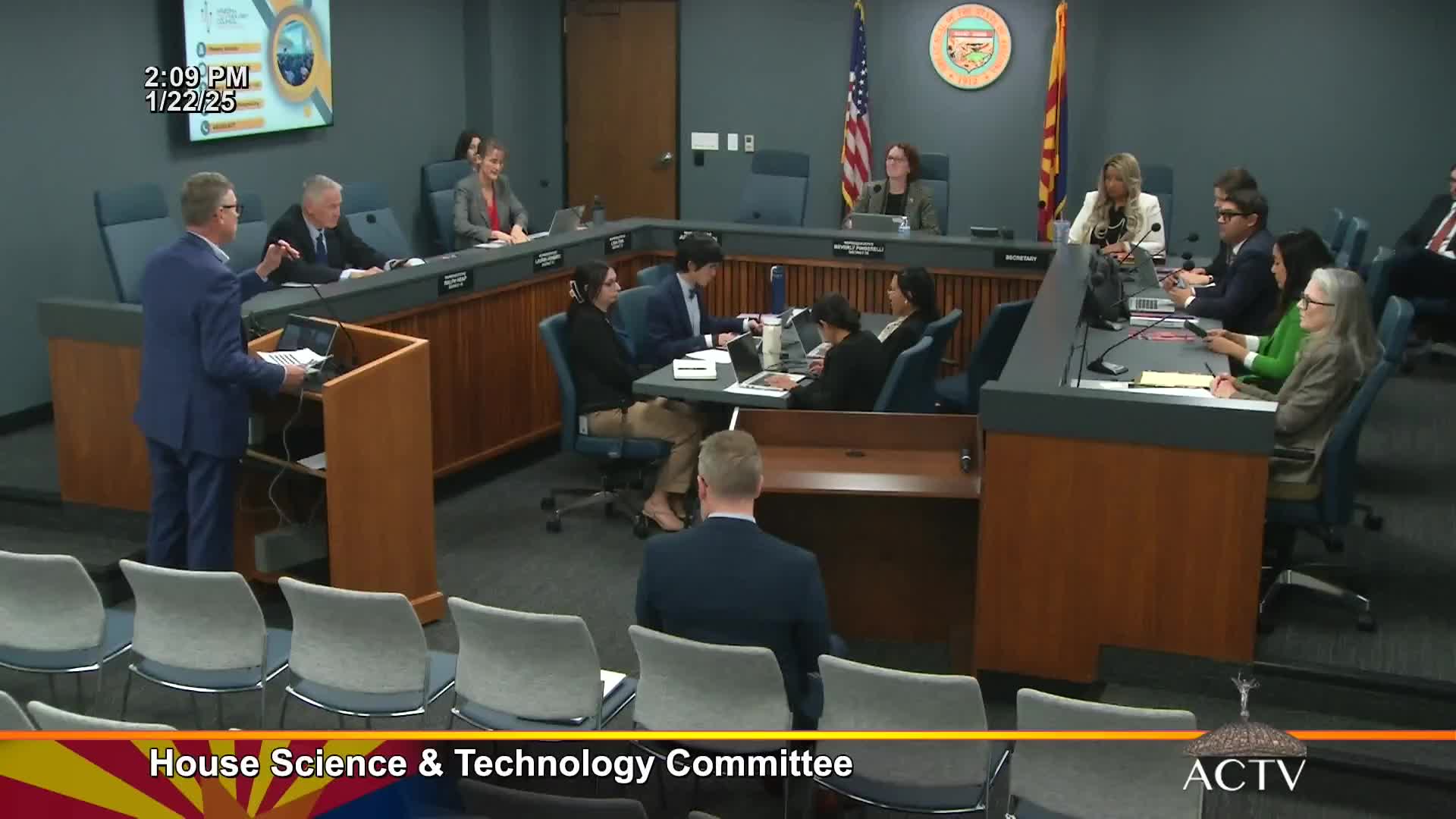
Chairwoman Beverly Pinkarelli convened the Arizona House Committee on Science and Technology and heard two presentations Tuesday from industry groups about the state’s expanding technology economy and remaining gaps in workforce and infrastructure.
Chairwoman Beverly Pinkarelli convened the Arizona House Committee on Science and Technology and heard two presentations Tuesday from industry groups about the state’s expanding technology economy and remaining gaps in workforce and infrastructure.
The Arizona Technology Council’s president and CEO, Steven Zylstra, told the committee Arizona is experiencing an unprecedented boom in advanced manufacturing and technology, driven in part by semiconductor and battery investments. "Talent is the number 1 issue facing the industry," Zylstra said, noting workforce shortages in areas from cybersecurity to manufacturing. He also urged lawmakers to support computer science access in K–12 schools and to restore funding for the state’s job training program.
Zylstra said the council provided the committee with its 2025 public policy guide and outlined policy tools he credited with helping attract investment, including a refundable research-and-development tax credit, angel investor tax credits and a reduction in the corporate tax rate adopted in 2011. He said the state has recorded more than 40 semiconductor expansion announcements totaling about $105 billion in investment and more than 16,000 new jobs, and that Arizona now ranks among the top states for semiconductor activity.
Tim Morrissette and Mark Perattore of the Greater Phoenix Economic Council told the committee that Greater Phoenix has become a national hub for advanced manufacturing, semiconductors and clean-energy projects and that the region’s competitiveness depends on a combination of talent pipeline, infrastructure and "speed to market." Perattore said GPEC is tracking roughly 240 active prospects at any given time and that venture capital activity in Greater Phoenix rose in recent periods, with more early-stage investment flowing into local startups.
Committee members pressed presenters on infrastructure and sustainability risks. Representative Ralph Heap asked about energy needs for new facilities; Zylstra said utilities have plans to expand capacity and that a mix of generation, storage and possibly small modular nuclear capacity will be required. He described energy storage at new battery factories as a strategy to make intermittent solar and wind generation more consistent. Representatives also asked about water use at advanced manufacturing sites; Zylstra said some firms are approaching "net zero" water use by recycling and reuse practices.
On education and the talent pipeline, Zylstra said only about 42% of Arizona high schools offer computer science and that the Tech Council’s priority is to make computer science accessible statewide rather than impose an unfunded graduation mandate. He said Scitech Institute programs operate in hundreds of K–12 districts and that the Council runs a Chief Science Officers program now active in 137 school districts with about 330 student officers.
Committee members and presenters discussed apprenticeship and internship strategies to address the "experience" barrier for new graduates seeking cybersecurity and engineering jobs. Zylstra noted that many employers seek three to five years’ experience and that apprenticeship programs created by companies such as Intel and TSMC are part of the solution. GPEC described a successful Central Arizona College training partnership that prepared thousands of workers for Lucid’s automotive assembly in Casa Grande.
The committee did not take policy action on the testimony beyond adopting its rules at the start of the meeting. Representative Lisa Fink moved to adopt the committee rules; the motion carried on a voice vote and the chair ordered the rules filed with the chief clerk in accordance with House Rule 9(c).
The presentations provided committee members with data and industry priorities as the legislature begins work on workforce funding, site selection incentives and infrastructure policy—particularly energy and water—needed to support large-scale semiconductor, battery and bioscience investments.
Votes at a glance Committee on Science and Technology, motion to adopt committee rules as printed and distributed: Mover — Representative Lisa Fink; second — not specified in the transcript; voice vote — ayes prevailed; outcome — adopted. Note: rules filed with the chief clerk in accordance with House Rule 9(c).