Get Full Government Meeting Transcripts, Videos, & Alerts Forever!
Get email alerts on the Committee Bill Roundup topic
No spam. Unsubscribe anytime.
Government Committee advances package: notary reforms, municipal planning option, guardianship path for unaccompanied youth and contested sex‑based terms bill
Summary
The Arizona House Government Committee returned multiple bills to the full House on Tuesday, advancing measures on notary reforms, local planning, juvenile guardianship for homeless youth and a contested clarifying measure on sex‑based legal terms.
The Arizona House Government Committee advanced multiple bills Tuesday, returning a set of measures to the full House with due‑pass recommendations. Committee members debated measures ranging from notary reforms to changes in how the state defines sex‑based terms.
Key outcomes at a glance
- HB2008 (Notary public requirements): Returned with a due‑pass recommendation (vote: 7–0). Sponsor: Representative John Gillette. - HB2113 (Flags on public property): Returned with a due‑pass recommendation as amended (vote: 4–3). Sponsor: Representative Nick Kupperer; amendment added county flag allowance. - HB2051 (Monthly questioning period for governor): Returned with a due‑pass recommendation (vote: 4–3). Sponsor: Representative Collin. - HB2023 (Municipal general plan ratification option): Returned with a due‑pass recommendation (vote: 7–0). Sponsor: Representative Selena Bliss. - HB2065 (County medical examiner/autopsy and crematory clarification): Returned with a due‑pass recommendation (vote: 6–1). Sponsor: Representative Matt Gress. - HB2079 (Guardianship pathway for unaccompanied minors near age 18): Returned with a due‑pass recommendation as amended (vote: 7–0). Sponsor: Representative Ben Blackman. - HB2062 (Arizona Sex‑Based Terms Act): Returned with a due‑pass recommendation as amended (vote: 4–3). Sponsor: Representative Lisa Fink.
Why it matters: The bills touch on property‑fraud prevention, local planning options for small municipalities, procedural changes for medical examiners and cremations, a new guardianship path advocated by homeless‑youth advocates, and a high‑profile measure to clarify the legal meaning of sex‑based terms in state law.
Selected details and testimony
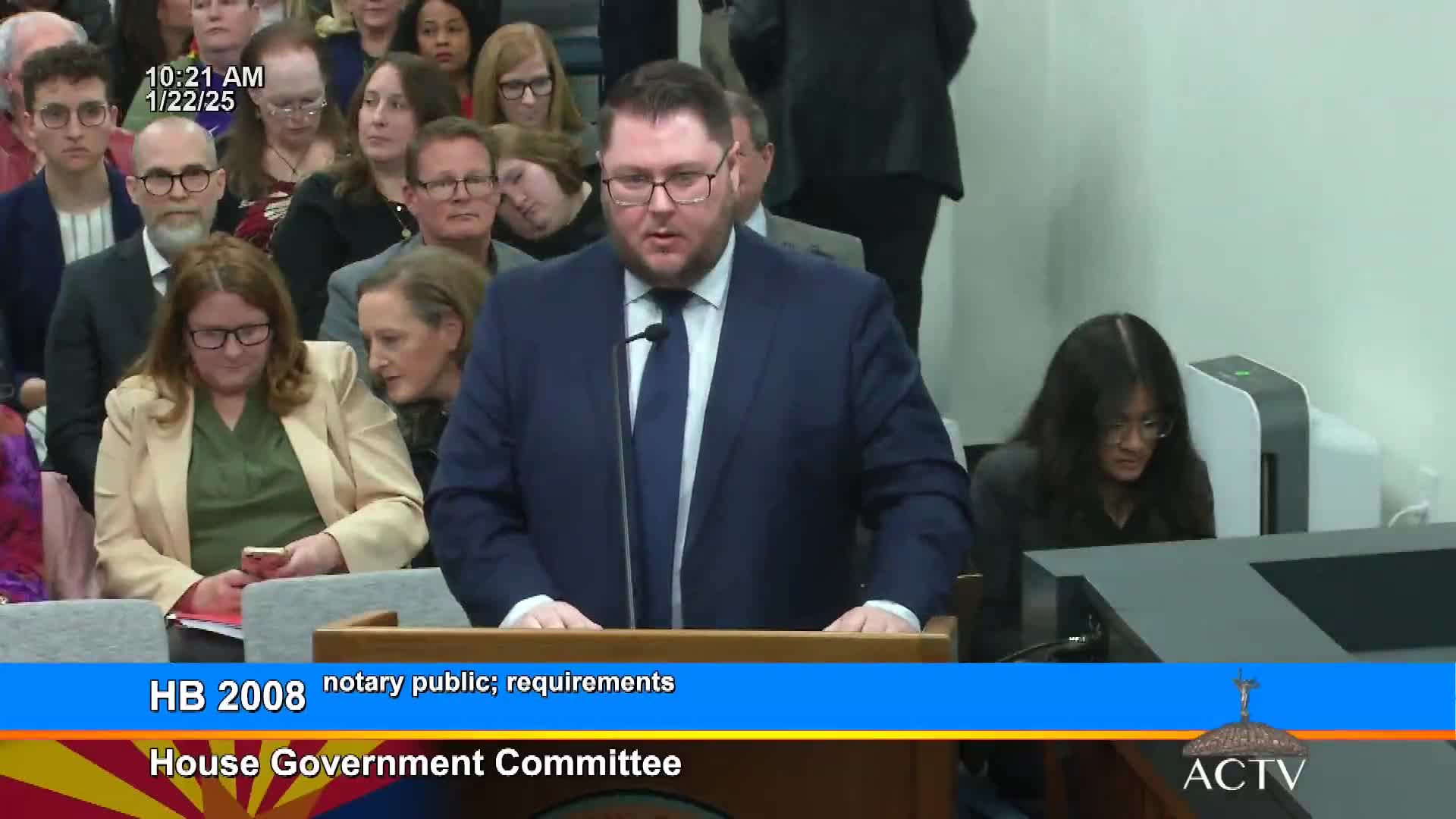
HB2008 — Notary reforms (due‑pass 7–0) Representative John Gillette, the bill sponsor, said the measure targets deed‑fraud schemes that have allowed criminals to take ownership of homeowners' property using falsified notarized documents. "This notary bill, this is 1 leg of an attempt to clean up what's called deep fraud or house theft," Gillette told the committee. Supporters included George Diaz from the Secretary of State's Office and representatives of the National Notary Association and the Arizona Association of Realtors, who emphasized fingerprint clearance cards and improved ID verification as fraud‑prevention steps.
HB2113 — Flags on public property (due‑pass 4–3) Representative Nick Kupperer said the bill would limit flags flown by government officials on public property to official flags such as national, state, Native nation and service flags; his amendment allowed counties to fly an official county flag. Marilyn Rodriguez of the ACLU of Arizona testified in opposition, arguing the measure "violates the First Amendment rights of public employees and elected officials" by broadly restricting expression on public property.
HB2079 — Guardianship pathway for unaccompanied youth (due‑pass 7–0) The committee returned a measure intended to create a guardianship pathway for 16‑ and 17‑year‑olds who are unaccompanied and near graduation age so they can access stable housing and services. Representatives of Homeless Youth Connection described the program's host‑family placements and cited cases of youths who lacked parental consent and were therefore ineligible for housing help. Dana Bailey, co‑CEO of Homeless Youth Connection, said the bill would open a path for teachers, relatives or vetted hosts to provide a stable home while the youth finish high school.
HB2062 — Sex‑based terms act (due‑pass 4–3) Representative Lisa Fink, sponsor of the Arizona Sex‑Based Terms Act, said the bill "clarifies the definitions of words already used in state law" such as "man," "woman," "male" and "female" and ensures that data collected for state purposes reflect biology. Supporters argued the measure protects single‑sex spaces and preserves legal consistency; Representative Paula Scanlon, a former collegiate athlete, described locker‑room concerns for women.
Opponents urged the committee to reject the bill. Ruth Carter, who identified as nonbinary, testified that the measure "discriminates against people like me" and said the bill would erase intersex and nonbinary Arizonans from legal recognition. Dozens of public commenters appeared in favor and opposed; testimony during the HB2062 hearing was strongly contested and at one point the chair asked disruptive attendees to leave.
Other bills
HB2051 would create a monthly questioning period in which the legislature could ask the governor questions during session; proponents said the plan would increase civic engagement and improve communication between branches (committee vote: 4–3). HB2065, carried by Representative Matt Gress, clarifies that licensed physicians can supervise autopsies for training and clarifies county authority to operate crematories; the bill passed committee 6–1 after a technical amendment requiring supervising physicians to be trained in forensic pathology.
Process notes
Most measures were moved by the committee vice chair during committee procedure and advanced to the House with a due‑pass recommendation. Several bills drew unanimous support from the committee (HB2008, HB2023, HB2079); HB2062 and HB2113 were split votes. All measures will next be scheduled for floor consideration by the full House.
What to watch: HB2062 is likely to draw broader floor debate because it deals with contested definitions used across statute, and HB2008 may prompt the Secretary of State and county recorders to coordinate implementation details for ID verification and fingerprint requirements.