Get AI Briefings, Transcripts & Alerts on Local & National Government Meetings — Forever.
Committee advances bill allowing one‑time extension of reentry transition services for eligible inmates
Loading...
Summary
House Bill 2024 would permit a one‑time extension of up to 90 days for transitional services for eligible incarcerated individuals; the Arizona House Judiciary Committee gave the bill a due‑pass recommendation after neutral testimony from the Department of Corrections and support from transition‑service providers.
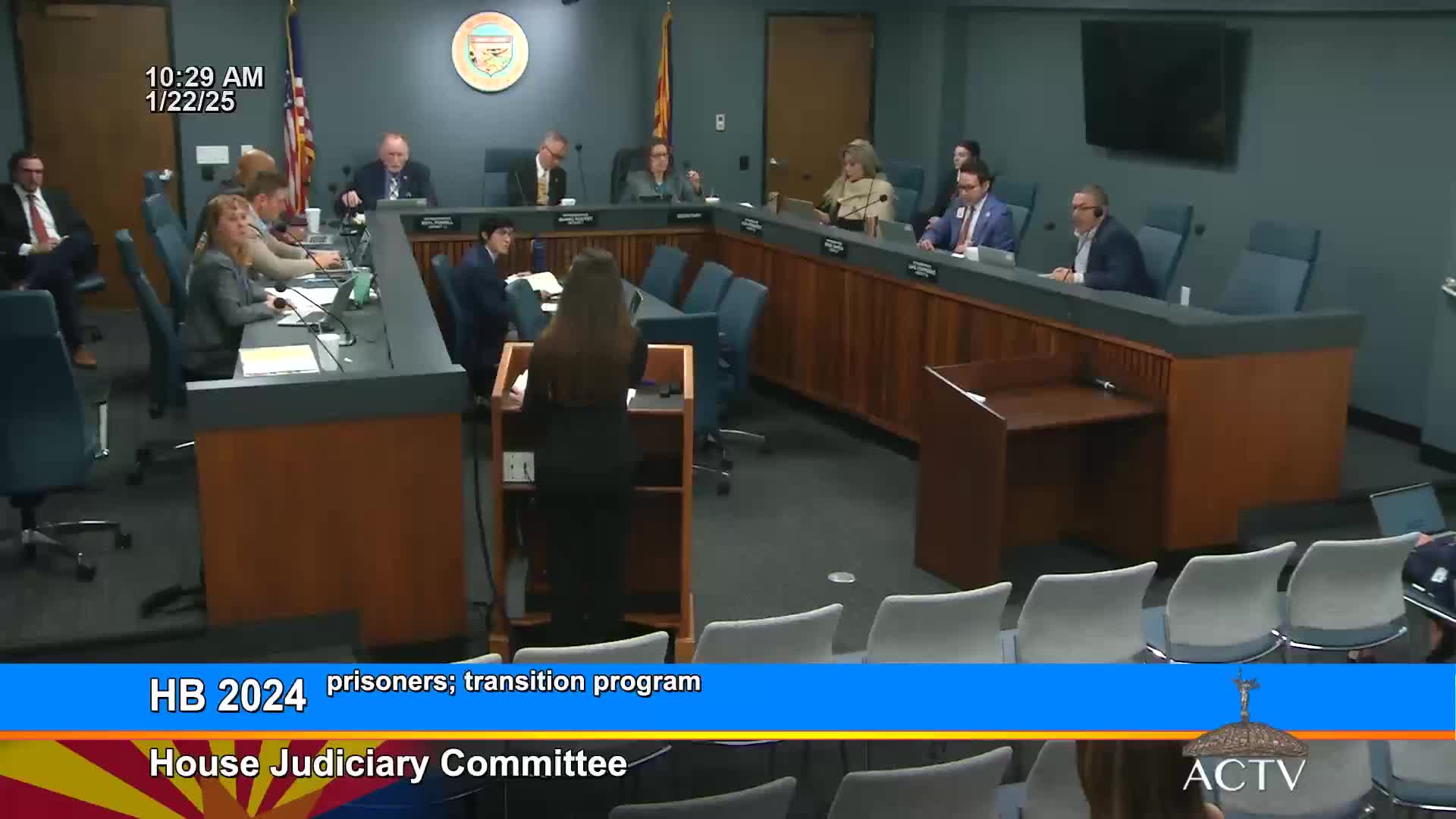
The Arizona House Judiciary Committee returned House Bill 2024 with a due-pass recommendation after brief testimony from the Arizona Department of Corrections and service providers about extending transition services for eligible inmates.
Representative Selena Bliss, sponsor of the bill who has run similar measures in prior sessions, said HB 2024 would allow inmates who meet eligibility requirements to receive a one-time extension of transition services — up to 90 additional days — to participate in reentry programs such as behavioral health treatment or substance-use disorder treatment as they prepare to leave custody.
Brianna Farmer, the chief legislative liaison for the Arizona Department of Corrections, Rehabilitation and Reentry, told the committee the department was neutral on the bill and thanked the sponsor for attention to the transition program. A provider, Jeff Taylor of SAGE Counseling, which operates reentry services, said the proposal responds to individuals who may need more time for housing, employment, or treatment and that the one-time extension could be shorter if a participant reaches stability sooner.
Supporters argued the extension would reduce recidivism by allowing participants additional time in structured programs when their needs are higher. Committee members asked about the potential for a backlog in placement slots; one member urged working with community providers to avoid limiting access. The department said it understood the concern and described the bill as addressing individual needs within the existing transition program.
The committee voted 8‑0 with one member absent to return HB 2024 with a due-pass recommendation.
Why it matters: Transition programs are tied to recidivism reduction; supporters said a modest, one‑time extension would let high‑needs participants complete stabilization steps without reentering the community prematurely. The department’s neutral stance leaves operational questions for later implementation discussions.