Get Full Government Meeting Transcripts, Videos, & Alerts Forever!
Get email alerts on the Criminal Justice topic
No spam. Unsubscribe anytime.
Arizona committee narrows harassment statute to require intent, adds public-officials criticism defense
Summary
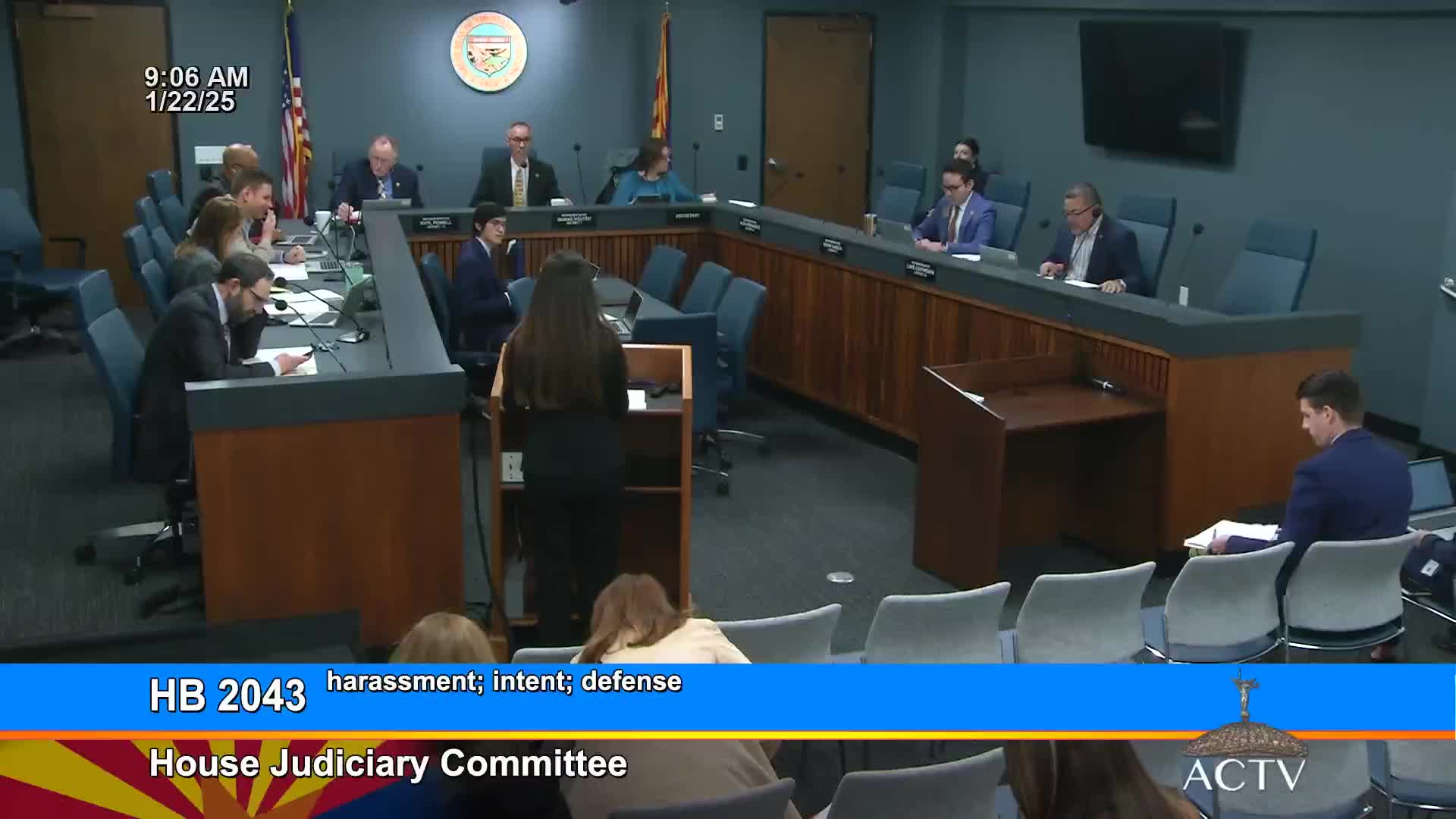
The Arizona House Judiciary Committee voted 7-2 to give House Bill 2043 a “due pass” recommendation after debate on whether the measure properly narrows a harassment statute and protects political speech directed at public officials.
The Arizona House Committee on Judiciary voted to return House Bill 2043 with a due-pass recommendation after members debated language clarifying the state harassment statute and carving out a defense for criticism of public officials.
House Bill 2043, described to the committee by the research analyst Nathan McCray, would change the statutory standard for harassment from acting “in a manner that harasses” to acting “with intent to harass.” The bill also would create a defense to prosecution when the alleged conduct is criticism directed at a public official, according to McCray.
The bill’s sponsor, Representative Alexander Collinan, told colleagues that adding an intent element would reduce vagueness in the statute and protect constitutionally protected speech. “We can’t have a law that is so broad as to prohibit people from very vociferously protesting,” Collinan said, arguing the change preserves free expression while targeting purposeful harassment.
Speakers in favor included Armando Nava of the Arizona Attorneys for Criminal Justice, who told the committee the bill “removes this vague language which opens so many people up to prosecution” and narrows exposure to prosecution to conduct done with intent. Marilyn Rodriguez of the American Civil Liberties Union also registered support, saying the revised language addressed ACLU concerns (she noted she would update the record if the RTS [request to speak] reflected opposition).
Opponents and skeptics urged caution. One committee member who identified concerns about protests at private residences said that demonstrating on a sidewalk outside a legislator’s home felt different than protected political speech and said he would vote no. Representative Collinan replied that residential picketing is addressed by a separate section of state law and that the bill was intended to avoid criminalizing ordinary political expression.
The committee adopted the measure on a 7-2 vote and returned HB 2043 with a due-pass recommendation. The bill will advance to the next committee step under that recommendation.
Votes at a glance: HB 2043 — due pass recommendation; tally reported by the chair: yes 7, no 2.
Why it matters: Supporters said the bill reduces criminal-law vagueness and avoids chilling political speech; opponents said the change could narrow tools for responding to conduct they consider harassment, including protests near private residences. The committee’s action keeps the bill moving while leaving some members vowing to press further changes on the floor or in subsequent committee work.