Get Full Government Meeting Transcripts, Videos, & Alerts Forever!
Get email alerts on the Teacher Pipeline And Funding topic
No spam. Unsubscribe anytime.
Lawmakers hear college reports on Arizona Teachers Academy; committee advances bill to let private universities receive ATA funds
Summary
Brad Kendricks of the Arizona Board of Regents and representatives from public and private teacher-preparation programs told the House Education Committee about enrollment, pathways and funding for the Arizona Teachers Academy; the committee advanced House Bill 2018 to allow eligible private postsecondary institutions to participate.
Arizona’s teacher pipeline and the Arizona Teachers Academy dominated a long committee segment on Jan. 17, as the Arizona Board of Regents, public institutions and private providers described program enrollment and funding and the committee advanced a bill to let private postsecondary institutions participate.
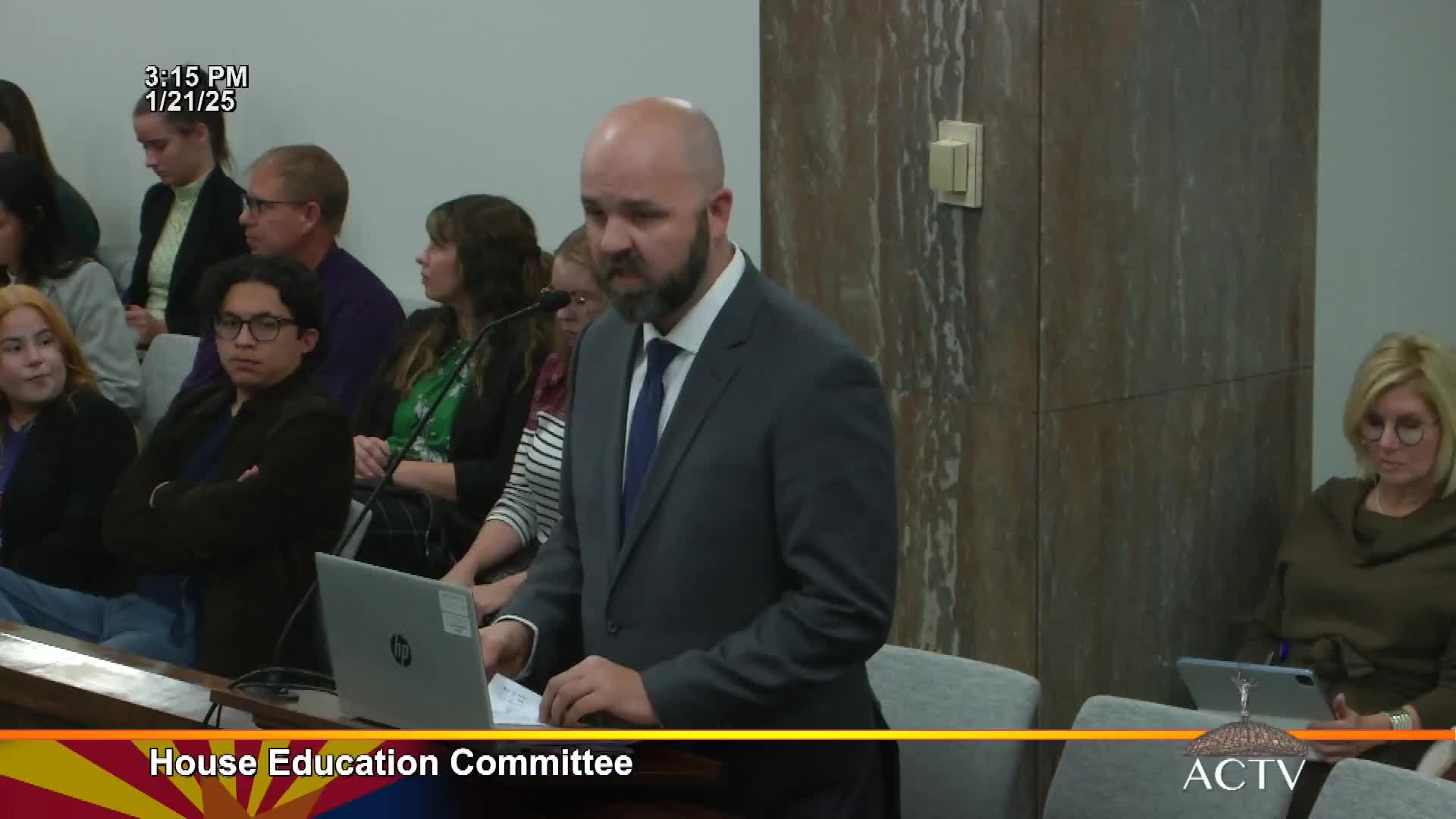
Brad Kendricks, vice president for finance, strategy and governance at the Arizona Board of Regents, told the House Education Committee that the Arizona Teachers Academy (ATA) is a “last-dollar scholarship” program that supports students in teacher-preparation pathways. He said the program enrolled roughly 33,100 students in fiscal year 2024 and that funding fluctuates year to year; ATA funds rolled over if unexpended and were appropriated at $15 million in prior years and temporarily increased to $30 million in FY24 before settling back to about $16 million. “These are last dollar scholarships,” Kendricks said, explaining that universities work with students to layer ATA awards on top of other aid.
Representatives from Maricopa Community Colleges, Pima, NAU, ASU, the University of Arizona and Grand Canyon University described pathways, grow-your-own programs, dual-enrollment support and an emphasis on special-education training in high-need areas. NAU said ATA-supported graduates are disproportionately placed in Title I schools and that about 82% of ATA recipients intended to remain teachers after their service obligation.
Committee members then considered House Bill 2018, which would allow eligible private postsecondary institutions offering post-baccalaureate teacher-preparation programs to receive ATA funds. The bill would cap ATA scholarship reimbursements for private institutions “to the remainder of the average in-state tuition and fees charged by Arizona public universities, minus other gifts and aid awarded to the student,” and it would appropriate $10 million from the state general fund for FY2026 to the ATA fund.
Supporters, including Grand Canyon University’s Dean Meredith Critchfield, said private institutions already supply a large share of Arizona teachers; GCU’s presentation noted a high retention rate of alumni in Arizona public schools. “GCU graduates are more confident in their first year,” Critchfield told the committee during public comment, relaying favorable district feedback.
Opponents, including the Arizona Students Association’s Shana Stevens, urged lawmakers to prioritize existing public-university wait lists before extending ATA funds to private universities. Stevens said public funds should first be directed to public institutions, noting public universities reported wait lists for ATA funding and arguing the state should fill those lists first.
The committee adopted amendments and returned HB2018 with a due-pass recommendation. The bill’s sponsor told the committee the $10 million appropriation would be sufficient to address current public-university wait lists while opening the program to private colleges; the bill requires private institutions that participate to cover any difference above the capped ATA reimbursement so students are not charged the remainder.
Why it matters: The Arizona Teachers Academy is the state’s primary tool for subsidizing teacher preparation. Expanding eligibility to private institutions would broaden the pipeline but also raises questions about how to allocate limited public funds and whether priority should go to public institutions that report waiting lists.
What’s next: HB2018 was advanced by the committee with a due-pass recommendation and will proceed through the legislative process. Committee members requested additional data on program budgets and projected fiscal impacts to public and private participants.