Get Full Government Meeting Transcripts, Videos, & Alerts Forever!
Get email alerts on the National Guard Deployment topic
No spam. Unsubscribe anytime.
Committee gives do-not-pass to bill that would bar North Dakota Guard from overseas combat
Summary
The House Government and Veterans Affairs Committee recommended a do-not-pass on House Bill 1315, which would restrict the North Dakota National Guard from overseas active-duty combat unless Congress declares war.
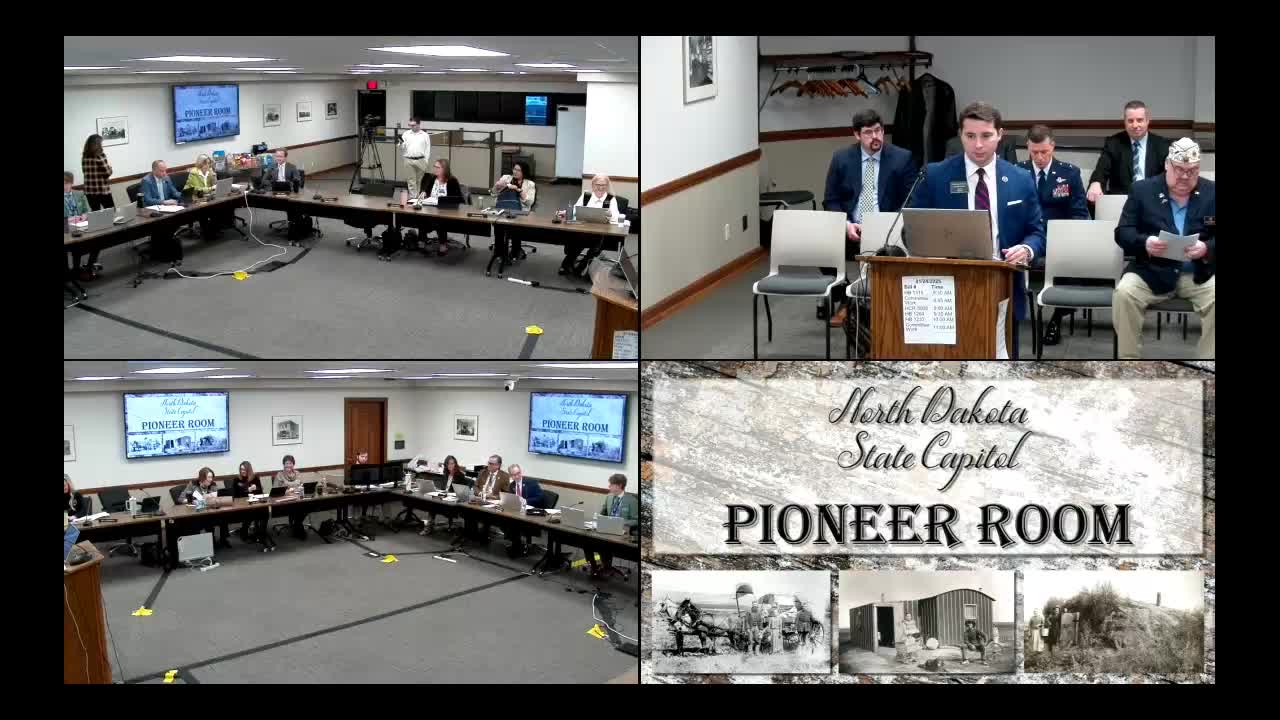
BISMARCK — The House Government and Veterans Affairs Committee recommended a do-not-pass on House Bill 1315 on a 11-2 roll call after a daylong hearing that drew veterans, Guard leadership and national advocates.
Representative Matt Heilman, a state representative from North Dakota’s 7th Legislative District in Bismarck, testified in favor of the bill. He said the text would prevent the state’s National Guard "from being deployed into active duty combat" unless Congress exercises the authority described in Article I, Section 8 of the U.S. Constitution. Heilman framed the proposal as a return to constitutional war-declaring powers and a way to prevent what he called "endless wars," and he told the committee his testimony included a list of National Guard members who have served and died since 2001.
The measure drew opposition from several witnesses who said it would harm readiness, recruiting and federal support. State Representative Jeremy Olson, a former Guard member, asked the committee to reject the bill, saying it would "severely hamper our military's ability to respond to national security threats quickly and effectively." Brigadier General Mitch Johnson, Adjutant General for the North Dakota National Guard, told lawmakers a restriction on overseas combat duty would prompt the Department of Defense to shift resources and missions to other states and would reduce federal funding and recruiting for North Dakota units. Johnson said the Guard’s current missions and force structure produce an "economic impact of $660,000,000 per biennium." He added that roughly 4,100 soldiers and airmen from 200 communities statewide provide state capability during emergencies.
Supporters calling for the change included Dan McKnight, chairman of a veterans group called Bring Our Troops Home, who described the effort as a national movement and urged passage. McKnight invoked examples and political endorsements outside the state and argued the bill would protect Guardsmen from serving in conflicts he said lack explicit congressional authorization.
Officials from the governor’s office also testified in opposition. Al Dorman, representing the governor’s office, told the committee the state’s current position is that there are legal authorities the federal government uses to call Guard units and that restricting access would place North Dakota at risk of losing federal training, equipment and future mission investments.
After deliberation, the committee approved a motion recommending the bill not pass. Vice Chairman Satrim moved the do-not-pass recommendation; Representative Christie seconded. Roll call recorded 11 votes in favor of do-not-pass, 2 opposed. Representative Steiner and Representative Van Winkle voted no; the remaining members voted yes.
The committee’s vote is a recommendation to the House; it does not itself end further floor action. The bill’s authors argued that, as written, the bill would not restrict the governor’s authority to deploy the Guard for state missions such as civil-authority or disaster response. Opponents emphasized the potential loss of federal funds, training and equipment and warned of consequences for recruiting if federal missions and orders moved out of state.
The committee hearing included detailed back-and-forth on training parity between Guard and active-duty units, the legal bases for federal activation, and whether federal funding could be curtailed if a state passed such a restriction. Testimony included both personal accounts of families who lost Guardsmembers in post-2001 conflicts and technical briefing from Guard leadership on mission sets and pay/benefits when Guardsmen serve on federal orders.
The bill will proceed according to the House rules and calendar; the committee recommendation will be part of its bill file.