Get Full Government Meeting Transcripts, Videos, & Alerts Forever!
Get email alerts on the Agriculture Drones topic
No spam. Unsubscribe anytime.
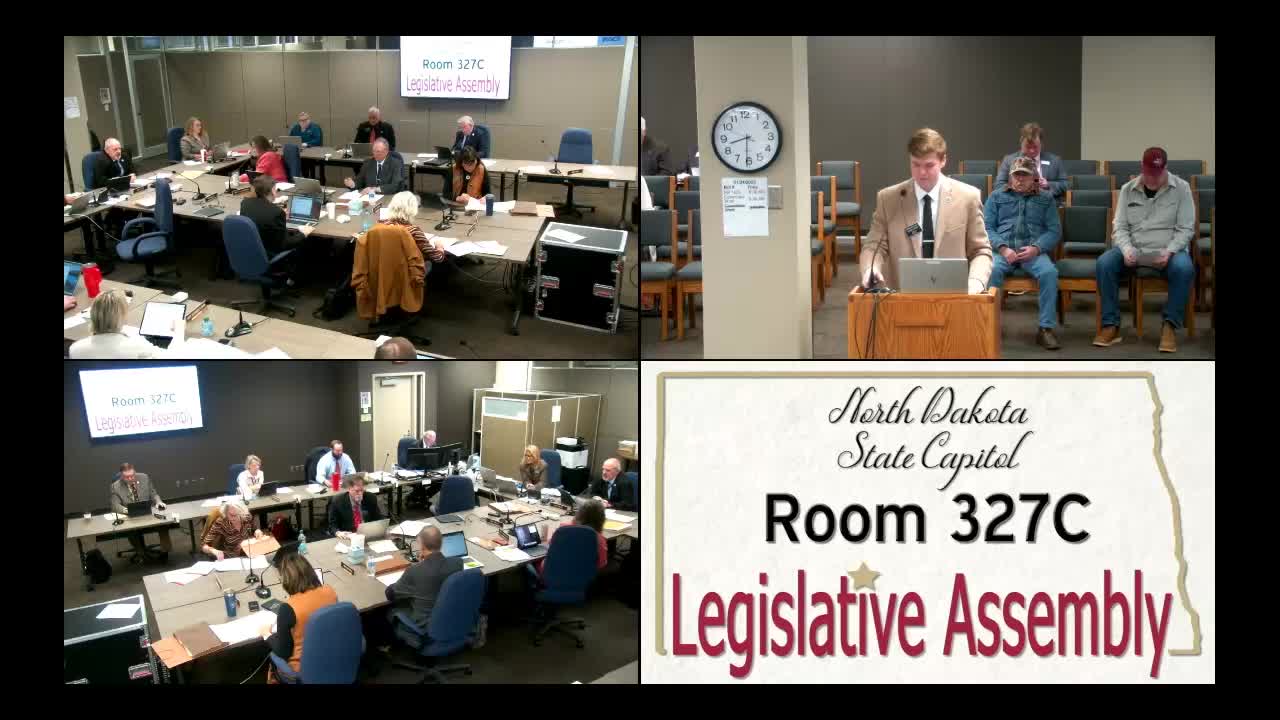
House Ag Committee hears mixed testimony on bill to restrict drones over animal feeding operations
Summary
A House Agriculture Committee hearing on House Bill 1429 drew farmers, industry groups and drone advocates to debate whether state law should restrict drones over animal feeding operations (AFOs). Supporters cited privacy and animal-safety concerns; opponents warned of federal preemption, vagueness and harm to commerce and innovation.
A House Agriculture Committee hearing on House Bill 1429 opened with sponsor Representative Dawson Holly describing incidents and farmer concerns that drove the proposal to restrict drones over animal feeding operations.
The bill, modeled on an Iowa law, would limit unauthorized drone flights over farms and large animal facilities and exempt government entities; Holly said the measure aims to protect private property and animals from intrusive or reckless drone operations.
The bill drew broad testimony from agriculture groups and farmers who said drones have been used by activists to record farm operations and that buzzing or errant aircraft can frighten animals and cause injury. Pete Hanabit of the North Dakota Farm Bureau and Julie Ellingson of the North Dakota Stockmen’s Association said their organizations support protections against unauthorized surveillance and animal harassment. Hanabit told the committee Farm Bureau policy already addresses unauthorized surveillance and that the bill fits that policy. Ellingson said the bill’s concept is to balance property rights, privacy and legitimate agricultural uses.
Opponents included drone operators and industry groups who warned the measure is legally vulnerable, vague and unnecessary. Clint Fleckenstein, a commercial Part 107 operator, said the bill “criminalizes the legal operation of unmanned aerial systems” by effectively regulating airspace and could put ordinary, lawful pilots at risk of prosecution. Frank Mattis, testifying for the North Dakota Unmanned Autonomous Systems (UAS) Council, argued federal law and FAA regulation govern national airspace and that recent federal and court precedent limits state and local regulation of aircraft. Mattis urged the committee to seek balanced alternatives that protect property rights without chilling UAS innovation or conflicting with federal law.
Other opposition speakers raised concerns the bill’s phrasing is vague (terms such as “secure farmstead,” “reasonable commercial or agricultural purpose,” and how long an aircraft “remains” over a homestead are not defined) and that enforcement authority and penalties are unclear. Several members of the committee pressed sponsor Dawson Holly on whether FAA rules preempt state law; Holly said legislative counsel advised the bill focuses on trespass and private-property intrusions rather than aerospace regulation, but acknowledged preemption is a “gray area” and the FAA could push back.
Committee members asked multiple practical questions: how many feet of airspace a landowner “owns” (several witnesses said federal law treats the airspace as sovereign and that property rights above the ground are limited), whether law enforcement and first responders are exempt (Holly said legislative counsel included exemptions for the state and political subdivisions), and whether existing criminal statutes already prohibit the conduct the bill targets (opponents said surreptitious intrusion and animal-harassment statutes may already cover much of the behavior).
Representative Holly said the bill targets hobbyist operators who fly for malicious motives and that the measure is not intended to stop legitimate commercial agricultural uses, emergency operations or first responders. Several testifiers suggested alternatives: clarify definitions, add narrowly drawn exemptions for research, education and volunteer search-and-rescue, or amend existing state statutes (titles 36 and 39 of the North Dakota Century Code) to explicitly cover electronic surveillance and harassment rather than regulating UAS directly.
Chairman Belts closed the hearing after public testimony and accepted the sponsor’s request for time to work on amendments; the committee did not take a final vote on House Bill 1429 at this hearing.
Why it matters: the bill sits at the intersection of property rights, animal welfare and rapidly changing drone technology. Committee members and stakeholders repeatedly noted the legal tension between state property-protection measures and federal control of the national airspace, and several witnesses warned that poorly drafted state regulation could prompt costly legal challenges and undermine economic development tied to UAS testing and industry activity.
Representative Holly said he will bring amendments for committee consideration before the bill returns for further action.