Get Full Government Meeting Transcripts, Videos, & Alerts Forever!
Get email alerts on the Dental Access topic
No spam. Unsubscribe anytime.
Lawmakers hear low performance on children's dental access; rebasing not in governor’s budget
Summary
Committee heard that North Dakota’s Medicaid dental rates were last rebased in 2009 and that the state ranks low on child dental access despite mid‑regional reimbursement; two bills were identified that would study dental access and add select dental coverage for Medicaid expansion members.
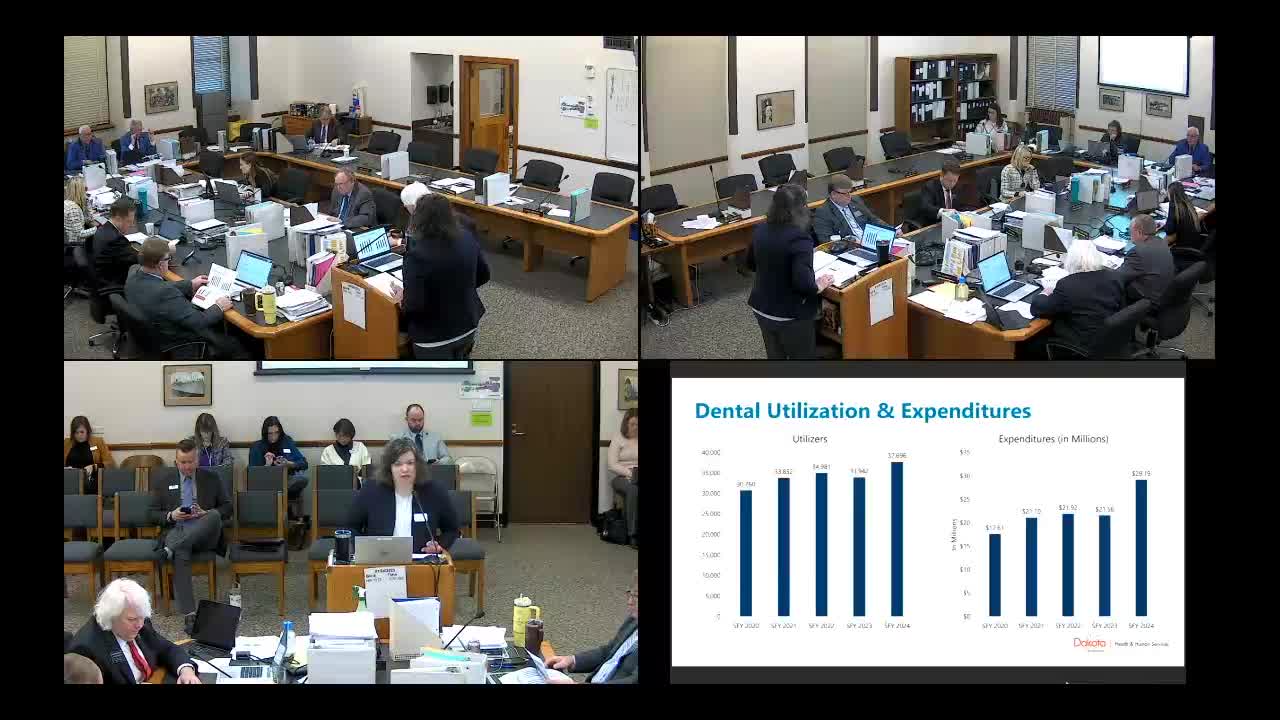
During an Appropriations Human Resources Division presentation, Sarah Acre said North Dakota Medicaid dental rates were last rebased in 2009 and have risen roughly 42% since that rebasing, but the state ranks 47th nationally on a child oral-evaluation performance measure.
Acre displayed a side‑by‑side chart showing performance on the periodic oral evaluation measure (children under 21 who received an evaluation) and the reimbursement rate for that single service. She told the committee that North Dakota was third in the region for reimbursement but 47th in the nation for performance on that measure and said: “I think it’s something that’s worth looking into further and certainly something that me and my staff spend a lot of time on.”
Lawmakers and staff discussed access barriers. Committee members raised common explanations—dentists declining Medicaid patients because of administrative burden and missed appointments—and Acre described steps the department has taken: convening a dental work group, surveying licensed dentists about program hurdles, and reducing administrative barriers where federal rules permit. She said some enrollment and federal requirements (for example, certain provider enrollment steps) cannot be waived because they are federally mandated, but the state has used outreach and operational changes to try to make participation easier.
Two bills related to dental were cited on the record. Acre identified House Bill 1567 as requiring a study of dental and oral health care status for Medicaid members and workforce supports for low‑income children. She also identified Senate Bill 2231 (earlier mis‑stated on the record but corrected during testimony) as a bill that would add certain dental services for Medicaid expansion members; the department said the initial fiscal note draft addressed a select group of services and that a later note will show broader fiscal impacts if the sponsor’s intent is to extend full dental benefits to all expansion members.
The committee asked for follow‑up materials; Acre said staff would provide a list of administrative changes underway and noted a dental vendor project that compared no‑show rates between Medicaid and commercial patients, finding reminder practices (calls, texts, emails) had a strong effect on attendance.
Ending: The department stressed that a dental rebase was not included in the governor’s budget and recommended further study and operational remedies while the legislature considers bills that could expand covered services for expansion members.