Get Full Government Meeting Transcripts, Videos, & Alerts Forever!
Get email alerts on the Education Budget Salaries topic
No spam. Unsubscribe anytime.
DPI requests $1.02 million in biennial salary equity funding to retain staff
Summary
North Dakota Department of Public Instruction officials told the House Appropriations Education & Environment Division they are seeking $1,023,497 in biennium salary equity funding—$624,333 in spending authority for federal funds and $399,163 in general funds—to raise average pay nearer the market and address hiring and retention pressures.
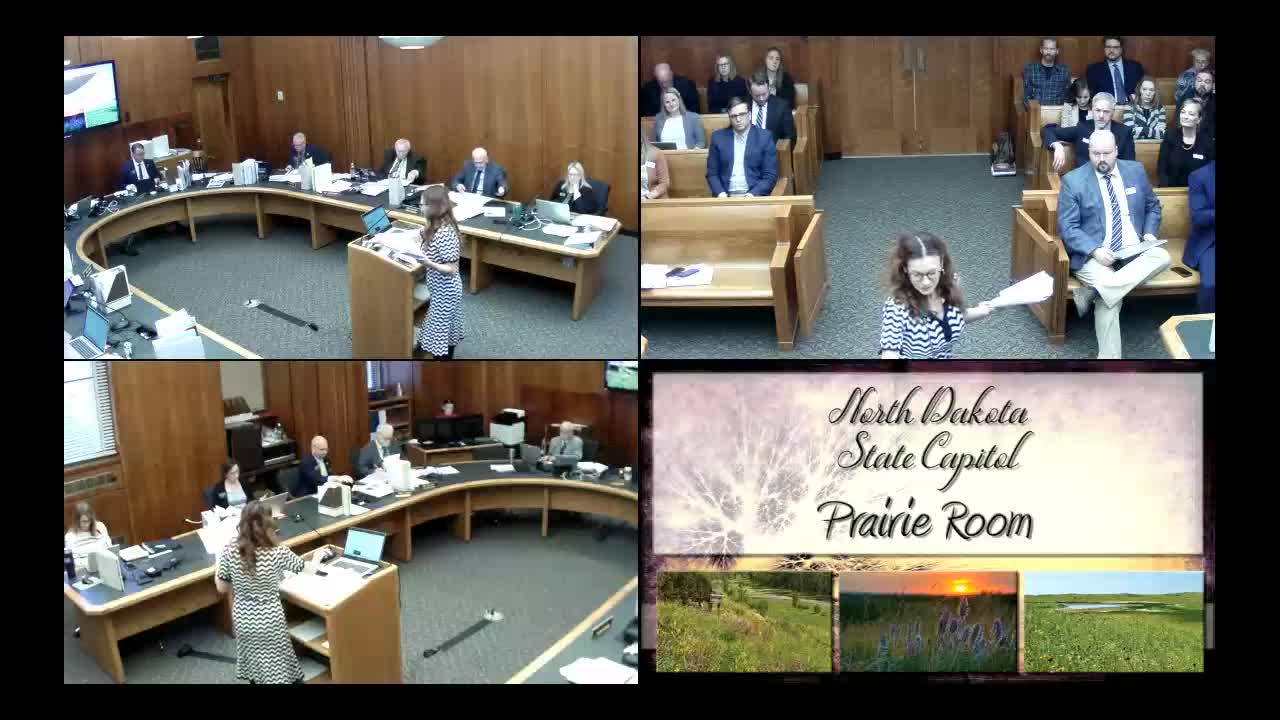
Kirsten Basler, State Superintendent of the North Dakota Department of Public Instruction (DPI), and Krista Schultz, DPI human resources manager, told the House Appropriations - Education and Environment Division on Friday that DPI is asking the committee for $1,023,497 in biennium salary equity funding to address hiring and retention pressures.
"We are requesting biennium salary equity increases funding for $1,023,497," Krista Schultz said, adding the request includes $624,333 in federal spending authority and $399,163 in general funds.
The department said it uses the Office of Management and Budget’s broadband salary ranges and a market policy point (MPP) mid‑point to set pay bands. Schultz said DPI typically hires around an 85–88 percent comp ratio and that equity adjustments made with 2023 funds raised the agency’s average comp ratio to 95.7 percent. Even so, she said DPI remains one of the lower‑paid state agencies: "we do remain the 16th lowest paid agency out of the 53 state agencies that are managed under the OMB compensation system." (Krista Schultz.)
Schultz described four hiring and retention concerns the money would address: retaining highly qualified staff while school districts’ pay rises; attracting new hires when DPI hiring starts lower than K–12 districts; leveraging existing staff for added responsibilities; and replacing retirees (22 percent of DPI staff will be eligible to retire in the next biennium). The department said its priority distributions would target program administrators and office directors first, with smaller amounts to support administrative assistants and executive leadership.
Representative Richter and other committee members pressed DPI on details such as how salaries compare to school district daily rates; Schultz said DPI’s agency averages (for example, program administrators at about $302 per day) remain below the top school districts’ figures from 2023–24. Schultz cautioned that school district salary data are from the 2023–24 year while DPI figures reflect 2025 pay.
Committee members also questioned DPI about long‑vacant FTEs listed in the department’s budget documents; Schultz said several open positions are funded with federal grants and DPI avoids hiring permanent FTEs until grant funding is expected to be continuous.
The discussion was framed as part of the agency requests in House Bill 1013; Basler and Schultz said their salary ask is a small portion of the bill but important for program continuity and retention.
DPI testified but no formal committee action or votes were recorded during the session on the salary request.
Two takeaways for the committee: DPI asked for a targeted, modest equity package that mixes federal and general funds; and staff urged the legislature to consider salary competitiveness with K–12 districts when assessing DPI recruitment and retention challenges.
(Reporting note: quotes and attributions come from the hearing transcript.)