Get Full Government Meeting Transcripts, Videos, & Alerts Forever!
Get email alerts on the Medicaid Rates Reimbursement topic
No spam. Unsubscribe anytime.
Medicaid rates, capitation and budget drivers outlined as state weighs provider inflation and ambulance increase
Summary
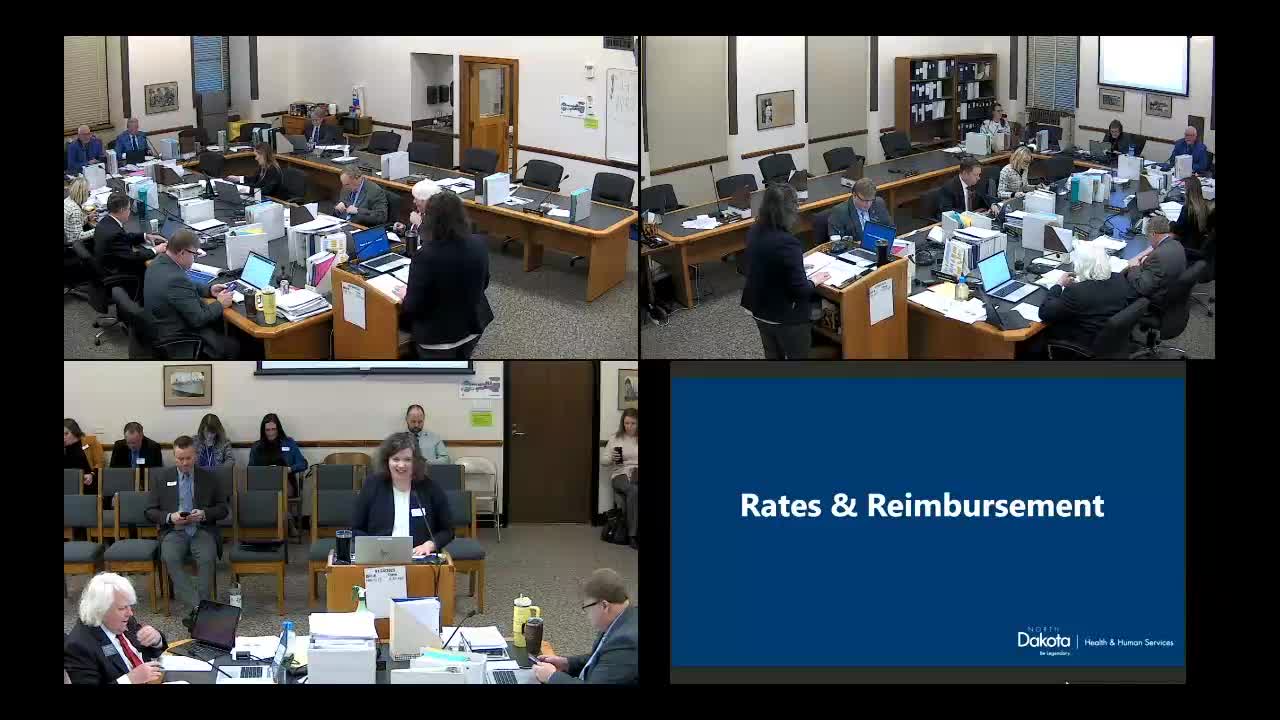
At an Appropriations Human Resources Division hearing, Medical Services Division leaders reviewed Medicaid rate methodologies, the governor's provider inflation request and proposed targeted rate increases for ambulance providers; officials also described 2025 capitation rates for Medicaid expansion and changes to managed-care safeguards.
Sarah Acre, executive director of the Division of Medical Services at the North Dakota Department of Health and Human Services, told the Appropriations Human Resources Division that the governor’s executive budget includes a $16.2 million request to increase provider rates through inflation and a $4.3 million targeted increase for ambulance reimbursement.
Acre said traditional Medicaid still uses fee-for-service payment methods—cost-based per diems for nursing homes and per‑episode classification systems (DRGs and EAPGs) for hospitals—while Medicaid expansion is paid through a monthly capitation payment to a managed-care organization (MCO). “I am Sarah Acre. I’m the executive director of the division of medical services,” Acre said when introducing the presentation and then described the two distinct rate methodologies.
The nut of the discussion centered on how the state sets those payments and how the governor’s budget would change them. For professional services the state uses relative value units (RVUs) and a conversion factor; Acre noted North Dakota’s conversion factor in 2024 was 36.26 versus Medicare’s $33.29. The governor’s provider inflation request would apply a 1.5% increase in state fiscal year 2026 and another 1.5% in fiscal year 2027 to many fee‑schedule items.
On ambulance reimbursement, Acre said the targeted increase would raise statewide ambulance rates to the lowest Medicare rural quartile; the administration requested the $4.3 million to align Medicaid ambulance payments with that Medicare benchmark after providers reported sustainability concerns.
Medicaid expansion capitation and managed‑care safeguards drew sustained scrutiny. Acre said the state’s 2025 capitation rates were set with its actuary and Blue Cross Blue Shield of North Dakota; the blended per‑member‑per‑month capitation increased to $1,176.44 in 2025 from $1,006.44 in 2023. She also said the capitation rate development incorporated Senate Bill 2012 from the prior session, which the department interpreted as requiring an assumed ceiling so MCO provider rates would not exceed 145% of Medicare; North Dakota’s actuarial work showed aggregate MCO payments already at roughly 144.5% of Medicare, so no downward adjustment was applied for 2025.
Acre described the state’s shift in managed‑care risk controls: the state will not impose a profit cap in calendar year 2025 and instead will require a high medical‑loss‑ratio (MLR). As she stated, “we will require that 92.3% of our MLR be used again for those services and quality improvement.” The committee discussed how the prior approach combined a roughly 2% profit cap with a lower MLR; members and staff asked how those changes affect incentives for MCO innovation and the state’s exposure to market shifts.
Committee members raised questions about federal match and national policy risk. Representative Murphy asked what would happen if Congress reduced the Medicaid expansion federal match; members noted that a large federal change could force reevaluation of the expansion model and the state budget.
The presentation also outlined operational constraints that affect rate timing: Acre described the cost‑report to rate timeline (providers submit cost reports, the department has roughly 90 days to set rates for a January 1 rate year) and the need to finalize nursing‑home rates at least 30 days before a rate year to enable private‑pay notice.
Ending: Department staff told the committee they will provide additional comparative rate information on select services on request and will continue to monitor federal policy developments that could change match rates or capitation assumptions. The administration asked lawmakers to consider the requested provider inflation and targeted increases when reviewing the executive budget.