Get Full Government Meeting Transcripts, Videos, & Alerts Forever!
Get email alerts on the Hunting Near Buildings topic
No spam. Unsubscribe anytime.
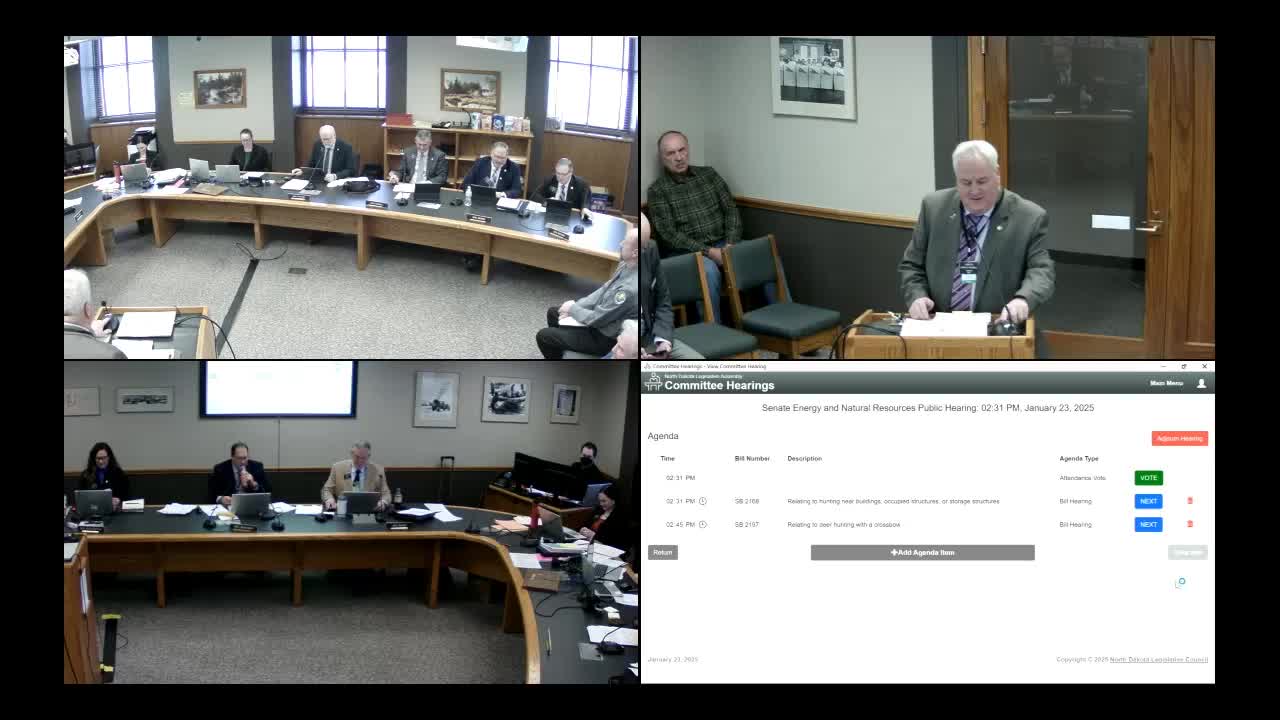
Senate committee hears competing views on bill to bar hunting within 440 yards of buildings
Summary
The Senate Energy and Natural Resources Committee on an unspecified date heard testimony on Senate Bill 2168, a proposal to make it illegal to hunt or pursue game within 440 yards of a building, occupied structure, or storage structure without the property owner’s consent.
The Senate Energy and Natural Resources Committee on an unspecified date heard testimony on Senate Bill 2168, a proposal to make it illegal to hunt or pursue game within 440 yards of a building, occupied structure, or storage structure without the property owner’s consent.
Senator Don Scheible, District 31, who introduced the bill, said the measure was prompted by a constituent who found damage and holes in buildings near which hunting occurred. "It was my understanding that we had laws to restrict shooting from 440 yards from buildings. ... This bill draft is an attempt to make sure that buildings are protected from being shot at," Scheible said. Scheible added he did not intend to broadly restrict hunting access and that owner consent should still allow hunting on the owner’s land.
The North Dakota Game and Fish Department opposed the bill at the hearing. Scott Winkelman, chief game warden, told the committee the department believes existing law and other criminal statutes already protect property and safety without broadly restricting hunting access. "We certainly agree the safety of individuals and their property is a priority. We feel the current laws that are on the books adequately do that without infringing on a person's ability to hunt on their own property," Winkelman said. He warned the bill could require neighboring landowners' consent to hunt in many places and could effectively close some public hunting lands near residences or structures.
Multiple hunting and conservation organizations and private landowners also testified in opposition. Sheldon Cieslak, representing the Hazen Sportsman's Club, and Daryl Belisle of the North Dakota Bow Hunters Association said the bill could deny longstanding hunting access on private and public lands and create neighbor-to-neighbor conflict. "If this will pass ... people would have to get permission from me, they'd have to get permission from 3 other people to hunt my family's land," Cieslak testified, describing a family parcel used for hunting for decades.
John Bradley, executive director of the North Dakota Wildlife Federation, expressed similar concerns about unintended consequences, including for urban management hunts that Game and Fish coordinates in cities. Winkelman and others noted that other criminal statutes — referenced in testimony as sections 12.1-17-3 (reckless endangerment) and 12.1-21-05 (criminal mischief) — already apply in many cases and are enforced by county law enforcement when appropriate.
Committee members questioned how the 440-yard standard originated and whether the bill would be enforceable in many circumstances. Senator Behm and others pressed for clarity that the bill's intent was safety and protection of valuable farm buildings rather than to restrict hunting on permissive land. Scheible said the measure aims to tighten protections and provide recourse for property owners who find their buildings shot or damaged but acknowledged it may not answer every enforcement problem.
The committee took testimony from multiple residents and groups opposing the bill and from state Game and Fish; no formal vote was recorded. Chairman Patton closed the hearing on Senate Bill 2168 and moved on to the next item on the agenda.