Get Full Government Meeting Transcripts, Videos, & Alerts Forever!
Get email alerts on the Student Mental Health Antisemitism topic
No spam. Unsubscribe anytime.
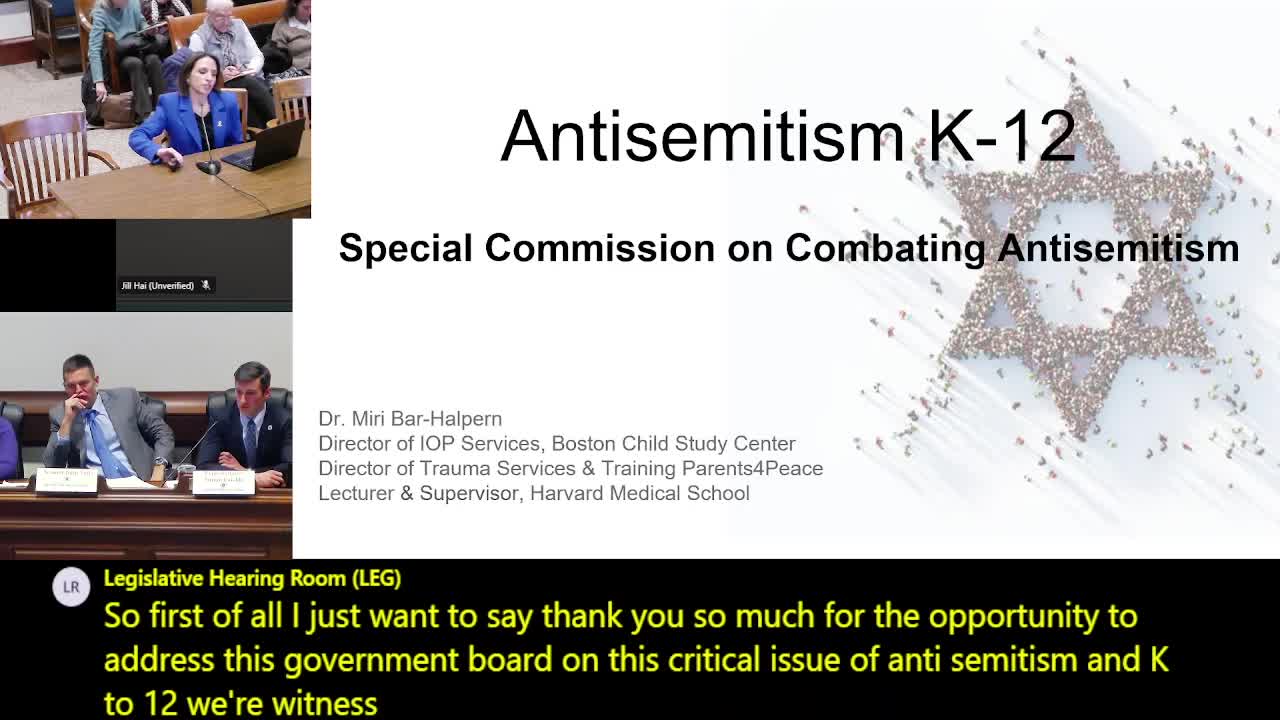
Psychologist warns antisemitic incidents and online exposure produce trauma that undermines students' learning and safety
Summary
Dr. Mary Bar Halpern told the commission that antisemitic incidents and online amplification are producing traumatic invalidation and chronic hypervigilance among Jewish and Israeli students, reducing academic functioning and increasing risk of self‑harm.
Dr. Mary Bar Halpern, clinical psychologist and director of intensive outpatient programs at Boston Child Study Center, told the commission that antisemitic incidents in schools and online are producing measurable trauma among Jewish and Israeli students.
Bar Halpern said Jewish people constitute about 0.2 percent of the world population and that online influencers can amplify antisemitic content to far larger audiences, increasing exposure. She described a pattern she and clinical colleagues have observed—what clinicians call "traumatic invalidation"—in which students' private experiences and emotions are denied, minimized, blamed or reinterpreted in ways that compound psychological harm.
"Traumatic invalidation is when someone is denying your private experience, your emotions, your thoughts," Bar Halpern said. She described examples reported to clinicians: students told their fear is not valid, that they are to blame, or that their grief is inappropriate because others also suffer. Those interactions, she said, can produce symptoms including hypervigilance, anxiety, depression, social withdrawal, loss of cultural expression and, in some cases, self‑harm.
Bar Halpern warned that chronic activation of the amygdala—the brain's threat response—impairs the prefrontal cortex functions needed for concentration, executive functioning and learning. "When the amygdala is working so hard, the prefrontal cortex ... completely shuts down," she told commissioners, arguing that constant fear undermines students' ability to focus and perform in class.
She urged the commission to recommend trauma‑informed, antisemitism‑specific school responses rather than one‑size‑fits‑all anti‑bias approaches. Her recommendations included early reporting after a single incident, uniform complaint procedures (UCP and Title VI processes), adoption at the district level of the IHRA (International Holocaust Remembrance Alliance) working definition of antisemitism, clear reporting and transparency, schoolwide trauma‑informed practices, mental‑health access and targeted protections for Israeli immigrant students who may face compounded trauma tied to overseas events.
Bar Halpern also urged anti‑bias education to include materials on online safety and digital literacy and recommended restorative practices that emphasize guilt and repair rather than shame. She called for vetted community partnerships and said parents should not be left to vet curriculum and instructional materials alone.
Commissioners thanked Bar Halpern for linking clinical evidence to policy options and said her account would inform the commission’s education and reporting recommendations.