Get Full Government Meeting Transcripts, Videos, & Alerts Forever!
Get email alerts on the Military Education Scholarship topic
No spam. Unsubscribe anytime.
Senate committee hears bill to extend state tuition scholarship to reserve service members
Summary
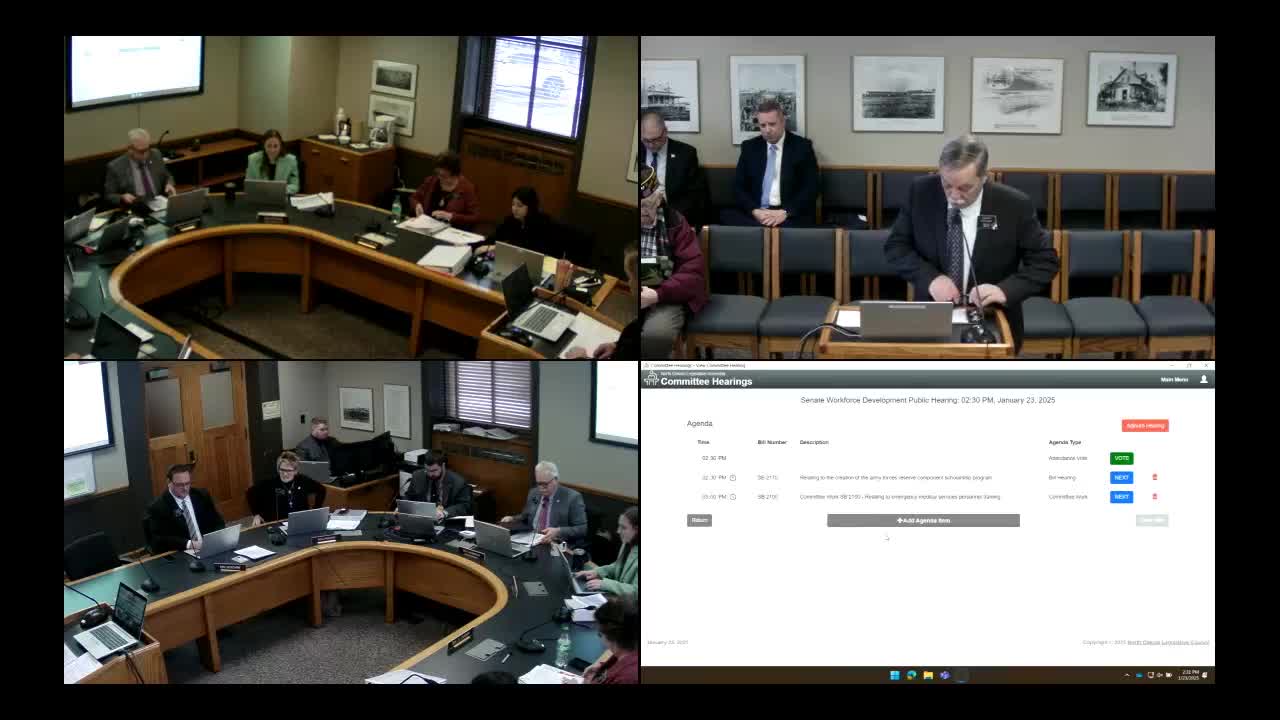
Senate Bill 2170, introduced by Senator Devere, would create a state scholarship to cover tuition for members of the U.S. armed forces reserve components similar to an existing North Dakota program for the National Guard.
Senate Bill 2170, introduced by Senator Devere, would create a state scholarship to cover tuition for members of the U.S. armed forces reserve components similar to an existing North Dakota program for the National Guard. The Senate committee heard supportive testimony from reserve advocates, technical amendment proposals from the North Dakota University System and neutral clarifying testimony from the National Guard before closing the hearing for committee work with no final vote.
The bill’s sponsor, Senator Devere, said the measure was requested by Army Reserve supporters and intended “to provide tuition for members of the reserve just as we do for members of the guard.” He told the committee the legislative question is whether reserve members “should be treated the same as members of the guard.”
Robert Black, an Army Reserve ambassador from Bismarck, told the panel the reserve footprint in North Dakota is small but meaningful. “We have roughly 400 reserve soldiers, sailors and airmen in North Dakota,” Black said, and provided a breakdown he attributed to local commands: about 62 naval reservists, 70 Marine Corps reservists, 38 air reserve members and roughly 200 Army Reserve soldiers. Black and other proponents said a state supplement would mirror the state program for the Guard and would be paid from a separate appropriation; reserve command estimates in committee testimony said about 40 people might avail themselves of a state scholarship.
Brenda (North Dakota University System) recommended several technical amendments aimed at making the bill administrable by higher-education institutions. Among the proposed edits she described: changing the bill’s definition of “institution of higher education” to “an accredited institution of higher education with a physical presence in the state”; replacing specific references to “Army” with “Armed” so the text covers all reserve components; aligning full-time enrollment units to a semester-equivalent standard (12 semester credits or the equivalent for quarter/clock-hour programs) to accommodate Rasmussen University (the sole quarter-hour school mentioned); and limiting a state award to an amount not to exceed the highest regular undergraduate tuition rate in the North Dakota University System to reduce fiscal exposure for private and tribal institutions. She also recommended tying the bill’s definition of “active duty” to the federal definition in Title 10 of the U.S. Code to aid administration.
Chris Martins, an attorney for the North Dakota National Guard who also serves in the Guard, offered neutral testimony and noted statutory intent differences between the Guard program and a potential reserve supplement. “The intent is not meant to supplement federal benefits,” Martins said, summarizing how the Guard’s state tuition benefit is framed in statute as recognition of state service. He also said the Guard requires members to seek federal tuition assistance before state funds but added that Air National Guard members currently lack access to federal tuition assistance and rely primarily on state benefits.
Committee members asked several clarifying questions that remained unresolved during the hearing: whether eligibility requires North Dakota residency, whether the reservist must be attached to a North Dakota unit (some reservists live in-state but are assigned to out-of-state units), how the fiscal note accounts for existing federal tuition assistance, and whether limiting the award to residents or to those tied to North Dakota units should be written explicitly. Senator Axman, Senator Powers and others pressed for clearer residency and unit-attachment language; Brenda said those points would be addressed in proposed amendments the University System had prepared.
Other administrative and policy details discussed in committee testimony included: - Federal tuition assistance amounts and rules: testimony noted federal tuition assistance exists for reserve components and the Guard, and recent federal adjustments increased certain caps to $4,500 (from $4,000), per testimony provided to the committee. - Academic-unit equivalency: committee staff and NDUS recommended defining full-time enrollment as 12 semester credits or the equivalent quarter/clock-hour measure so that quarter-based programs (Rasmussen University was named) are treated equitably. - Eligibility disqualifiers: the sponsor clarified the bill intended to exclude only dishonorable discharges; other discharges such as medical discharges would remain eligible. - Scholarship limits and treatment while called to active duty: NDUS advised limiting state awards to cost of attendance and not allowing institutions to require repayment if a student withdraws because of active-duty orders; the bill’s language on maximum eligibility units (48 units) was discussed and NDUS proposed clarifying how active-duty withdrawals affect those units.
Several committee members raised logistical and policy concerns about unintended effects. National Guard witnesses said the state program had been used as a recruiting tool for the Guard and that extending a similar state benefit to reservists could have second-order effects on Guard recruitment. Committee members and some commenters also worried about rural access to affiliated training or administration if the program required institution-based oversight in limited geographic hubs; NDUS and others discussed grants and administrative arrangements to address travel and access burdens.
No formal committee action (vote or motion on final passage) was taken at the hearing. The chair closed the public testimony portion and opened the bill for committee work; NDUS said it would provide a “Christmas tree” (consolidated) version of proposed amendments for members to review. Committee members asked for additional time to review the amendments and supporting materials that had been forwarded by staff before the panel returns to committee work.
The committee record shows the bill attracted mostly supportive and neutral testimony in the hearing. Proponents emphasized parity between reserve members and Guard members and cited workforce and readiness rationales; university staff emphasized statutory alignment and administrative clarity; Guard representatives noted recruitment and program-differentiation concerns. The committee adjourned without vote and will consider amendments and further committee work before any final action.