Get Full Government Meeting Transcripts, Videos, & Alerts Forever!
Get email alerts on the Background Checks Digital Fingerprinting topic
No spam. Unsubscribe anytime.
Lawmakers, providers press for faster criminal-background checks; BCI cites IT limits and federal timeline
Summary
Senate Bill 2194 would require the state Bureau of Criminal Investigation to accept digital fingerprints and includes a $5 million appropriation to expand processing; childcare providers and insurers urged speedier turnarounds while BCI said existing projects and security constraints limit immediate expansion.
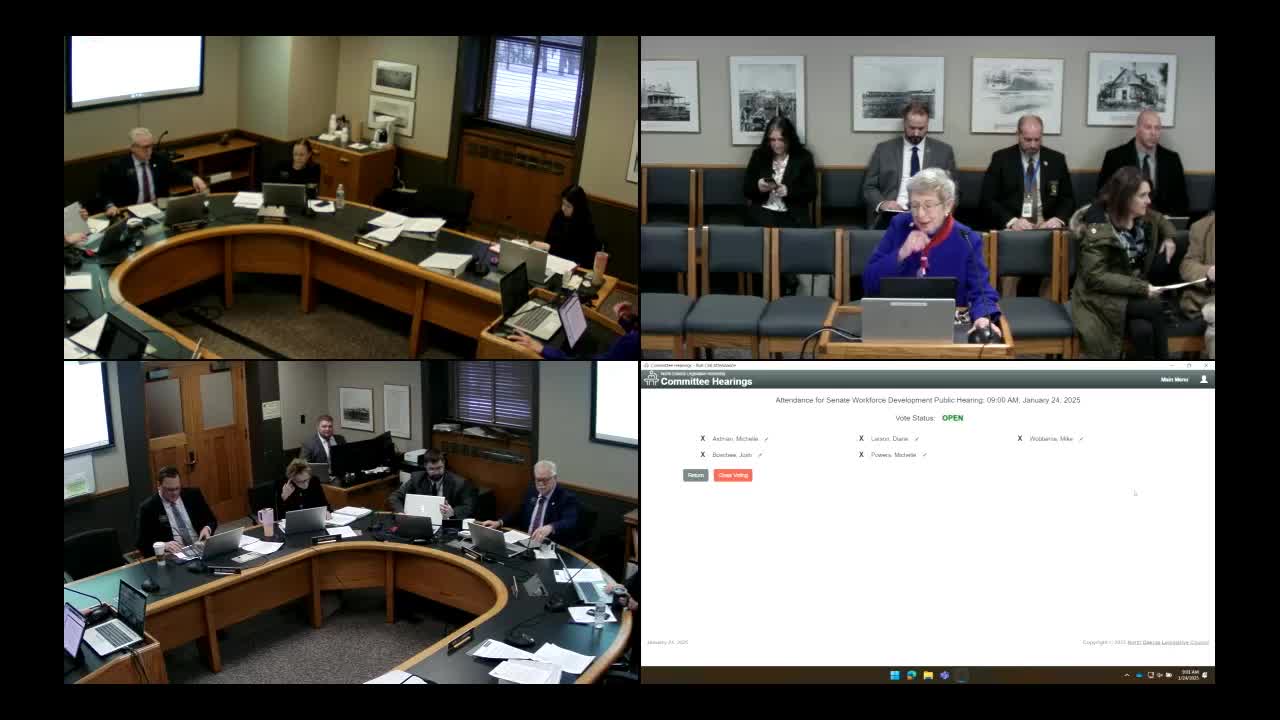
Senator Judy Lee, sponsor of Senate Bill 2194, told the Workforce Development Committee she wants the Bureau of Criminal Investigation to accept digital fingerprints and speed processing of criminal-history checks for job applicants.
"Without digital fingerprints being available to BCI, it's a very slow turnaround," Senator Judy Lee said as she opened the hearing on the bill.
The bill proposes that BCI accept digital fingerprint submissions and includes an appropriation request intended to help the agency update systems to process digital submissions more broadly. Supporters said the change would shorten wait times for job applicants in childcare, long-term care and other licensed professions and help employers hire quickly in a tight labor market.
"It's that gap. We can interview and everything, but then we wait for the background check," said Bill Baumann, chief executive officer of the Missouri Valley Family YMCA and spokesperson for the North Dakota Alliance of YMCA. Baumann told senators his organizations see average turnaround times of about "8 to 13 working days" and that prolonged waits drive applicants to other sectors.
John Arnold, deputy insurance commissioner, said the Insurance Department typically takes about "8 days to turn around" a clean background check after it receives fingerprints, and described how licensing rules require a complete application before the department can initiate FBI-based checks. Arnold said agencies sometimes must wait for applicants to finish prelicensure exams before fingerprints can be submitted.
Representatives from the Bureau of Criminal Investigation described both capabilities and constraints. Steve Harstad, chief agent with BCI's criminal records oversight, said BCI currently accepts Live Scan electronic fingerprints from devices connected to the state network and that, for a complete and accurate request, the agency's turnaround "is just less than 4 days." Harstad also warned that accepting outside digital devices or third-party payment without careful IT work raises security and integration issues.
Rebecca Dubin, criminal history records supervisor at BCI, told the committee the bureau processes about "over 60,000 applications" annually and said digital submissions can be faster but that annual workload, staffing and the completeness of each submission affect turnaround. She said BCI currently staffs six criminal history records specialists who handle the processing.
Harstad said the attorney general's office and BCI are working on a larger IT upgrade funded by a federal grant awarded in fall 2024 and estimated to run into 2026. He expressed caution about a $5 million appropriation in the bill, saying this is "probably the first time I will stand up in opposition of receiving $5,000,000," though he described the bill's goals as sound and said the funding could be used to build infrastructure and then to help outside entities obtain devices if funds remain.
Witnesses and committee members discussed several distinct bottlenecks: (1) the technical link between fingerprint collection devices and the state network (Live Scan); (2) acceptance of electronic payment from non-state entities; and (3) other parts of a full background check process (reference checks, multi-state records) that occur outside BCI's fingerprint-based record search. Deputy Insurance Commissioner Arnold stressed that federal/FBI rules and the need for a complete application limit whether agencies can initiate fingerprint checks before applicants complete prelicensing steps.
Supporters urged other, lower-cost fixes in the short term — for example, allowing new childcare staff to begin under direct supervision while checks complete — as a way to immediately reduce hiring delays.
The committee held the bill for further discussion; no committee recommendation or vote was recorded during the hearing.
Ending: Committee members said they will return to the bill after clarifying the appropriation's intended uses and BCI's upgrade timeline. Senators also suggested follow-up with Human Services on whether supervisory-start policies can be revised to reduce hiring delays for childcare providers while technical work continues.