Get Full Government Meeting Transcripts, Videos, & Alerts Forever!
Get email alerts on the Publication Requirements topic
No spam. Unsubscribe anytime.
Counties weigh option to post commission minutes online as newspapers warn of transparency loss
Summary
The committee heard House Bill 1380, which would allow counties to publish board of county commissioners' proceedings on their official websites instead of in newspapers. Proponents said the change would save taxpayer money; newspapers and publishers warned it could reduce public access, independent verification and archival permanence.
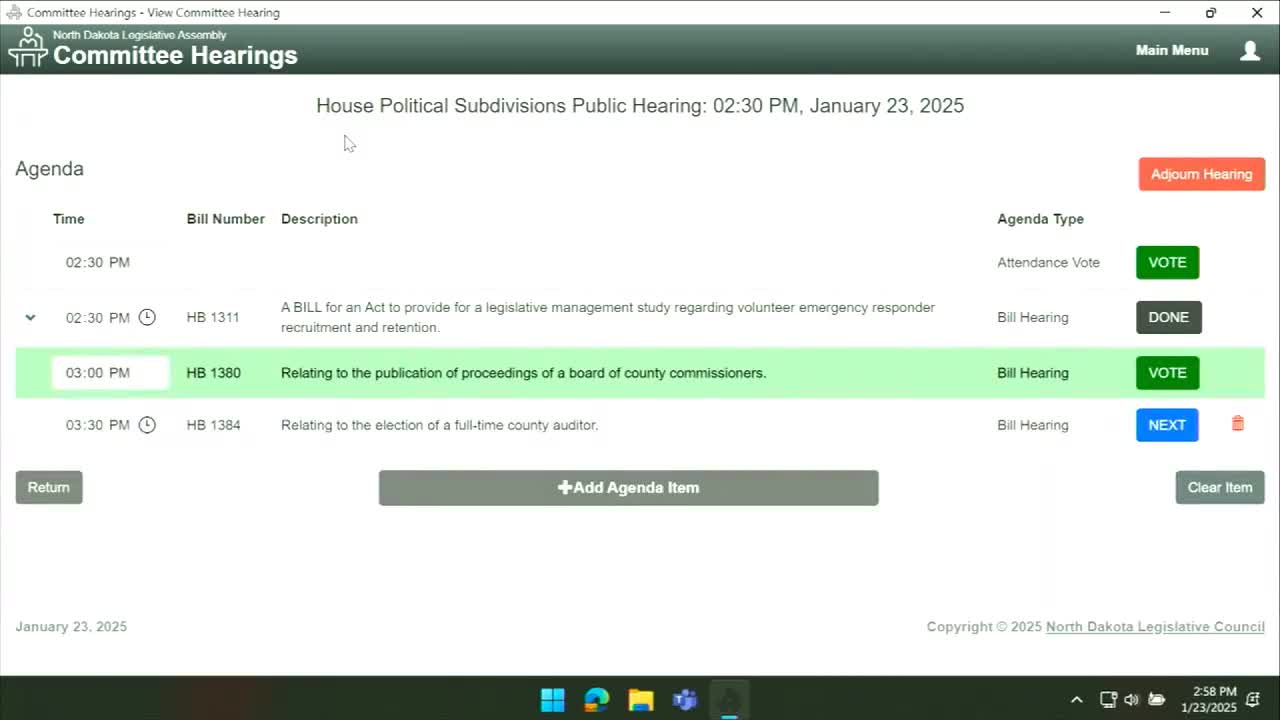
The Political Subdivisions Committee held a hearing on House Bill 1380, a measure that would allow counties the option to publish proceedings of a board of county commissioners on an official county website rather than in a newspaper.
Representative Matt Heilman, the bill sponsor, told the committee the change would give counties an option and could save money. "This bill is brought to me by an individual who said this will be saving the counties lots of money," Heilman said during his opening remarks, and he cited county testimony estimating large publication costs.
Danelle Presque, representing the North Dakota Association of Counties (NDACO), urged support and presented statewide budget figures she said counties reported: publication budgets that totaled about $450,000 in 2019 and rose to about $750,000 in 2024. Presque said county auditors told NDACO that meeting minutes typically represent roughly one-third to one-half of those publication costs and that Office of Management and Budget (OMB) proposed rate increases could raise statewide publishing costs further.
Oliver County auditor Jaden Schmidt testified with county-specific numbers: total county publishing costs of $5,263.50 in 2023 and $10,552.74 in 2024; minutes publication specifically rose from $1,467.80 in 2023 to $3,827.51 in 2024. Schmidt said minutes are posted to the county website about one week before newspaper publication and recommended a "do pass".
Opponents said moving minutes to county websites risks reducing access and independent verification. Cecile Worman, executive director of the North Dakota Newspaper Association, cited survey results she said showed 85% of respondents believe public notices should be placed in newspapers, and she argued newspapers provide independent, verifiable and archived records. Worman said there is no enforcement mechanism in the bill to ensure minutes posted to government websites are published or preserved and pointed to ndpublicnotices.com, a newspaper-run statewide public-notice site, as an existing free access resource.
Publishers and local newspaper owners also warned of local reliance on print editions in rural communities and said some counties rely on voter choice or existing legal requirements to ensure independent publication. Testimony included both technical and civic arguments about reach, archival permanence, affidavits of publication, and the role of an independent press in verifying that publication occurred.
Nut graf: The hearing laid out a tradeoff between potential cost savings for counties and concerns about public access, independent verification and historic archiving of official county proceedings. Committee members asked multiple witnesses about how residents without reliable internet access would be notified and how counties might balance online posting with other notification methods.
Committee action: The committee completed the hearing; no committee vote on the bill was recorded during the session. The bill remains under committee consideration pending further action.