Get Full Government Meeting Transcripts, Videos, & Alerts Forever!
Get email alerts on the Volunteer Emergency Responders topic
No spam. Unsubscribe anytime.
Committee gives do-pass to study of volunteer emergency responder recruitment and retention
Summary
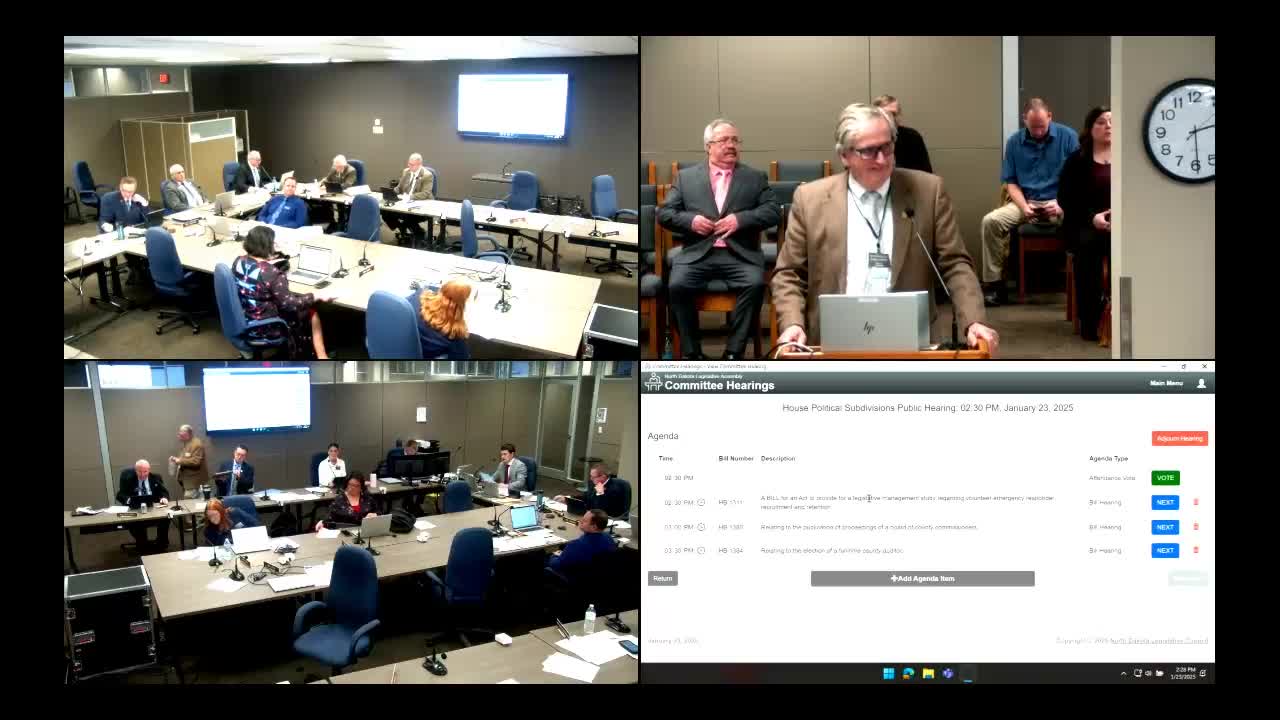
The Political Subdivisions Committee voted 12-0-1 to recommend House Bill 1311, which would direct a legislative management study into recruitment and retention of volunteer emergency responders after testimony that rural departments are strained by falling volunteer numbers.
The Political Subdivisions Committee voted 12-0-1 to give House Bill 1311 a "do pass" recommendation after hearing testimony that volunteer emergency responder rosters in parts of the state are shrinking and that longer response times and mutual-aid requests are becoming more common.
Representative Bernie Satrim, sponsor of House Bill 1311, told the committee the measure would fund a legislative management study into recruitment and retention of volunteer emergency responders. "A high percentage of the geography our state of our state's emergency needs are provided by our neighbors who volunteer to service in our time of most critical need," Satrim said, highlighting rural reliance on volunteers for ambulance, fire and search-and-rescue work.
Supporters and local volunteers described multiple pressures on volunteer services. Travis Bateman, representing Badlands Search and Rescue, said, "Volunteerism as a whole is on the decline and this is something that is impacting public safety and emergency services in North Dakota every day and every night." Bateman and other witnesses told the committee that volunteers are increasingly unable to attend training, respond because of work or family commitments, or shoulder increasing out-of-pocket costs for fuel, equipment and travel.
Representative Begley described one local ambulance service's compensation practices as an example of variation across jurisdictions. Begley said his service offers a $50 weekend on-call stipend and about $40 per run and that their small volunteer service averages about 100 runs a year. Committee members asked whether volunteers are routinely paid; witnesses said compensation varies widely and is often insufficient to cover volunteer costs.
Committee discussion emphasized the public-safety implications in rural areas when local volunteer rosters decline and neighboring districts must provide mutual aid. Representative Hager moved a "do pass" recommendation; a second was recorded and the clerk reported the vote as 12 yes, 0 nay, 1 absent. The committee placed the bill on the consent calendar unless pulled for floor action.
Nut graf: Lawmakers said the study would collect statewide information on how volunteer emergency services are staffed, what incentives exist, and what costs fall on volunteers, to inform potential policy or funding responses.
The bill now moves forward with the committee's recommendation and, barring a floor pull, will be placed on the consent calendar for further consideration by the full House. No amendments were adopted at the committee hearing.