Get Full Government Meeting Transcripts, Videos, & Alerts Forever!
Get email alerts on the State And Local Government topic
No spam. Unsubscribe anytime.
Committee considers raising long‑term lodging reimbursement to federal rate; hospitality industry backs change, fiscal impact under review
Summary
Sen. Kristen Rose (District 27) proposed tying long‑term legislative lodging reimbursement to the federal GSA rate and increasing the percentage used for month‑long stays; hospitality representatives and fiscal staff discussed market impacts and budget implications.
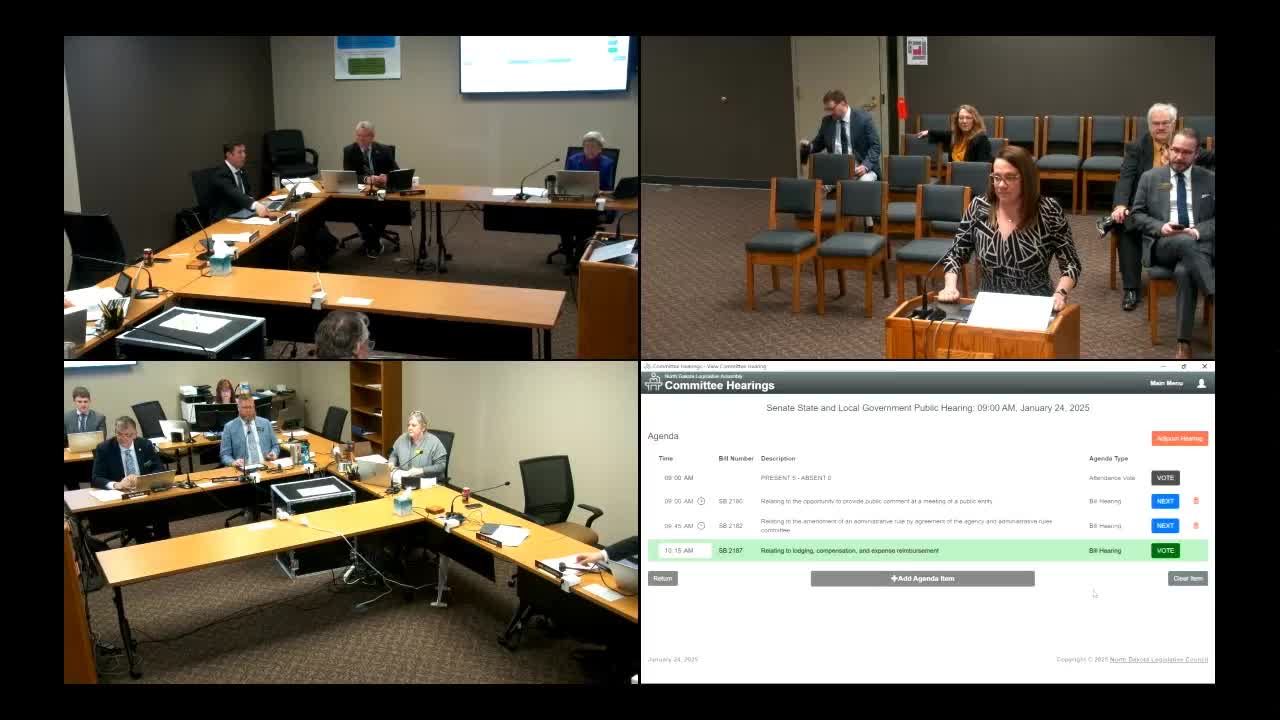
Sen. Kristen Rose (District 27) told the Senate State and Local Government Committee that Senate Bill 2187 would update the legislative lodging reimbursement formula for extended stays and align it with the federal General Services Administration (GSA) rate. Rose said it has become increasingly difficult for legislators to secure month‑long housing at the previously used reduced state rate and proposed tying reimbursement to the federal rate.
Under Rose’s draft, the long‑term lodging calculation would shift from the current percentage of the state daily lodging reimbursement to a higher percentage of the federal rate; in the version presented to the committee the sponsor suggested 85% of the federal daily lodging rate for month‑long stays (an increase from the 70% figure used in prior state practice). Rose characterized the change as a pass‑through to lodging providers rather than an increase in pay to legislators: “It is not any increased pay to legislators. It is a pass through that goes directly to whoever is renting your housing to you.”
Hospitality industry and fiscal staff
Rudy Martinson, speaking for the North Dakota Hospitality Association, said the association supports the bill and that it would address housing availability for legislators during the session. Martinson agreed to consult local Bismarck hotels and return with a recommended percent or range that better matches local market conditions.
Joe Goplin (director, Fiscal Management Division, Office of Management and Budget) and the committee’s fiscal manager discussed the fiscal implications. During testimony committee fiscal staff provided an illustrative fiscal note indicating a nontrivial increase in monthly lodging cost per covered legislator if the change combined both the move to the full federal rate and the proposed percentage increase; staff said they would provide precise budget estimates for the committee to review. The sponsor and committee members asked hospitality representatives to consult local lodging providers and return with suggested percentages and market feedback.
Committee discussion and questions
Several senators asked whether the bill should replace or be merged with another pending lodging bill discussed earlier in the session; sponsors and staff suggested the committee could blend the bills or amend one to capture both objectives. Senators also noted interplay between hotels and private rentals (condos/apartments) used for long stays and said a change to reimbursement could affect both markets.
Next steps
Committee members asked hospitality representatives for a local market recommendation on an appropriate percentage of the federal rate and requested a clearer fiscal estimate of the budgetary impact. The committee closed the hearing on SB 2187 pending that further feedback and did not take a final vote.
Ending
The sponsor said she would accept committee guidance; the hospitality association agreed to consult its members on a recommended percentage and the Office of Management and Budget said it would supply a clearer fiscal estimate for committee consideration.