Get Full Government Meeting Transcripts, Videos, & Alerts Forever!
Get email alerts on the State And Local Government topic
No spam. Unsubscribe anytime.
Sponsor seeks authority for agency‑committee agreed rule changes; attorney general’s office flags constitutional, public‑notice risks
Summary
Sen. Bob Paulson told the committee SB 2182 would permit an agency and the Administrative Rules Committee to jointly agree to amend or create related administrative rules if both agree a change is “reasonable.”
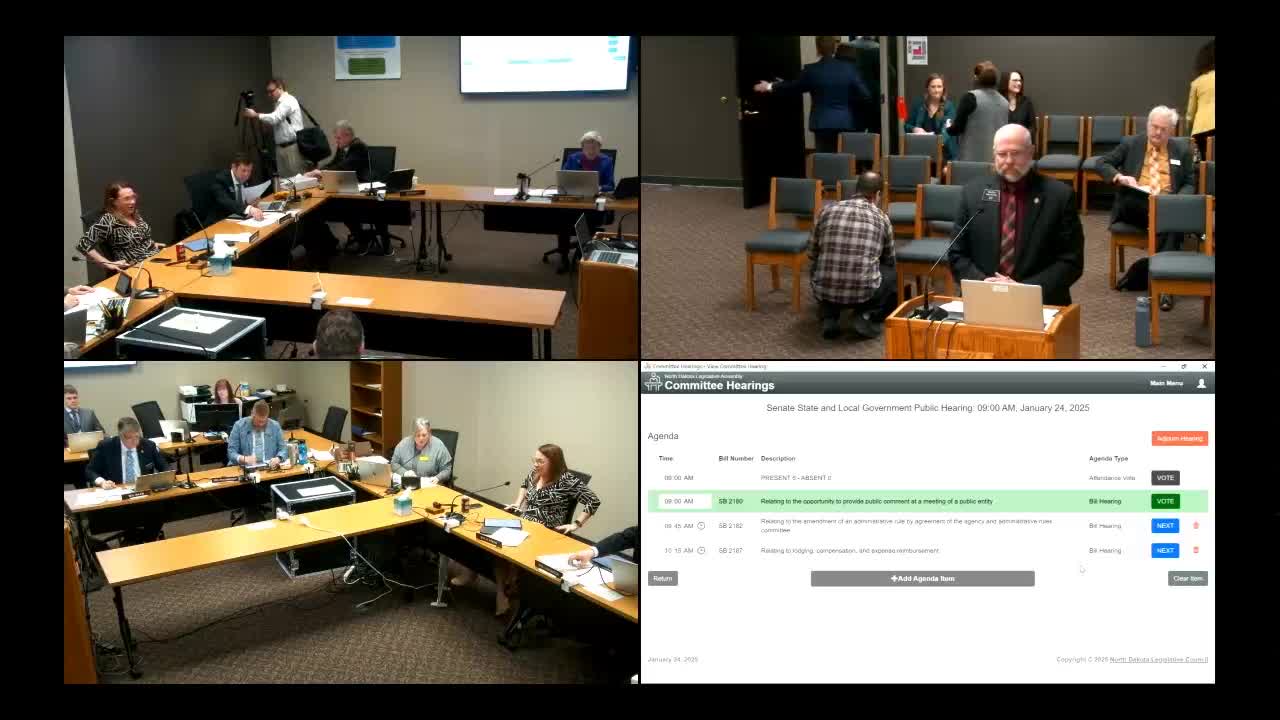
Sen. Bob Paulson told the Senate State and Local Government Committee that Senate Bill 2182 would add an element to the statute governing administrative rules allowing an agency and the Administrative Rules Committee to agree that an amendment, repeal or new related rule is "reasonable" and therefore permissible.
Paulson said the change would address a recurring practical problem: when agencies or the committee identify a needed technical or procedural fix after the formal rule‑adoption process is complete, current law restricts corrective changes to a short list of statutory reasons for voiding or changing rules. “If both the agency and the committee agree that the change is reasonable, we have the authority to do it,” Paulson said.
Constitutional and process concerns from the attorney general’s office
Assistant Attorney General Allison Hicks appeared in opposition and recommended a do‑not‑pass, raising three central concerns: (1) constitutional delegation — the bill would give a subset of the legislature (the Administrative Rules Committee) quasi‑legislative authority to change regulatory language without the full legislative process, raising issues cited in North Dakota Legislative Assembly v. Bergum (2018); (2) operational risk — the bill vests negotiating authority in a single “representative of the agency,” which could allow an agency employee or sub‑official to bind an agency contrary to the agency head or governing board; and (3) public‑notice and vetting concerns — the Administrative Rules Act (chapters 28–32) requires public comment and a written record of consideration; Hicks said the proposed language could allow rule changes without that public comment, legal vetting, or the Administrative Rules Act’s statutory checks.
Hicks told the committee the change would likely be viewed as a delegation of legislative authority and could undercut the public‑comment process and legal review designed to test rules for statutory authority, clarity and legality. “There would be a lot of discretion for those select legislators on that administrative rules committee, and so this would almost certainly be a constitutional violation,” Hicks said.
Sponsor response and committee reaction
Paulson said his intent was practical and technical: commonly the agency and rules committee agree a tweak is appropriate but current statute lacks a clear path. He said Legislative Council drafted the language and he would work with representatives and the committee on edits; after hearing the attorney general’s concerns he suggested he could pursue fixes in the House if necessary.
Committee members asked questions about delegation limits, time‑sensitive rules, and whether holding a rule over would create untenable timing risks for agencies that must meet federal or statutory deadlines. Several senators and committee counsel referenced the Administrative Rules Act’s existing voiding standards and the six reasons currently listed there (for example, lack of statutory authority, conflict with state law, failure to comply with procedural requirements).
Next steps
The attorney general’s office recommended a do‑not‑pass on SB 2182. Paulson offered to work with Legislative Council and Representative Pyle on language and indicated he could consider holding the bill to refine it if the committee preferred. The committee closed the hearing; no vote occurred during the recorded testimony.
Ending
The hearing closed with the committee signaling concern about constitutional and public‑notice implications and a direction for the sponsor to confer with Legislative Council and the attorney general’s office on possible revisions before any committee action.