Get Full Government Meeting Transcripts, Videos, & Alerts Forever!
Get email alerts on the State And Local Government topic
No spam. Unsubscribe anytime.
Senator proposes guaranteed public‑comment period for political‑subdivision meetings; school boards and agencies push back
Summary
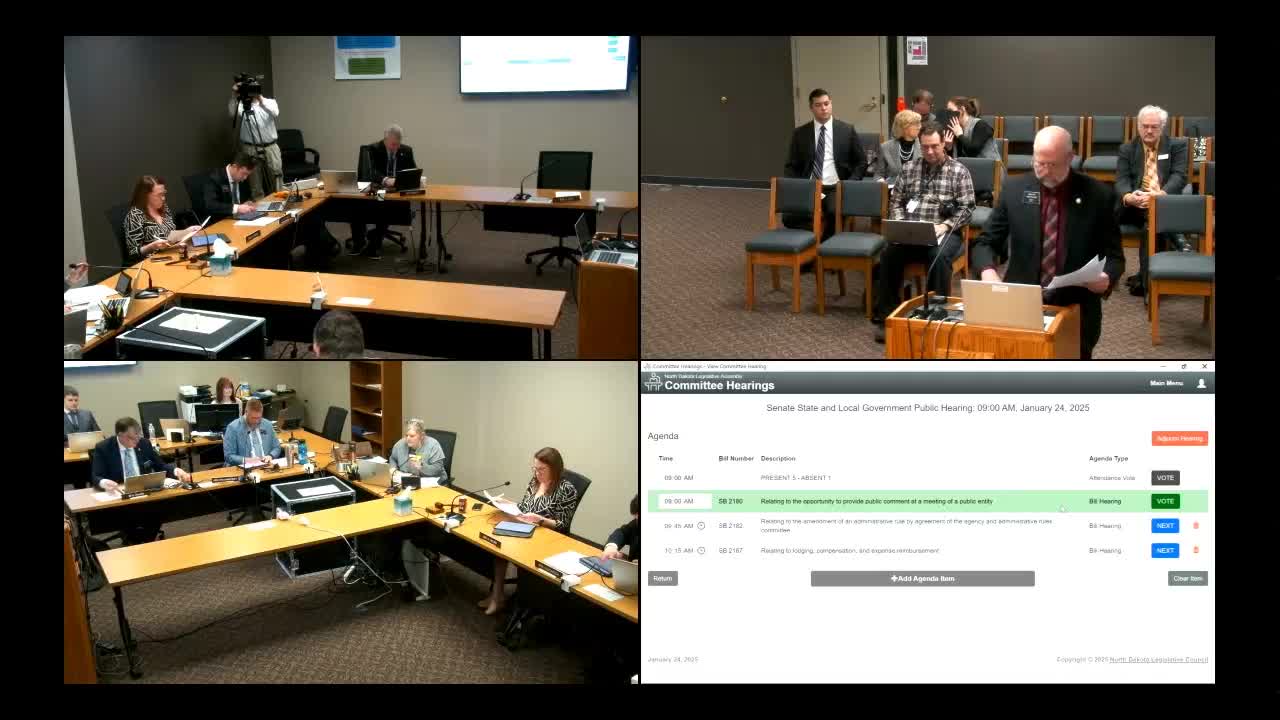
Sen. Bob Paulson introduced Senate Bill 2180 to require political subdivisions to include an opportunity for public comment at regular meetings, telling the Senate State and Local Government Committee that the change would protect citizens’ ability to redress their government.
Sen. Bob Paulson introduced Senate Bill 2180 to require political subdivisions to include an opportunity for public comment at regular meetings, telling the Senate State and Local Government Committee that the change would protect citizens’ ability to redress their government.
The bill’s sponsor said the measure aims to prevent scenarios in which residents learn after an annual meeting that they must wait months to speak or are told their remarks are out of order because an item is not on the current agenda. “The ability of a citizen to redress their government and be heard is a bedrock principle of our nation and our state,” Paulson said.
Supporters and opponents concentrated on the same practical details: who would be covered, how often comment must be allowed, whether comments may be limited to agenda items, time limits, and protections for confidential or legally exempt information.
What the bill would do
Paulson’s proposed amendment (distributed at the hearing) narrows his original draft to regular meetings of political subdivisions and adds specific provisions that include: a requirement that a regular meeting include an opportunity for an individual in attendance to provide public comment; an application to at least one regular meeting for subdivisions that meet more frequently than once a month; a provision that an individual providing comment supply a name and address in writing; a prohibition on limiting public comment topics to agenda items; and permission for a political subdivision to limit time per speaker and total time. The amendment also allows a subdivision to adopt a written public‑comment policy and to prohibit comments that are defamatory, abusive, harassing, unlawful or disclose confidential or exempt information.
Support from municipal officials; concerns from schools
Corey Peterson, representing the League of Cities and a former Horace mayor, told the committee his membership originally opposed an earlier, broader draft but now supports the sponsor’s amended language. Peterson said local leaders commonly balance public comment against the need to keep meetings moving and that local discretion has worked in his experience: “Most of the time I gave everybody 2, maybe 3 minutes and if there wasn't that many people in the room that wanted to get involved, I'd let it go a little bit longer. It was at my discretion.”
By contrast, Chris Ann Norby Jonner, in‑house counsel for the North Dakota School Boards Association (NDSBA), urged the committee to preserve local control and boardroom procedures. “Our public board meetings are not public meetings. They're meetings held in public,” she said, describing why many school boards limit public comment to noticed agenda items and why boards adopt policies that exclude certain topics (for example, personnel matters or student records protected by FERPA). She recommended amendments that would let each board define when and how public comment is allowed, including limiting comments to agenda items in some situations.
Several school leaders and educational groups echoed the NDSBA concerns. Dr. Paul Stremek of the North Dakota School Study Council and Alexander Public School Superintendent Leslie Bieber both said allowing broad, unrestricted comment could expose individual employees to defamatory or prejudicial remarks and would undercut existing complaint and grievance procedures. Bieber said that upsetting personnel issues aired spontaneously in public can deprive employees of due process and that local procedures — including asking to be placed on a future agenda — are the usual route to resolve disputes.
Legal and procedural clarifications
Assistant Attorney General Annika Lockard testified in a neutral capacity about notice and meeting types under state open‑meeting law. She told the committee that regular meeting agendas may be amended during the meeting to add items and that a presiding officer can move an off‑topic public comment to a later agenda item, but that special meetings are limited to the notice provided when the meeting was called. Lockard’s explanation highlighted the practical difference, in her view, between regular and special meetings for any statutory requirement to allow public comment.
Key contested provisions
A number of committee members pressed Paulson on specific language. Senator Braunberger and others questioned the requirement that commenters provide a written name and address; Paulson said the provision reflected a League of Cities request to allow a subdivision to understand who is speaking and whether comments are likely to be pertinent. Several senators and witnesses urged adding exceptions to protect people whose addresses are ordinarily redacted for safety reasons (for example, law enforcement officers or victims of domestic violence).
Senators also discussed time limits, including whether to require a minimum per‑speaker allowance or rely on subdivisions’ discretion and a total time cap. The sponsor said he would accept committee work on those numeric limits if members wanted them spelled out.
Next steps and procedural status
The committee heard a mix of support and opposition and invited side‑by‑side comparisons between the sponsor’s amendment and the NDSBA template policy. Paulson said he has worked with the League of Cities on amendments and that he would continue to refine language. The committee closed the hearing on SB 2180 without taking final action. Members indicated further amendment work and clarification would be needed if the bill moves forward.
Ending
No formal vote was taken during the hearing. Committee members said they wanted additional drafting to clarify address‑redaction exceptions, personnel and FERPA protections, and practical rules on speaker time and frequency before returning the bill to committee action.