Get Full Government Meeting Transcripts, Videos, & Alerts Forever!
Get email alerts on the Environmental Budget topic
No spam. Unsubscribe anytime.
Senate Bill 2024 would add one PFAS chemist and fund new DEQ laboratory; lawmakers seek details on fees and grants
Summary
Senate Bill 2024 proposes one new DEQ chemist focused on PFAS/emerging contaminants and funding to relocate and equip a new chemistry laboratory. Lawmakers pressed agency officials on funding sources, timing, equipment costs and the petroleum tank compensation and restoration funds.
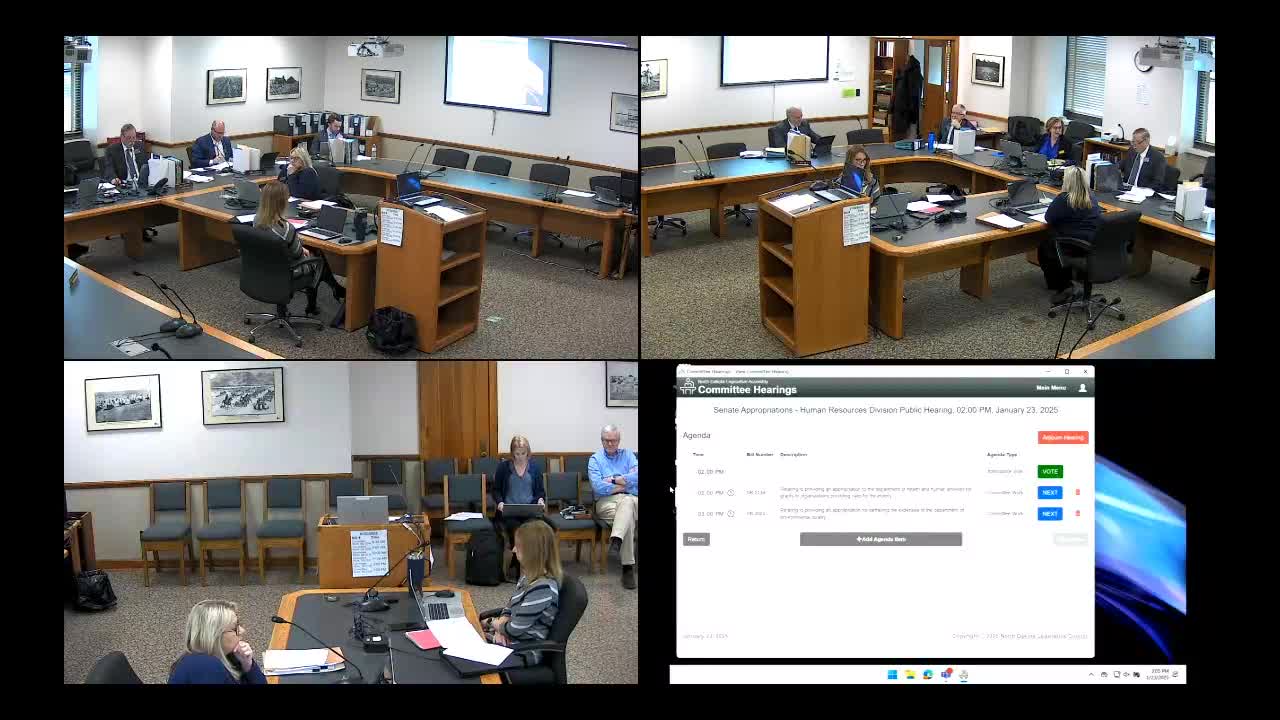
The Senate appropriations subcommittee on human resources on Feb. 24 reviewed Senate Bill 2024, the budget request for the Department of Environmental Quality, including authority for one new chemist position and funding tied to a new chemistry laboratory to test emerging contaminants such as PFAS and PFOS.
The committee heard that the proposed 1 FTE chemist would staff a new emerging-contaminants lab that can test at parts-per-trillion levels and that initial startup and equipment costs are substantial. "As we move to the new laboratory, then we would establish that emerging contaminant lab," said Dave Glott, who identified himself to the committee as a DEQ staff member. DEQ staff told the committee the position is intended to be funded primarily by special fees collected for PFAS testing rather than general funds.
Why it matters: Senators pressed for clarity about where authority and revenue would come from if testing demand lags, how much of the lab costs are one-time versus ongoing, and how much of DEQ’s grant totals are federal passthroughs. The committee did not vote on the bill and asked DEQ staff for additional documentation before final action.
Most important details
- Position and purpose: The budget includes authority for one new FTE described in the worksheet as "1 FTE chemist position" to operate an emerging-contaminant/PFAS testing program.
- Funding plan: DEQ said the FTE would be paid from special funds (the agency’s operating special fund) funded by collections for PFAS testing. Beth (DEQ budget staff) said the appropriation authority would be placed in a pooled funding line and DEQ would request vacancy funding when the position is filled. "That that FTE would be funded with special funds through our operating special fund, and that would be funded by collections for the PFAS testing itself," Beth told the committee.
- Timing: DEQ estimated the new laboratory could be operational in mid-to-late 2026; testimony cited an initial target of July 2026 that may slip to February 2026. Committee members asked whether the position could be funded only in the second year of the biennium; DEQ staff said that is feasible given equipment lead times.
- Costs and carry-forward authority: Committee discussion clarified several amounts in the agency worksheets. A new FTE payroll line was identified as about $353,402 (annual payroll total shown on the worksheet). DEQ characterized certain move and equipment costs as one-time, explaining that the Office of Management and Budget typically moves one-time costs to special funds in the executive recommendation.
- Equipment and operating costs: DEQ testified there will be both one-time equipment purchases (some individual lab instruments can cost $200,000–$300,000) and ongoing operating costs. Staff estimated some permanent increases for rent (~$500,000) and IT/telephone/contract services tied to the move and IT unification.
- Fees and testing turnaround: DEQ staff said PFAS tests are "kind of pricey," with a ballpark of $500 per test (possibly higher), and that limited national lab capacity can delay results months.
- Grants and federal funding: DEQ said a large increase in the grants line reflects Infrastructure Investment and Jobs Act (IIJA/"IGJA" in testimony) construction and pass-through grant activity (municipal and rural water projects). The agency agreed to provide a detailed schedule identifying which grants are federal versus special or general funds before the subcommittee acts.
Petroleum tank and restoration funds
Committee members questioned DEQ about the Petroleum Tank Release Compensation Fund and the Environmental Quality Restoration Fund (Fund 258). DEQ staff described how annual tank fees (for eligible underground and aboveground bulk storage tanks) provide revenue and investment income, and explained the fund aims to maintain a multiyear balance (witnesses cited a target range referenced in rules or guidance of roughly $6 million to $9 million). The fund provides up to $1,000,000 of coverage (per site) for cleanup costs when responsible parties are unable to pay, and some cleanup payments are made from a continuing appropriation rather than the biennial budget appropriation.
Committee requests and next steps
Members requested: (1) a detailed breakdown of the $22–23 million grants line showing federal vs. special vs. state funding sources and which awards are pass-throughs; (2) the current balances for the Petroleum Tank Release Compensation Fund including amounts invested off-ledger (Brio/Rio investment account); (3) procurement estimates and quotes for the database/IT items (Windsor quote noted); and (4) clarification of the laboratory one-time move and equipment requests versus ongoing operating needs.
DEQ staff said they will provide the requested schedules and documentation. The subcommittee did not finalize or move the bill; the chair said the committee will reconvene once members have the additional information.
Quotations attributed to witnesses are taken from committee testimony and staff answers recorded during the Feb. 24 hearing.