Get Full Government Meeting Transcripts, Videos, & Alerts Forever!
Get email alerts on the Consumer Protection topic
No spam. Unsubscribe anytime.
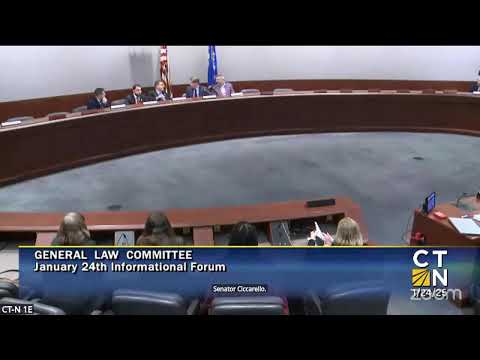
General Law Committee holds informational forum with Connecticut Department of Consumer Protection
Summary
Department of Consumer Protection officials briefed the General Law Committee on licensing, inspections, recalls, gaming oversight and enforcement, describing staffing levels, recent program metrics and planned system upgrades; no formal committee actions were taken.
The General Law Committee heard a broad informational briefing from the Connecticut Department of Consumer Protection on Jan. 28, 2025, as Commissioner Caffarelli Hu and division directors described licensing, inspections, recalls, gaming oversight, enforcement actions and public outreach.
"Our mission is to ensure a fair and equitable marketplace for businesses and safe products and services for consumers," Commissioner Caffarelli Hu told committee members at the start of the forum. She said the agency employs roughly 300 people across 12 divisions and handles work that touches residents’ daily lives from home improvement to gaming oversight.
Why it matters: The forum assembled the agency’s senior staff to explain how DCP enforces Connecticut law, recovers consumer funds, and regulates industry activities that generate hundreds of millions in state revenue. Committee members asked about enforcement capacity, licensing system modernization, recalls, hemp regulation and outreach to non‑English speakers.
Key details from the briefing
- Licensing and operations: The licensing unit manages more than 300,000 active credentials across roughly 200 license types, processes tens of thousands of new applications annually and handles nearly 200,000 renewals, and — as reported by the commissioner — transfers about $57,000,000 to the general fund. Jason Cohen, director of operations, said the complaint center has achieved a greater than 65% positive rating on follow‑up surveys and recovered nearly $500,000 for consumers last year.
- IT and system modernization: Cohen said DCP uses the enterprise licensing and enforcement platform known as Lisonbee and plans a public RFP and review of that system in 2027 to modernize and update functionality.
- Drug control and pharmaceutical work: Rod Marriott, director of the drug control division, described responsibilities for pharmacies, the prescription monitoring program, cannabis inspections and drug diversion investigations. He said the division oversees about 150,000 credential holders and partners with federal and state law enforcement on diversion cases. Marriott said state take‑back events in 2023 resulted in destruction of more than 60,000 pounds of unwanted pharmaceuticals collected across the state.
- Food safety, weights and measures and product recalls: Frank Green, who manages food standards and weights and measures, said recent work highlighted allergen labeling and a large recall tied to misbranded cookies. He noted Connecticut performs about half of reported state food processing inspections and most produce inspections in the area, and that the division is preparing to test accuracy at EV charging stations as those become more common.
- Gaming oversight and revenue: Chris Gillman, gaming director, said the gaming division has 61 employees and manages more than 12,000 active gaming credentials, inspects licensed gaming and lottery facilities, and audited gross gaming revenue that produced more than $730,000,000 in contributions to the general fund last fiscal year. Gillman described enforcement actions, a voluntary self‑exclusion list for problem gaming and an updated policy limiting use of the word "free" in iCasino marketing.
- Investigations, home improvement and consumer frauds: Pamela Brown, director of investigations, said the home improvement unit investigated more than 1,250 complaints last year and sought arrest affidavits under the Home Improvement Act in multiple cases. Her division also reported more than 584 occupational enforcement complaints in 2024, 62 occupational license compliance inspections, 11 affidavits of arrest for unlicensed work, and 150 assurances of voluntary compliance. The consumer frauds unit identified 237 unlicensed martial arts clubs and about 120 charity donation bins with violations; DCP issued a press release about the charity‑bin findings the same day.
- Liquor control and enforcement: Caitlin Anderson, director of liquor control, said DCP enforces Connecticut’s three‑tier distribution system (manufacturer → wholesaler → retailer). She reported nearly 950 new permits issued last year and said the division opened almost 1,000 enforcement cases; the division increased minor‑compliance checks by 178% and received grant funding to expand enforcement operations.
- Communications, outreach and workforce development: Caitlin Kraslet (communications) and Catherine Blinder (education and outreach) described a consumer protection newsletter translated into five languages, expanded community outreach, internships and public seminars (including a Feb. 7 seminar aimed at buyers and sellers in real estate). Blinder said DCP has expanded translation capacity and targets outreach to non‑English speakers and other hard‑to‑reach groups.
Committee questions and follow up
Committee members pressed DCP for implementation details and data the agency said it would provide. Questions included (1) a breakdown of the licensing revenue sent to the general fund (commissioner said the agency would supply precise figures), (2) staffing and funding for tribal casino oversight and gaming field staff, (3) the number and role of on‑the‑ground occupational inspectors (Pamela Brown said the agency has six Lisonbee inspectors in the occupational enforcement unit and four licensed building officials among staff), (4) plans and equipment purchases to test accuracy at EV charging stations, and (5) enforcement and consumer protections for automatic renewal contracts and charity donation bins.
No committee votes were taken; the session was informational. Several divisions will return for additional briefings: the committee scheduled a follow‑up forum on gaming compacts and tribal partners.
Taper/next steps
Committee leadership and DCP officials said they will provide requested follow‑up data on licensing revenues, staffing paid by tribal compacts, and a written explanation of the three‑day cooling‑off/cancellation rule for home‑improvement contracts. DCP officials also said they will circulate materials and continue outreach efforts, including the consumer protection newsletter and planned public seminars.