Get Full Government Meeting Transcripts, Videos, & Alerts Forever!
Get email alerts on the County Budget topic
No spam. Unsubscribe anytime.
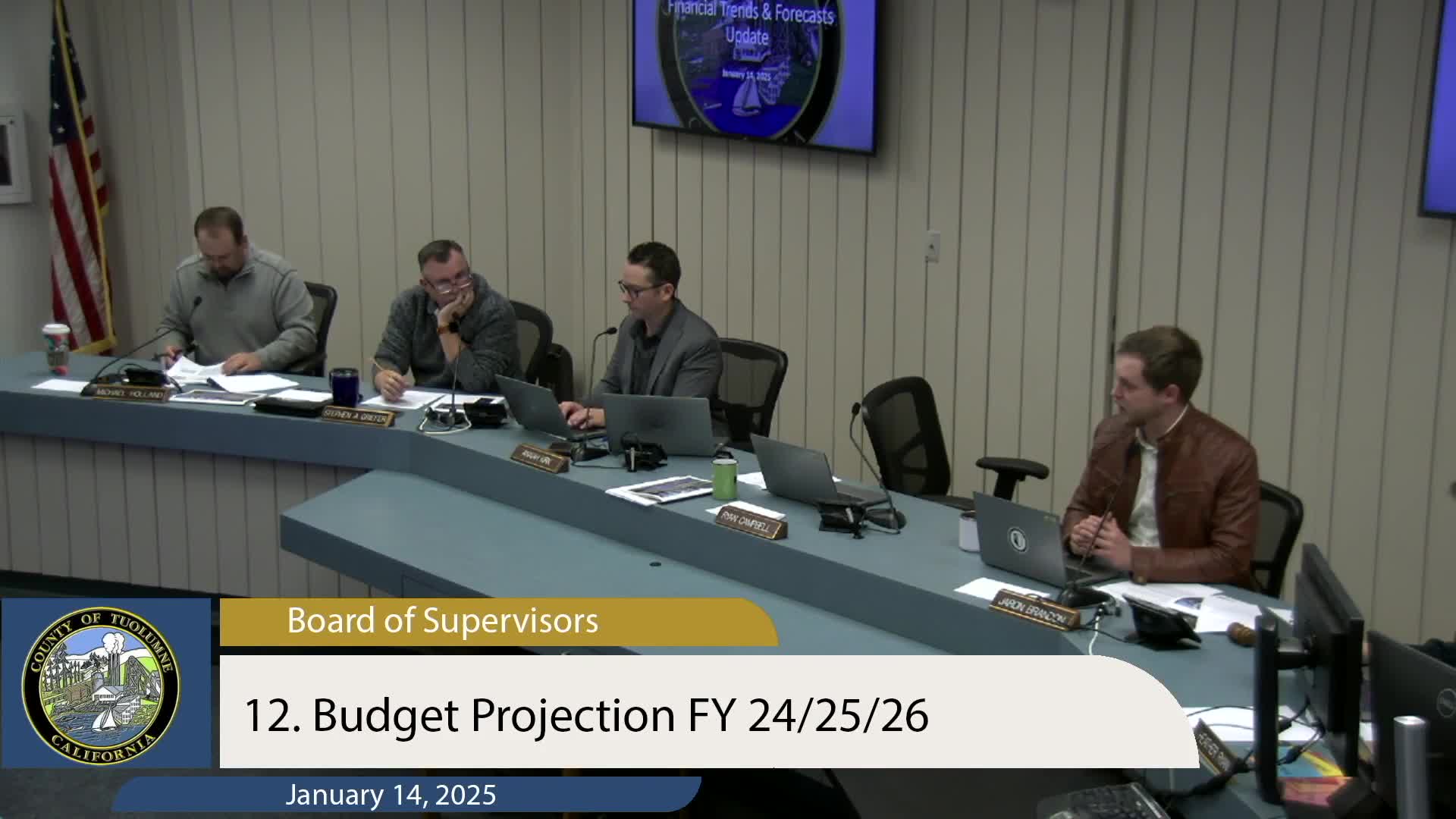
Tuolumne County staff lays out multiyear budget outlook; recommends 15% cuts to non‑public‑safety departments
Summary
Tuolumne County officials on Jan. 14 told the Board of Supervisors that rising mandated costs, uncertain sales‑tax growth and the planned end of a federal SAFER grant will leave the county with multi‑million‑dollar shortfalls unless the board approves cuts or new revenue sources.
Tuolumne County officials on Jan. 14 told the Board of Supervisors that rising mandated costs, uncertain sales‑tax growth and the planned end of a federal SAFER grant will leave the county with multi‑million‑dollar shortfalls unless the board approves cuts or new revenue sources.
The county administrator, Tracy Riggs, and Auditor‑Controller Donnie McNair presented a detailed, slide‑driven multiyear outlook that showed the county’s adopted 2024–25 budget of about $302.7 million and about $124.9 million in general‑fund appropriations. The presentation emphasized that only roughly $67 million of that total is discretionary general revenue available to cover net county costs.
Why it matters: County leaders said the largest near‑term fiscal stress point is the scheduled end of the federal SAFER firefighter grant that has been funding staffing in Tuolumne County Fire. Director‑level staff told the board the change could produce a shortfall in the fire fund measured in the low single‑millions of dollars unless alternative funding is found or service levels are reduced.
Tracy Riggs, the county administrator, said the numbers are provisional and will change as departments finalize budgets, but she asked the board to give firm direction so staff can prepare the 2025–26 budget for department review. “These numbers will undoubtedly be different from what you see, say, in April,” Riggs said, adding that the county is still compiling actuals and correcting estimates.
The presentation listed key cost drivers for the general fund: a growing PERS fixed‑payment tied to the county’s unfunded liability (nearly $12 million across funds in 2024–25, a significant portion charged to the general fund), rising liability and workers’‑compensation allocations, and an increase in costs that are allocated as internal mandated costs (about $17 million charged across general‑fund cost centers in 2024–25). The slide deck also showed that Tuolumne County is 77% public lands, limiting certain local revenue options, and noted that sales tax growth in the county is volatile and unlikely to produce major revenue bumps in the near term.
After questions and a lengthy discussion among supervisors, staff recommended an immediate, two‑part approach: 1) departments outside the public‑safety “wheel” (defined during the meeting to exclude sheriff, probation, district attorney, public defender, juvenile hall, animal control and related public‑safety cost centers) should prepare plans to reduce their next‑year budgets by about 15 percent; and 2) public‑safety budgets should be held at status‑quo (no growth) and be required to seek any additional revenue opportunities or delay nonessential expenditures to limit further pressure on the general fund. The county administrator asked departments to prepare detailed proposals and said staff would return with a consolidated plan for board action.
Chair Brandon, opening the item, thanked finance staff and told the board: “I just want to put a moment to appreciate that I think this is a really good step for us,” summarizing the need to pull the county’s disparate data together into a single outlook.
The board voted to direct staff to prepare the reductions and bring back concrete proposals. Supervisor John Kirk made the motion and it was seconded by Supervisor Holland; the motion passed on a 4–1 vote with one supervisor recorded as opposed. (Clerk notes and the meeting record show the board asked staff to return with the draft reduction plan within roughly two weeks so the work can be included in the March budget development schedule.)
Next steps: staff said departments will be asked to draft cost‑reduction plans and that the county will run a short internal survey of staff and department heads to collect efficiency and revenue ideas. The county also scheduled a short follow‑up to review priorities before the formal budget season begins; the CAO said the department heads will be asked to submit proposed reductions and revenue items so the board has specific options when it meets to adopt the 2025–26 budget in June.
Ending: County leaders emphasized that the projections are dynamic and that the board can revisit priorities and proposals as updated revenue estimates and actual year‑end balances become available. The CAO said staff will return with a consolidated proposal showing how a 15% reduction for non‑public‑safety departments would translate into dollar amounts for the remainder of the 2024–25 fiscal year and for 2025–26.