Get Full Government Meeting Transcripts, Videos, & Alerts Forever!
Get email alerts on the Quantum Economic Development topic
No spam. Unsubscribe anytime.
Committee hears bill to create state advisory and grant support for quantum technology development
Summary
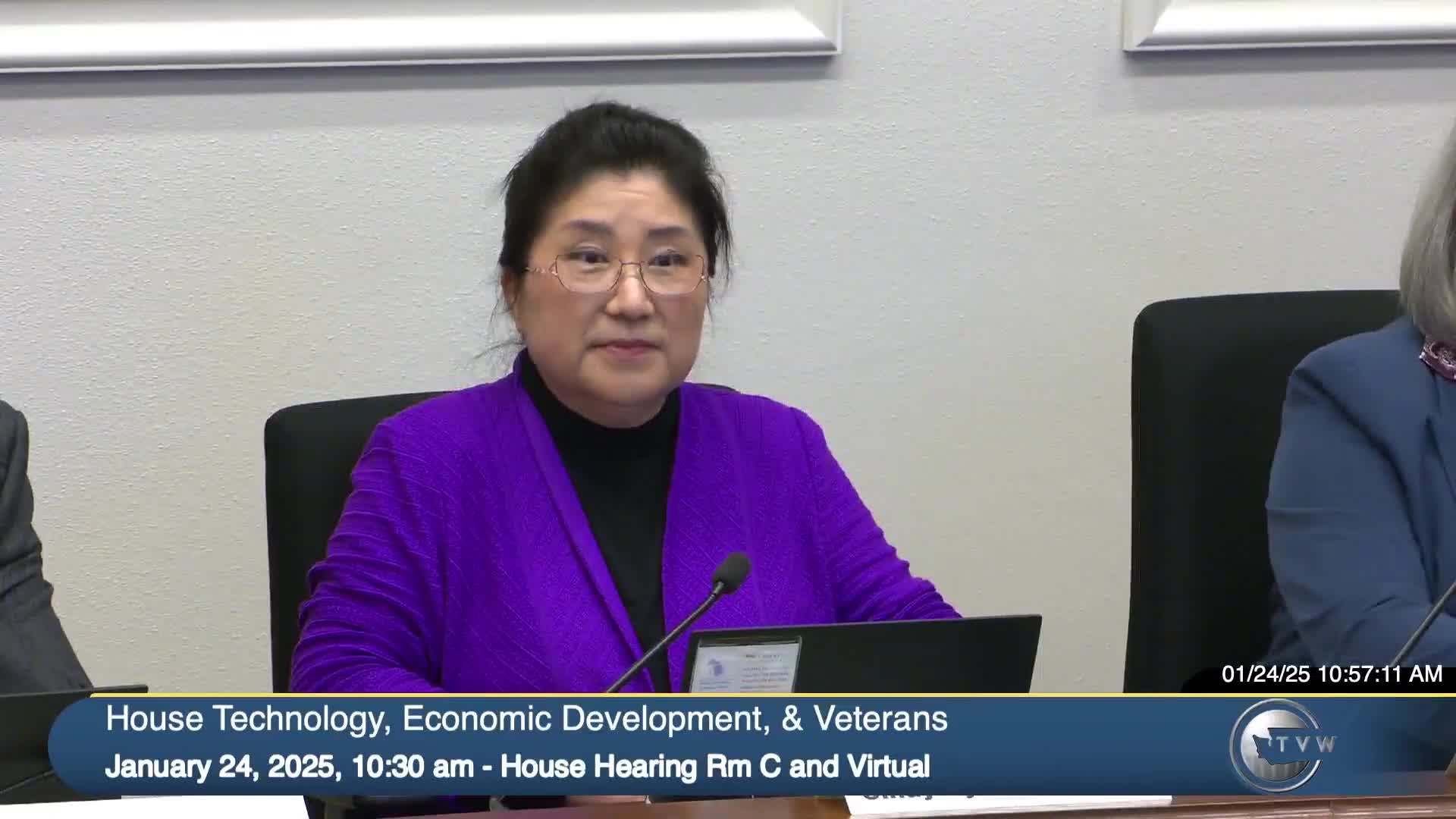
The Technology, Economic Development and Veterans Committee on Jan. 24 took testimony on House Bill 1360, a bill to promote economic development in quantum technologies by creating a Department of Commerce advisory committee, a grant program to support applicants for federal quantum grants, and a workforce-development plan.
The Technology, Economic Development and Veterans Committee on Jan. 24 took testimony on House Bill 1360, a bill to promote economic development in quantum technologies by creating a Department of Commerce advisory committee, a grant program to support applicants for federal quantum grants, and a workforce-development plan.
Supporters told the committee the proposal aims to position Washington’s universities and companies to compete for federal funding and to develop a quantum-literate workforce. “Now is really the time to seize the day and expand the strengths to ensure that the state of Washington leads the way,” Nancy Albritton, dean of the University of Washington College of Engineering, said in support.
The nut graf: witnesses from higher education and research argued the state’s existing technology ecosystem and research capacity make Washington well situated to build a quantum cluster, but they recommended measurable workforce and commercialization supports and careful handling of proprietary information tied to state grants.
Nancy Albritton said federal investments already support quantum test beds at the University of Washington and recommended state action to amplify those strengths and attract additional research and industry partnerships. “We’re very enthusiastic at the university…and we’re here to serve and help out as needed,” she said.
Michael McNeil Forbes, professor of physics and astronomy at Washington State University, told the committee state funding would help early-stage, fundamental research bridge toward larger federally funded center grants and help retain students and talent in the region. Charles Marcus, a physicist and materials professor at the University of Washington and former director of Microsoft’s Quantum Laboratory in Copenhagen, warned that other regions and states are making large investments and that Washington risks losing companies and talent if it does not act.
Committee members raised several amendment ideas and concerns. The prime sponsor proposed reducing the advisory committee size (from 10) and discussed fiscal constraints and options such as requiring a funding match for state grants (a 5:1 match was floated for discussion). Representative Penner asked whether the bill should explicitly require the advisory committee to consider risks alongside economic development — for example, cybersecurity and cryptographic risks posed by quantum computing — and the sponsor said they were open to that amendment.
The bill creates a 10-member advisory committee, requires Commerce to partner with a university with an existing quantum program to staff grant-making, and sunsets the advisory committee in June 2027; it also authorizes a Commerce-run grant program to support applicants for federal grants. The committee received technical and institutional testimony but took no formal votes on Jan. 24.
Members additionally discussed a proposed narrow public-records exemption for business trade secrets tied to grant applications and whether to require state grants to be matched by federal, private, or institutional funds. No final language was adopted at the hearing; the committee closed testimony and indicated amendments and technical work would follow.