Get Full Government Meeting Transcripts, Videos, & Alerts Forever!
Get email alerts on the Wildfire Response topic
No spam. Unsubscribe anytime.
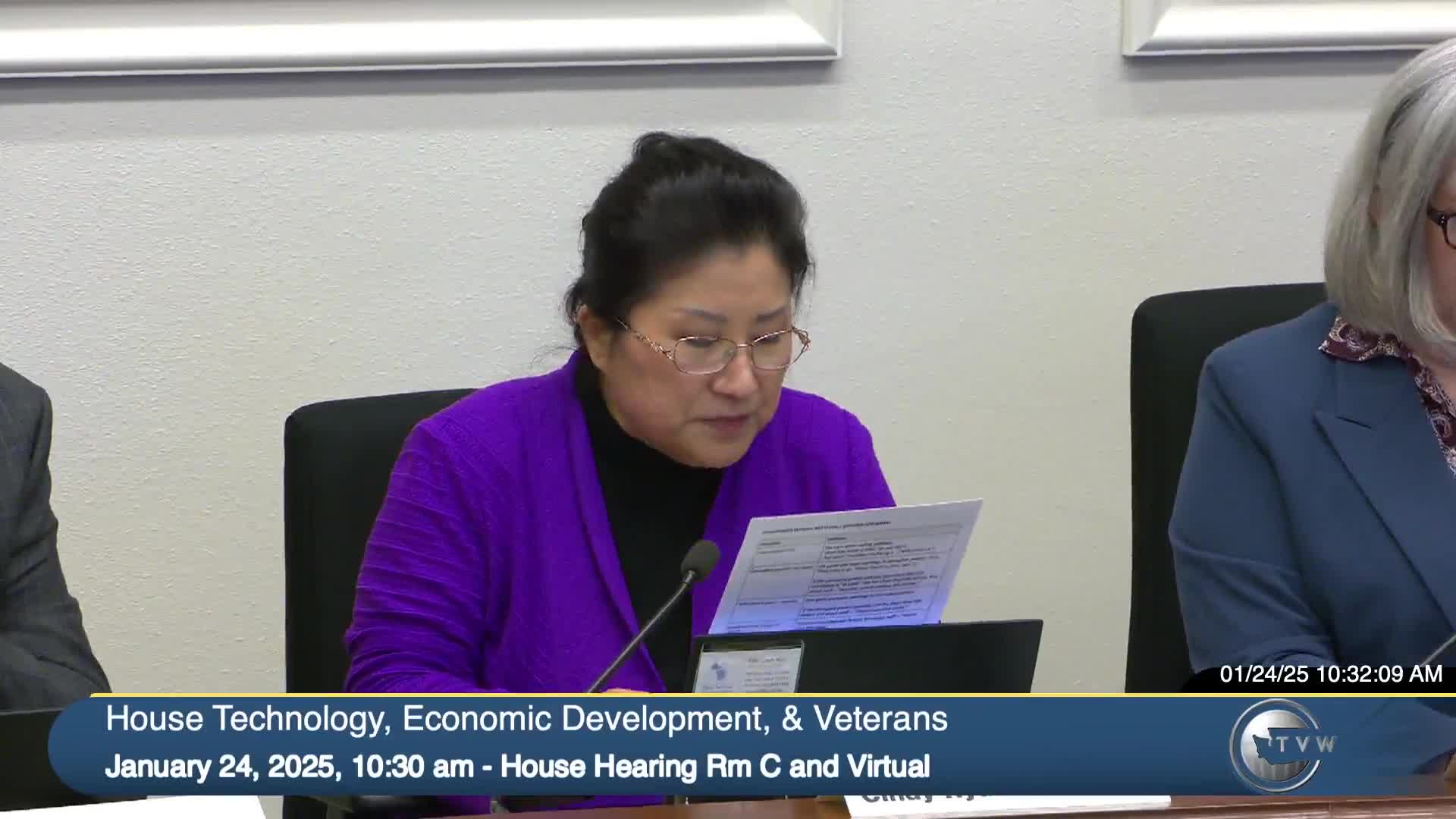
Committee hears bill to allow earlier pre-positioning of state fire resources
Summary
The Technology, Economic Development and Veterans Committee on Jan. 24 heard testimony on House Bill 1271, a proposal to allow the Washington State Patrol fire chief to mobilize and pre-position fire service resources not only in response to an incident but also in preparation for one that is predicted to exceed local capabilities.
The Technology, Economic Development and Veterans Committee on Jan. 24 heard testimony on House Bill 1271, a proposal to allow the Washington State Patrol fire chief to mobilize and pre-position fire service resources not only in response to an incident but also in preparation for one that is predicted to exceed local capabilities.
The bill’s sponsor and witnesses said the change is intended to speed response times and reduce damage from rapidly expanding wildfires and other disasters. “Each of us have a responsibility to do whatever we can to prepare our communities for wildfire response,” the prime sponsor said, arguing that pre-deployment helps contain fires sooner and protect life and property.
The nut graf: supporters — including local fire chiefs and marshals — told the committee the statutory change is largely procedural but would give clearer authority to pre-position strike teams and apparatus across the state using existing mobilization plans and funds, potentially reducing deployment delays during high-risk weather events.
Leonard Johnson, fire chief for the McLean Black Lake Fire Department and chair of the fire defense committee for the Washington State Fire Chiefs Association, said the mobilization plan already has been used to pre-position resources in recent years. He said resources were deployed nearly 36 hours before some 2023 fires into Kittitas, Yakima and Klickitat counties, helping local agencies contain fires and allowing backfill to move to growing incidents in Spokane County. “This statute gives better access to that fund for the chief of the state patrol to approve these types of needed events,” Johnson said.
Randy Collins, fire marshal for Mason County and a representative of the Washington State Association of Fire Marshals, told the committee pre-positioning is a common strategy under red-flag conditions and credited advance placement of apparatus with helping keep some incidents small enough to manage. “If it’s predictable, it’s preventable,” Collins said, urging the committee to approve the bill.
Committee members pressed witnesses on the sources and reliability of the predictions that would justify pre-deployment. Witnesses described ongoing coordination among state agencies, the Northwest Coordination Center, federal partners and in-state meteorologists and fire behavior analysts who provide probabilistic modeling of ignition and fire expansion based on fuels, wind projections and historical behavior. “They have been very successfully giving us good wind estimates” and assessments of where fires could expand, Chief Johnson said, while cautioning that predictions are not foolproof.
Members also discussed financing. The prime sponsor and Chief Johnson said the mobilization program has been supported in recent biennia by a budget proviso in the disaster relief fund (they cited an $8,000,000 proviso per biennium) and that a fiscal note attached to the bill was in the low hundreds of thousands (the sponsor referenced about $410,000). Chief Johnson said the program has been operating under provisos for several years; he estimated roughly $24,000,000 was spent on fire mobilization last year and said only about $200,000–$300,000 of that was used specifically for pre-positioning because of a $500,000 limitation on pre-deployments.
No formal action or vote was taken at the Jan. 24 hearing; the committee closed the hearing after testimony and questions and indicated the bill would be handled in forthcoming committee work. Staff provided the committee briefing and said members could submit follow-up questions and amendments ahead of the next executive session.
The hearing record shows supporters emphasized the bill as a policy change to clarify statutory authority and speed deployments, while committee members sought further detail on prediction methods and long-term funding requirements.