Get Full Government Meeting Transcripts, Videos, & Alerts Forever!
Get email alerts on the Criminal Justice topic
No spam. Unsubscribe anytime.
Sheriff urges expanded alternative-custody campus as Prop 36 is expected to increase jail demand
Summary
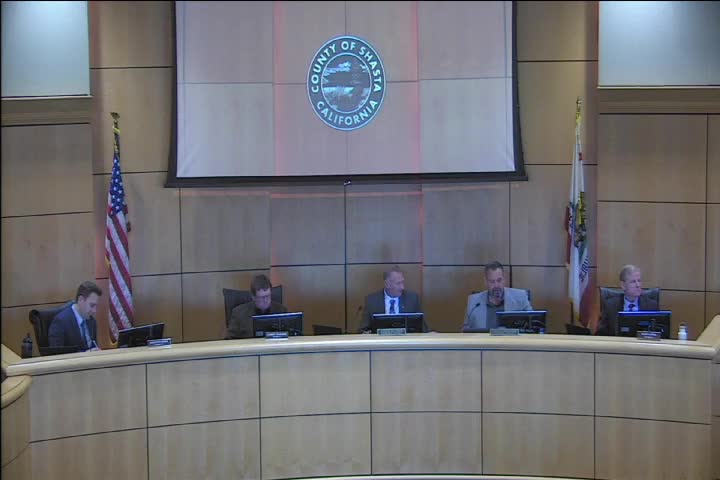
Sheriff Johnson, Shasta County’s sheriff, told the Board of Supervisors on Jan. 14 that the county’s jail system lacks capacity to absorb expected increases in bookings from the recently passed Proposition 36 and urged the board to expand the county’s alternative-custody program into a larger corrections-and-rehabilitation campus.
Sheriff Johnson, Shasta County’s sheriff, told the Board of Supervisors on Jan. 14 that the county’s jail system lacks capacity to absorb expected increases in bookings from the recently passed Proposition 36 and urged the board to expand the county’s alternative-custody program into a larger corrections-and-rehabilitation campus.
The proposal matters because the county jail’s rated capacity (484 beds) and a long-standing court cap that limits usable beds to about 90 percent mean little practical spare capacity once classification and medical needs are considered. Sheriff Johnson said the court cap requires holding newly booked offenders pending judicial review, which can delay releases and increase in-custody populations.
Sheriff Johnson said the immediate goal is to expand alternatives to incarceration that both hold people accountable and reduce pressure on jail housing. Those alternatives include a larger alternative custody program that would: run vocational training (car care, culinary, wood processing and expanded agricultural production); provide mental-health and substance-use treatment; and use electronic monitoring and warrant enforcement to maintain accountability for participants who violate program rules.
The sheriff described the county’s existing program—operated from a site on Brush Flower Lane—as successful but too small. He shared an operating budget figure for the program (about $3.68 million currently) and said an expanded program would still cost far less than building a new jail. He also presented three county parcels the sheriff’s office has explored for a campus: a 20-ish-acre split of the “Big League Dreams” site (Abernathy Road), a 40-acre former transfer-station parcel near Main Street, and a roughly 90-acre parcel at 7251 East Side Road near River Ranch Road that the sheriff identified as his preferred option.
Undersheriff Gene Randall briefed the board on how the court-cap order and inmate classification reduce usable capacity: certain housing units are set aside for higher‑risk or medically vulnerable inmates, so even when the jail appears to have open beds, staff must sometimes release inmates in particular classifications to make space for new arrivals.
Sheriff Johnson said alternatives such as expanded work crews, farming, timber/woodcutting and automotive programs could provide both rehabilitation and revenue (the sheriff described existing farm production that supplements jail food costs) and argued the county should build program infrastructure now—fencing, cameras, training facilities and a sheriff’s operations building—and reserve land for a future jail if funding becomes available. He emphasized the proposal would avoid building housing that triggers higher regulatory and capital costs from the state corrections board.
Board members and several public speakers voiced support for expanding alternatives and for moving quickly. Supervisor Kellstrom asked the board to return the topic to a future agenda and to allow the sheriff and county executive to pursue securing property in the near term; counsel advised a formal ad hoc committee could not be created in the presentation item but that the board could schedule a later action item. The board agreed to bring the proposal back for formal consideration on a future agenda.
Supervisor Scribe (chair) had earlier asked Sheriff's Office, district attorney, public defender, courts and Redding Police Department to attend a multi‑stakeholder criminal-justice meeting; he proposed dates including Jan. 29, Feb. 13, Feb. 25, Feb. 27 and March 6 for joint briefings and accountability timelines. Several supervisors said they supported convening stakeholders to identify capacity, prosecution and sentencing timelines.
Public commenters who testified during the item largely supported the sheriff’s concept and urged quick action, citing retail theft, repeat offenders and jail overcrowding as immediate community problems.
The board did not approve construction or acquisition funds at the Jan. 14 meeting. Instead, a motion was made to return the sheriff’s presentation as an agenda item for possible action; Supervisor Kellstrom moved to bring the item back and a second was recorded as “not specified.” The board did not take a final vote on construction or property acquisition at this meeting.
The sheriff and undersheriff said further work would include forming partnerships with behavioral-health providers, probation, vocational trainers and nonprofits to shape the programs and secure funding.
Looking ahead, the sheriff asked the board to consider the campus as a near-term accountability option that could be scaled while the county plans for any long-term correctional facility when capital funding becomes available.