Get Full Government Meeting Transcripts, Videos, & Alerts Forever!
Get email alerts on the Prevailing Wage topic
No spam. Unsubscribe anytime.
Bill would make public‑works pay follow current prevailing wages during project performance; supporters say it reduces turnover, opponents warn of bid unpredict
Summary
Senate Bill 5061 would require public‑works contracts to pay prevailing wage rates in effect when work is performed rather than freezing rates at bid award; labor groups supported the change, while contractors and utilities warned of bid and budget uncertainty.
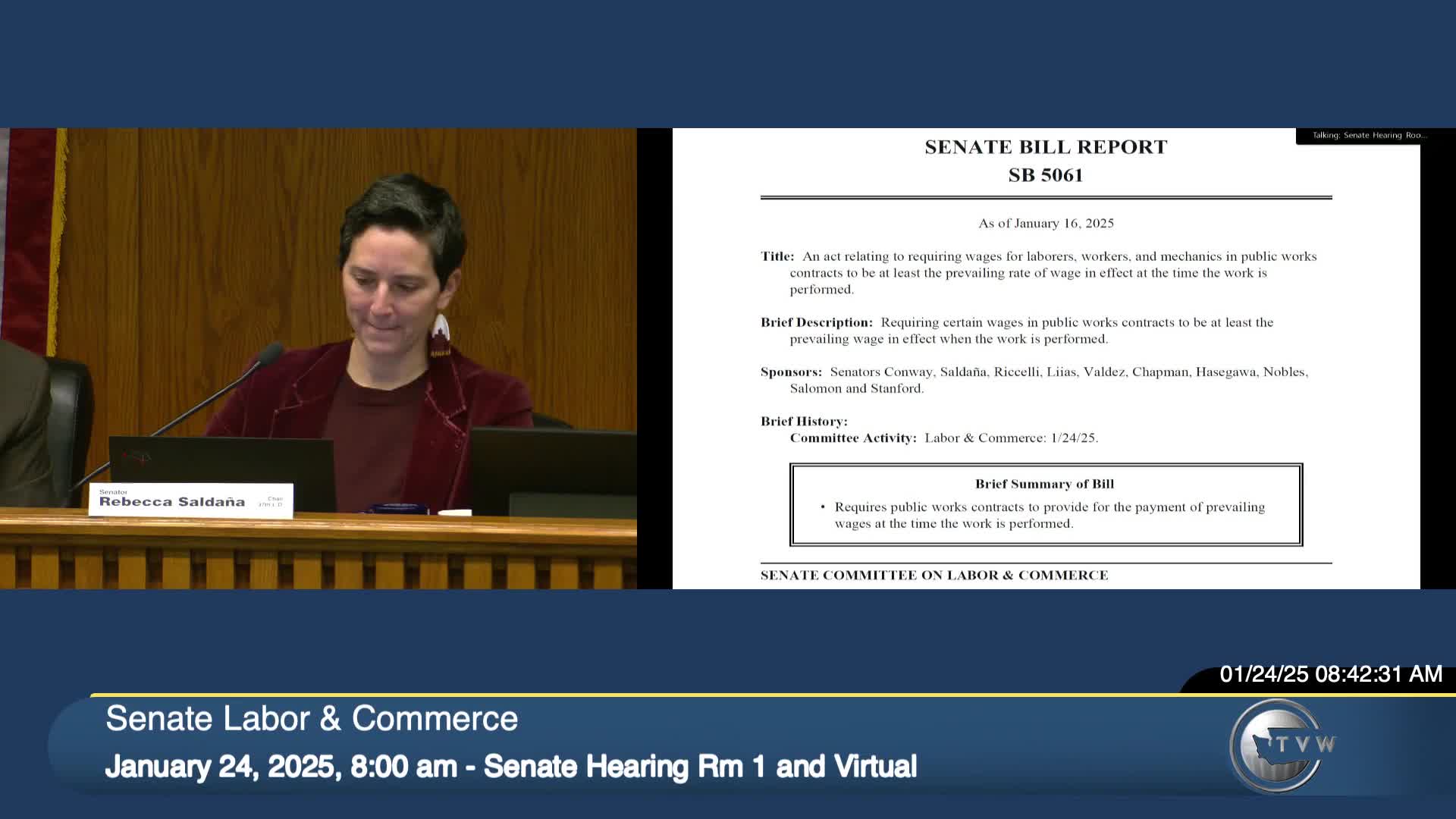
The Senate Labor & Commerce Committee on Jan. 24 heard Senate Bill 5061, which would require public works contracts to adjust minimum wages for laborers, workers and mechanics so that they are not less than the prevailing wage in effect at the time the work is performed.
Committee staff Jared Sachs explained the current law: the prevailing wage is set by the Department of Labor & Industries (L&I) and is determined at the time the prime contractor’s bid is due or, when a contract is not awarded within six months, at the date the contract is awarded. L&I publishes prevailing wage rates twice a year in February and August (with updates taking effect 30 days after publication). The bill would require contracts to stipulate that minimum wage rates be adjusted so the wage is at least the latest prevailing rate in effect when the work actually occurs.
Union and labor representatives strongly supported the measure. Mina Long of the Washington State Building and Construction Trades Council said wage freezes on multi‑year projects cause turnover and drive up costs; “the solution in this bill would ensure that wages on public works projects be adjusted to reflect the current state wage rates at the time the work is performed,” she testified. Bricklayers and allied craft workers, the Washington State Labor Council (AFL‑CIO), the International Brotherhood of Electrical Workers Local 76 and other unions said the change would protect workers from losing purchasing power on long projects, reduce turnover, and promote fair competition.
Supporters also urged safeguards for contracting and noted some contractors voluntarily adjust pay. Chris Herrman of the Washington Public Ports Association said ports support prevailing wages but are concerned the bill does not address the so-called “two‑CBA” issue in prior drafts and that mandatory change-order language can stall projects; he said the current bill is improved for omitting mandatory change orders but still leaves unresolved questions.
Opponents — including Associated Builders and Contractors, Associated General Contractors, the Washington Association of Sewer and Water Districts, and local small-business and minority-business advocates — warned the change would reduce predictability for bidders and could disadvantage small and mid‑size contractors with thin margins. Carolyn Logue of ABC’s Inland Pacific chapter said contractors need certainty when preparing bids and that frequent adjustments create unpredictable cost exposure. The Washington Association of Sewer and Water Districts highlighted that many districts raise project funding through rates rather than general taxation, and repeated wage adjustments could force rate increases for consumers.
Committee members asked how often L&I adjusts the prevailing wage (staff said twice a year but noted corrections may occur throughout the year) and raised questions about the “two‑CBA” prevailing‑wage calculation that can produce unexpected spikes. Several witnesses recommended pairing wage-adjustment language with change-order authority or a mechanism to account for dramatic or unexpected increases in prevailing wages.
No committee vote was taken; testimony on the bill was extensive and the chair indicated further conversations would continue.
Why it matters: Proponents say the bill prevents real‑term wage erosion and turnover on long public projects; opponents say it would increase contract-cost uncertainty and could harm small contractors and rate‑funded utilities unless paired with protections such as change‑order mechanisms.